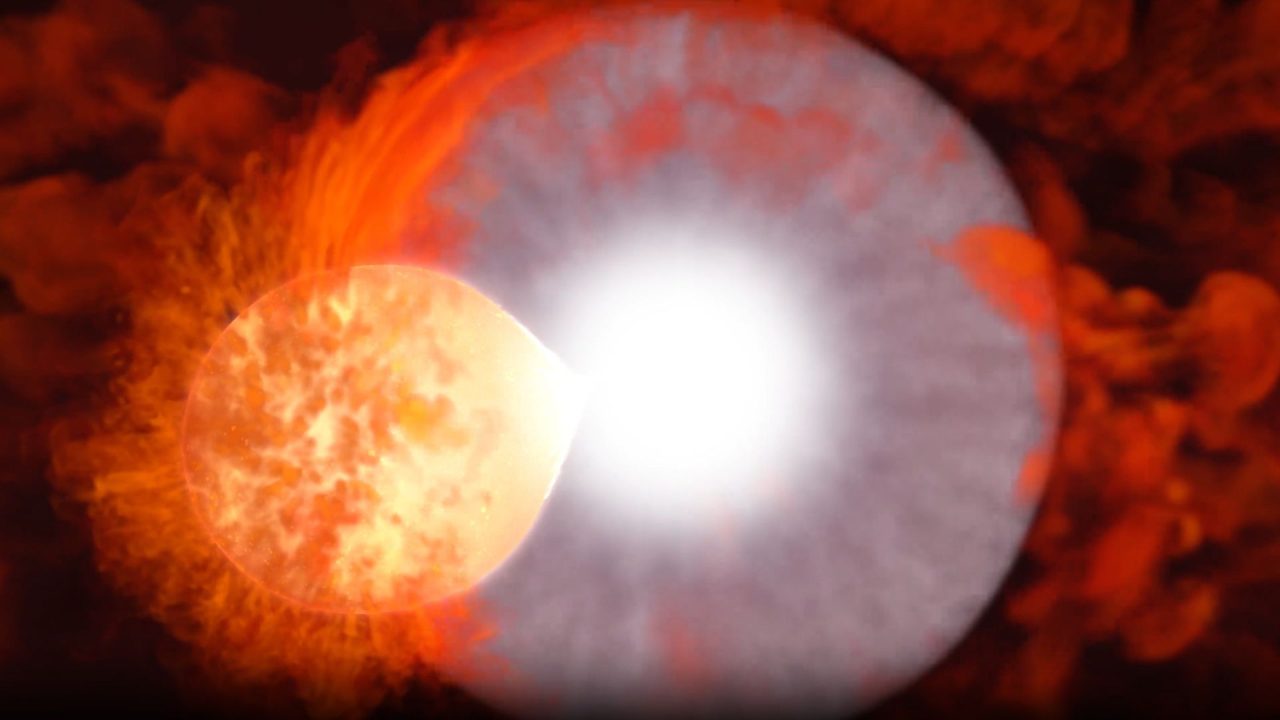
Astronomers have addressed public curiosity regarding T. Coronae Borealis, widely known as the ‘Blaze Star,’ which has remained unexplored for the past two years despite expectations of a dramatic nova event. T. CrB is not a single star but a binary system composed of a dense white dwarf and a bloated red giant. Over an approximately 80-year cycle, the white dwarf’s gravity strips material from the red giant until it reaches a critical threshold, triggering a nova explosion that temporarily increases the system’s brightness by a factor of 1,000.
Bradley Schaefer of Louisiana State University explained that while experts are confident an eruption will occur soon, precise prediction is difficult due to the inability to accurately measure the rate of gas accumulation on the white dwarf’s surface or determine the exact trigger mass. The last nova eruption was visible in 1946, placing the system well within the expected window for the next event. Schaefer noted that the timing depends primarily on how fast gas from the companion star is accumulating on the white dwarf.
Elizabeth Hays, lab chief at NASA’s Goddard Space Flight Center, highlighted that earlier dimming and brightening episodes have caused excitement but have not yet led to the main event. Hays stated that the nova is likely to occur within the next few years, though she expressed surprise if it is not observed by 2030, marking 84 years since the previous eruption. She compared the unpredictability to weather forecasting, where conditions may be ripe for a storm but the exact timing is uncertain.
When the eruption occurs, there will be no visual warning before the light reaches Earth, though an early flash in the X-ray spectrum is possible. Amateur astronomers are currently monitoring T. CrB every minute or two. Once the star brightens by approximately one magnitude, alerts will be issued globally. Observatories will then initiate pre-prepared programs to capture the event, which will peak in less than a day. T. CrB will jump from a normal magnitude of +10, invisible to the naked eye, to +1.7, making it appear brighter than Polaris. Hays predicted that visibility will drop below naked-eye limits within a couple of days, while radiation in radio, X-ray, and gamma rays will remain visible for months or years.
Stargazers can locate T. CrB in the constellation Corona Borealis during early November evenings, near the star Epsilon Coronae Borealis. The constellation lies between Hercules and Bootes. For U.S. viewers, the star sets a few hours after sunset but reappears in the northeastern predawn sky.



Does it actually hurt to look at it with naked eyes once it peaks? Or just bright?
Wild that we know it will happen but not when. My telescope is ready for the 2030 deadline.