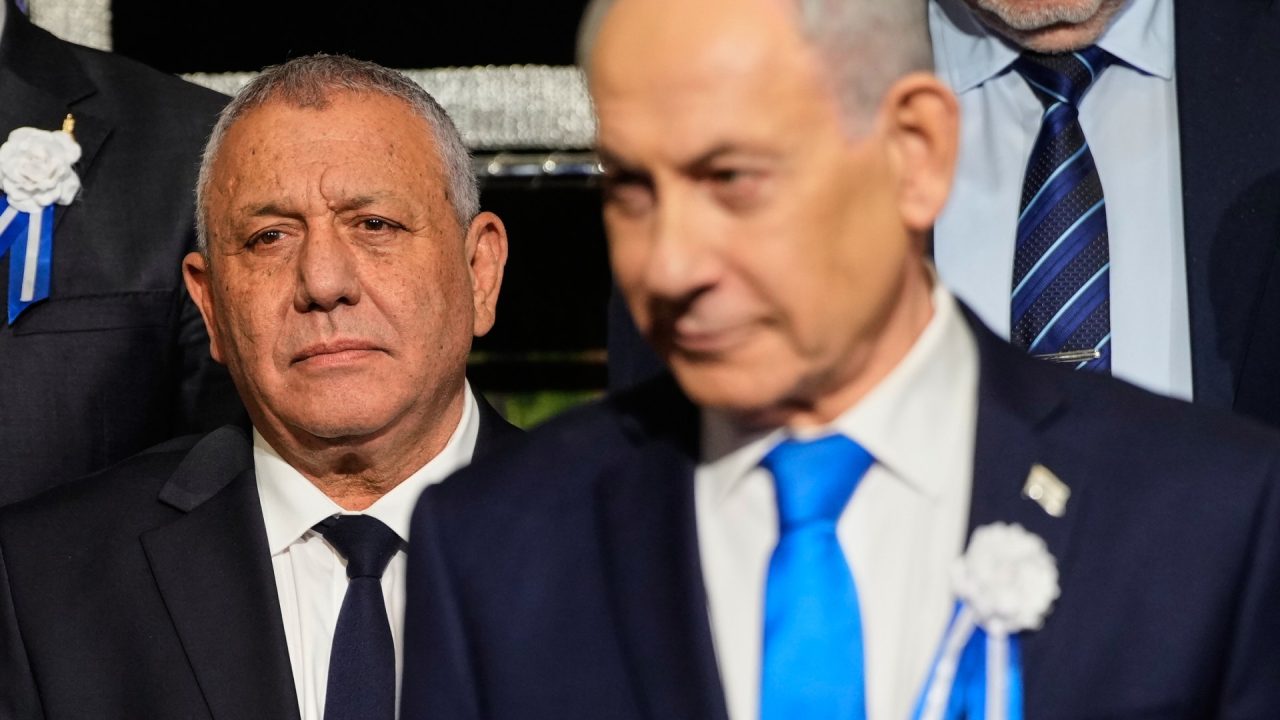
Benjamin Netanyahu, Israel’s caretaker Prime Minister, has renewed his call for a national unity government with his political rival, Gadi Eisenkot. In a video statement issued on Saturday, Netanyahu asserted that a coalition between the two figures is the only viable path to guaranteeing the country’s security. He stated that their recent meeting on Thursday reinforced the necessity of forming such a broad alliance.
Netanyahu argued that a united government could eliminate the threat from Iran. He claimed that Tehran would not hesitate to utilize nuclear weapons against Israel and urged, “Let’s meet in one room, without preconditions.”
Eisenkot, a former army chief of staff who was last week tasked by President Isaac Herzog with forming a government, quickly rejected the appeal. Eisenkot dismissed the proposal as a ploy, stating that Netanyahu “knows he lost the election.” “Netanyahu is calling for negotiations while they are already underway,” Eisenkot said. “These tricks don’t work on me.”
The political deadlock follows the October 27 elections, in which neither bloc secured a majority. In the 120-seat Knesset, Netanyahu’s right-wing and religious allies secured 53 seats, while Eisenkot’s four-party alliance gained 48. Arab-led parties achieved a record high with 19 seats. Herzog authorized Eisenkot to form a government after 67 lawmakers, including representatives from Arab-led parties, endorsed him, compared to 46 who supported Netanyahu.
Eisenkot faces a deadline of 28 days, with the option for a 14-day extension, to construct his administration. He has ruled out including Arab-led parties in his cabinet. His strategy involves creating a minority “national emergency government” where his 48 supporters vote in favor against 46 opponents, allowing the 26 lawmakers from Arab and ultra-Orthodox parties to abstain. This mechanism would enable government approval without an absolute majority.
Netanyahu has warned that a minority government of this nature would result in the “collapse” of Israel. His proposed alternative would include center-right Jewish parties while excluding Arab parties. Netanyahu’s allies have made unsubstantiated claims that Arab-led parties “stole” the election, a campaign that Eisenkot labeled as “racist” on Friday.
While Eisenkot has indicated willingness to work with members of Netanyahu’s Likud party and Bezalel Smotrich’s Religious Zionism bloc if their commitment to unity is genuine, he insists on breaking away from “extremists,” specifically supporters of far-right minister Itamar Ben-Gvir. The Knesset is scheduled to elect a new speaker on Tuesday, with the opposition nominating Matan Kahana, a former military officer, to replace Netanyahu ally Amir Ohana.

Calling Arab parties racist is beyond disappointing. We need unity, not more divisive rhetoric from the right-wing bloc.
Netanyahu is clearly just trying to sabotage the process. He knows he lost and wants to keep the country in limbo.
Wait, so they are using the 26 abstaining lawmakers to form a government? That seems incredibly fragile and unstable.
I am genuinely surprised Eisenkot rejected this. Security threats are real, and splitting the country now is dangerous.
This minority government plan sounds like political suicide. Can you really govern if the opposition just votes you out daily?