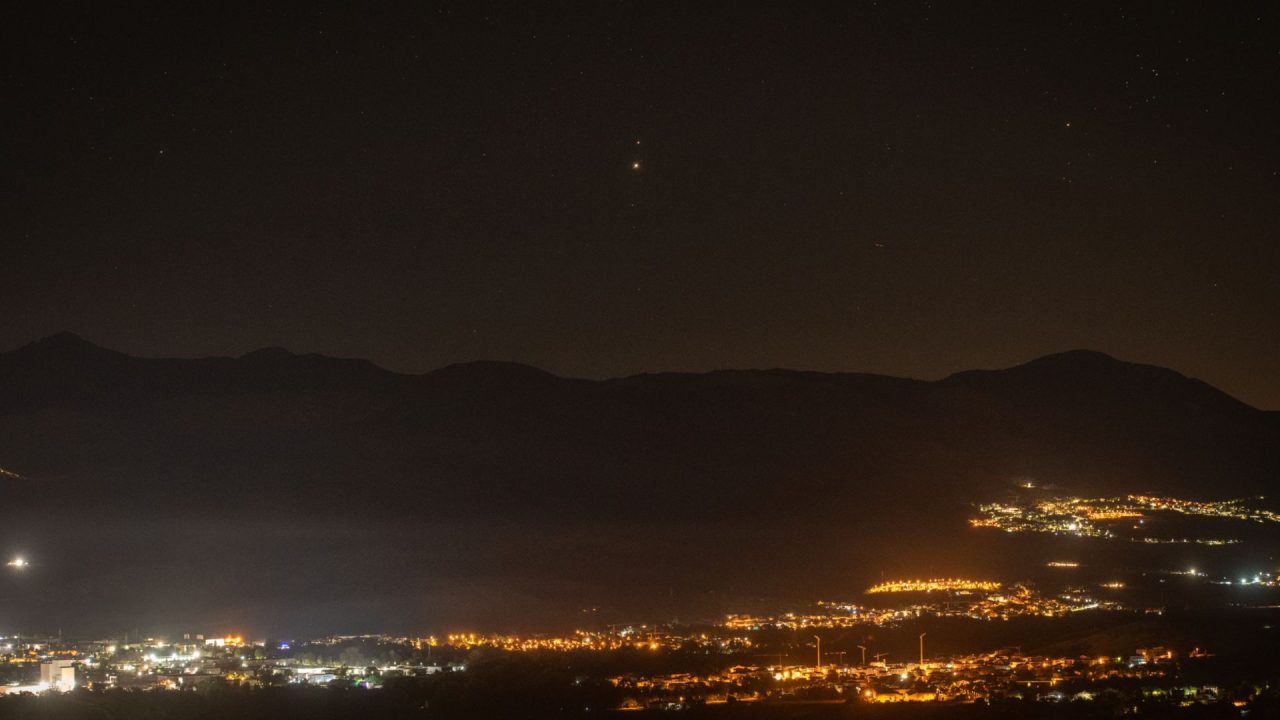
Stargazers will have a rare opportunity to observe a close alignment between Jupiter and Mars on the night of November 15-16, 2024. The two planets will appear just over one degree apart as they rise above the eastern horizon around midnight for observers in the United States. This alignment is situated in the heart of the constellation Leo, with the bright blue-white star Regulus glowing nearby.
This celestial event is a result of perspective; in reality, the distance between Mars and Jupiter spans over 368 million miles (592 million kilometers). Meanwhile, the light from Regulus, a main-sequence star, travels approximately 79 light-years to reach Earth. Astronomers refer to this type of close pass as an appulse, which occurs roughly every two to two and a half years when Mars, moving on a more distant orbit, catches up to Jupiter.
According to data from In-The-Sky, this specific configuration will not recur until July 2029. Both Mars and Jupiter are superior planets, meaning their orbits lie beyond Earth’s. Consequently, they appear as full disks through a telescope, unlike the inner planets Mercury and Venus, which display phase changes similar to the Moon. A telescope with a six-inch aperture is sufficient to distinguish the distinct characteristics of each world.
Through optical equipment, Jupiter reveals its massive cloud bands and zones, which are formed by ammonia and water masses moving in different directions through its hydrogen and helium atmosphere, driven by strong jet streams. Mars, in contrast, appears as a reddish-ochre disk featuring dark surface markings. According to NASA, these dark areas are patches of basaltic rock that have been scoured clean of the iron-rich dust that typically covers much of the Martian surface. For those interested in capturing the event, Space.com has published guides on observing and photographing the solar system’s planets, along with recommendations for telescopes and cameras available in 2026.



November is usually too cold for stargazing in my area, so this might be tricky for me.
I remember the last close pass years ago. Can’t wait to see these two meet again.
The fact that Mars looks like a red dot while Jupiter shows bands is wild.
Cool event, but honestly, why wait until 2029 when we could just look at pictures today?
Will I need a telescope to see this, or can I spot it with the naked eye?
I love this reminder that perspective creates these beautiful illusions across the vastness of space.