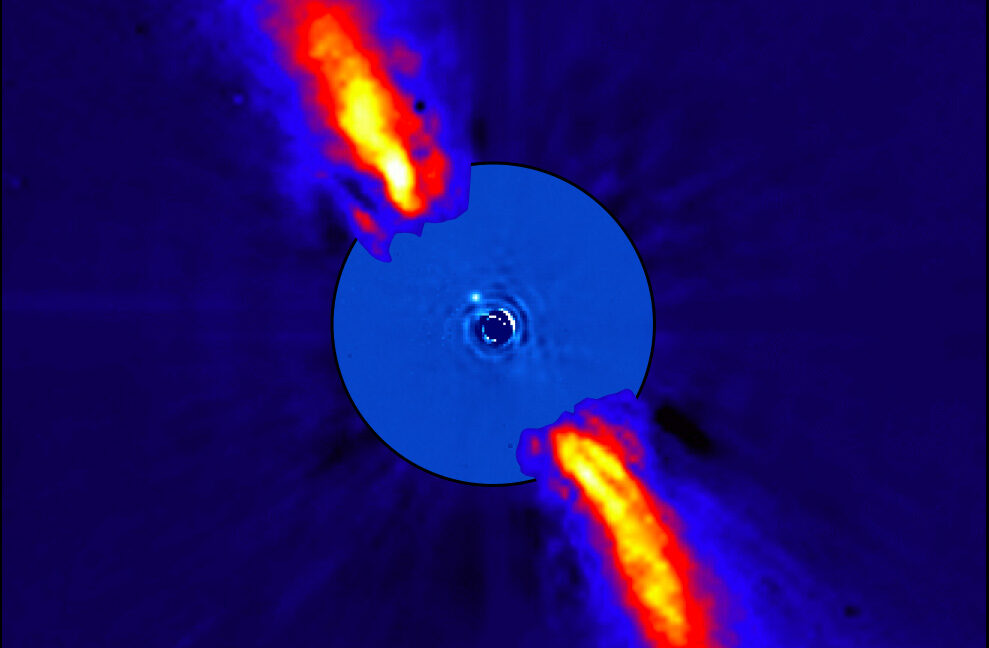
Astronomers using the James Webb Space Telescope have identified significant deposits of ice in the debris disk surrounding the young star Beta Pictoris, located approximately 64 light-years from Earth. Published in the journal Science, the study led by Sarah Betti of the Space Telescope Science Institute reveals the presence of both water and carbon dioxide ice within the system’s rubble disk.
Beta Pictoris is a young star, estimated to be around 20 million years old, and is surrounded by a vast disk of dust and debris where planets are currently forming; three planets have already been identified in this system. The discovery is notable because the observed water ice is glassy rather than crystalline and is mixed with carbon dioxide in proportions similar to those found in comets within our own Solar System.
Researchers indicate that this composition suggests the ingredients necessary for forming water-rich worlds may be common around young stars. Beta Pictoris has been one of the most extensively studied stars in the sky, with its disk first imaged in 1984. Because the disk is viewed nearly edge-on from Earth, it serves as a natural laboratory for observing the growth of planetary systems. This type of debris disk is continuously replenished by collisions among comets and planetesimals, which are the fundamental building blocks of planets.



Edge-on view makes it easier to study. Smart choice of target for the Webb mission so far.
Comets here seem similar to ours, but the disk is still very young. How fast do these systems actually mature?
If these ingredients are common, maybe most young stars have the building blocks for oceans. That is a huge leap.
Beta Pictoris has been studied for decades. It is finally paying off with these detailed composition results.
Does the presence of carbon dioxide mean life is likely there? I am hoping for water-rich planets, not aliens.
It is wild that we can distinguish specific ice types in a system sixty light-years away with this much detail.
I don’t get why the headline says older than the star. The ice is just inside the same young system.
Glassy ice usually implies rapid freezing in cold environments, so this finding helps pinpoint where the original planetesimals formed.