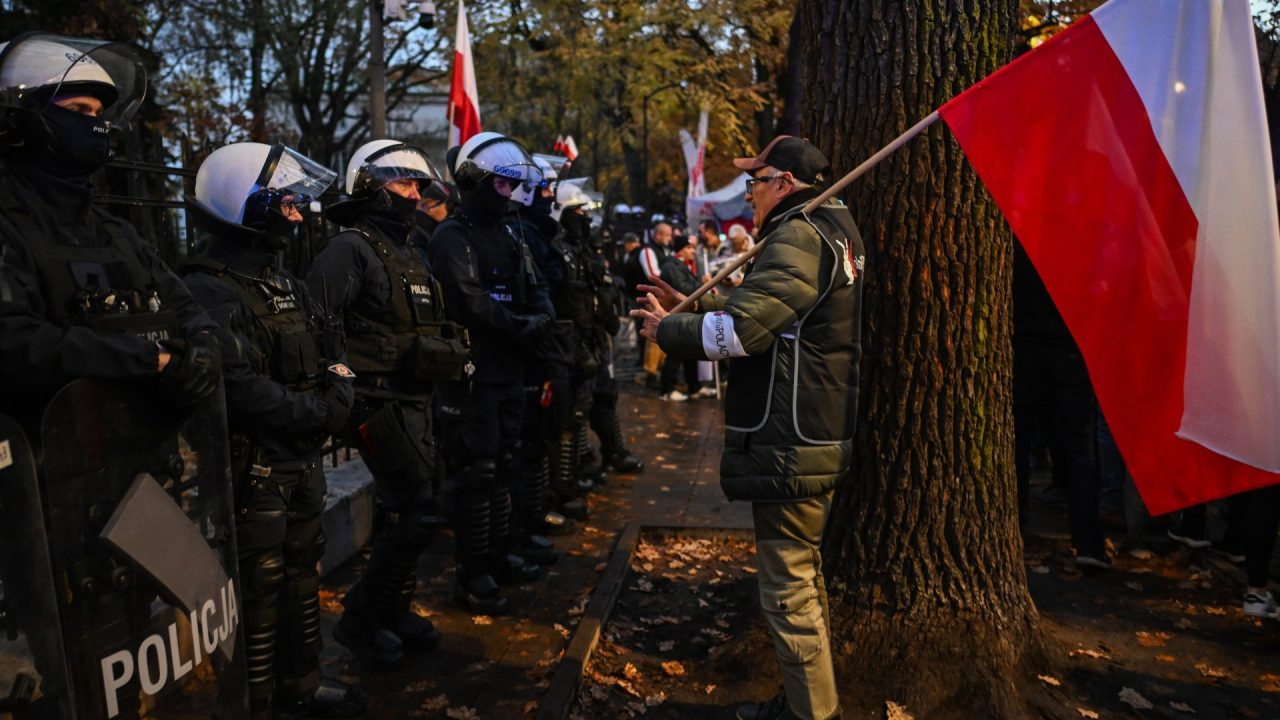
The ongoing power struggle for control of Poland’s Constitutional Tribunal has reached a critical point, with the country’s two main political camps accusing one another of violating the rule of law. According to recent analysis, this internal conflict is inadvertently playing into the strategic interests of Russian President Vladimir Putin, who benefits from the erosion of public trust in Polish state institutions.
The dispute stems from a decade-old controversy. In 2015, the then-governing Civic Platform party appointed judges to the Tribunal to fill vacancies reserved for the incoming administration. The subsequent Law and Justice government used this incident to push for the appointment of party-aligned judges. Now that the Civic Platform-led coalition is back in power, it is attempting to seat new judges, but President Karol Nawrocki and the Tribunal’s leadership, both aligned with Law and Justice, have blocked their installation. Tensions peaked last month when a newly elected judge ordered the suspension of the Tribunal’s president and deputy, prompting the deployment of police to the building. President Nawrocki condemned the move as a forcible takeover, while Prime Minister Donald Tusk defended it as necessary to restore legal order.
Moscow has already capitalized on this confrontation. On November 3, former Russian President Dmitry Medvedev characterized the judicial intervention as a “coup.” The dynamic in Poland mirrors a decade ago when Law and Justice was in power; currently, the Liberal-Civic Platform coalition is accused of acting unlawfully, while the conservatives mobilize street protests under the banner of protecting the rule of law. This has led to a situation where Prime Minister Tusk is perceived as a strongman, with images of him reading a journal featuring political theorist Carl Schmitt circulating widely on social media. Schmitt is known for the concept that the sovereign is defined by the ability to decide on exceptions.
Public engagement with these political battles has waned compared to the mass protests of the previous decade. Citizens are increasingly disillusioned by what they view as hypocrisy on both sides, and their attention has shifted toward more pressing daily concerns such as the cost of living and national security. The geopolitical context has also shifted drastically, with Russia’s full-scale war in neighboring Ukraine and its ongoing hybrid and information warfare campaigns aimed at weakening Poland’s position on the global stage.
Experts warn that the worst-case scenario could involve the judicial system overriding electoral outcomes, similar to the precedent set in Romania in December 2024, where the Constitutional Court annulled a presidential election citing foreign interference. In Poland, the danger lies in a two-front squeeze on democracy: on one side, foreign-backed digital manipulation fuels distrust in the state; on the other, the establishment may govern through a state of exception via subordinated courts. This dual pressure diminishes space for civic self-determination.
While much of the domestic commentariat views this as a standard rivalry between EU-oriented liberals and US-backed conservatives, radical influencers aligned with Russian and Chinese narratives are seeking to delegitimize the state as a “foreign occupation.” Analysts note that the primary danger is no longer just one bloc controlling the Tribunal, but the cumulative effect of both sides undermining the legitimacy of state institutions. As Poles lose faith in these institutions, the bond between citizens and the state weakens, creating a self-reinforcing dynamic that ultimately strengthens Russia’s strategic position.



This article misses the point. It’s not just about judges; it’s about basic rule of law.