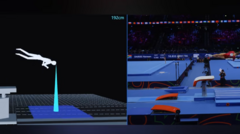
Officials in elite gymnastics have indicated that they would be “highly surprised” if AI-assisted judging is not in place for the 2028 Los Angeles Olympic Games, signaling a major shift toward technology-driven decision-making in the sport. This stance persists despite significant criticism from leading gymnasts who argued that the recent application of the system at the World Championships in Rotterdam was unfair and potentially dangerous.
The controversy centered on the use of the Judging Support System (JSS), an AI technology developed by Fujitsu since 2017 that uses motion analysis to recognize gymnastic elements and provide objective numerical data. At the recent World Championships, Olympic vault champion Carlos Yulo and British gymnast Harry Hepworth had their vault difficulty ratings downgraded by the system from 5.6 to 5.2. Both athletes performed the piked Dragulescu, but the AI detected a tuck position in Hepworth’s form, specifically noting that he bent his legs during the half twist to prepare for landing, which the system flagged as a lower difficulty requirement.
Hepworth, who finished sixth in the vault final, stated that the downgrading “definitely cost me a few positions” and questioned the purpose of attempting high-difficulty elements if they were subject to such technicality. Yulo, who fell on his vault in the final to finish seventh, expressed frustration, telling Inside Gymnastics that he is “not a robot” and that the system’s interpretation of a pike position did not match the human perception of his performance. Both athletes argued that forcing straight legs, as implied by the higher difficulty requirement, increased the risk of injury.
Andrew Tombs, president of the Men’s Artistic Gymnastics technical committee, defended the system, stating that the decisions made at the championships were correct according to the parameters set in the JSS. Tombs explained that the system is designed to support judges in making marginal decisions on body angles, where differentials of a single degree can significantly impact scoring. He noted that judges would likely have downgraded the ratings even without the AI, and that ongoing conversations with coaches are aimed at fine-tuning the biomechanical points at which measurements are taken to provide more flexibility in future competitions.
The expansion of AI in judging is not limited to gymnastics. Governing bodies for other judged Olympic disciplines, including equestrian dressage and freestyle skiing, are exploring similar technologies to enhance fairness, accuracy, and viewing clarity. Ronan Murphy, the FEI’s dressage director, acknowledged that while AI can assist with welfare checks and technical observations, it cannot yet assess the artistic harmony between horse and rider, meaning human judges will remain essential. In winter sports, Urs Lehmann, secretary general of the International Ski Federation, expressed a desire to use AI to reduce judging time from an average of one minute and 45 seconds to as little as 15 to 20 seconds, with the goal of implementing AI-assisted judging in major disciplines by 2029.



It is fascinating to see this expanding into skiing and dressage too. Technology is changing everything.
Wait, so they are downgrading difficulty based on leg position? That sounds incredibly rigid for athletes.
Gymnastics needs objectivity, but I worry the AI misses the artistry that makes routines exciting.