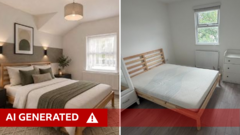
A growing trend in the UK property market, dubbed “housefishing,” is drawing attention to the extent to which artificial intelligence is being used to enhance listing photographs of homes. Estate agents are increasingly employing AI tools to improve the visual appeal of properties, which some experts argue can cross the line from helpful visualization to active deception.
The practice allows for modifications such as repainting walls, adding imaginary lawns, or virtually furnishing empty rooms. However, Olivia Nicole, 29, shared her experience with the BBC after viewing a five-bedroom property in south-west London that differed significantly from the images displayed on Rightmove. Upon visiting the home, she noticed that rooms were smaller, decor was different, and structural features, such as a raised wall section and smaller windows, were not present in the AI-enhanced listings.
Ms. Nicole noted that the discrepancy wasted her time, as she had taken several hours off work for the viewing. The images in question were also visible on Zoopla and Winkworth, all of which stated they had strict guidelines for AI usage and subsequently removed the problematic photos.
While estate agents have historically used wide-angle lenses or photo editing software to improve listings, the accessibility of AI has accelerated this process. Jack Bushrod, who runs the social media channel Housing Horrors, reports a surge in AI-enhanced images over the past six months. He advocates for the use of AI to declutter or add furniture but opposes alterations that change structural elements, such as removing pillars or adding windows, which he argues misleads prospective buyers.
A survey of 906 UK homebuyers found that one in five individuals who purchased a home in the past year had viewed a property where the listing photos had been digitally enhanced to make the home appear better than it actually was. Meanwhile, Cara, 38, is currently selling her home in Lowestoft, Suffolk, and was surprised to see her estate agent, Howards, use AI to remove clutter from her children’s rooms. Howards has since implemented a policy of labelling all AI-enhanced photos and stated that it does not use the technology to misrepresent fundamental features of a property.
Trading Standards has advised that estate agents may use AI for basic enhancements or virtual furnishing, provided the technology’s use is clearly indicated. However, structurally altering a room to hide features or add elements could mislead consumers and violate the law. Experts predict that as more agents adopt these tools, the practice will become more widespread, raising calls for mandatory labelling of AI-generated images in property listings.



Trading Standards needs to step in. One in five buyers are being misled, that is unacceptable.
Why does nobody care about virtual furniture? It helps you visualize the space without lying about size.
I was shocked when my own photos were edited without asking. At least now they have to label them.
It’s ridiculous that agents can just paint over windows. We need strict rules to stop this deception.