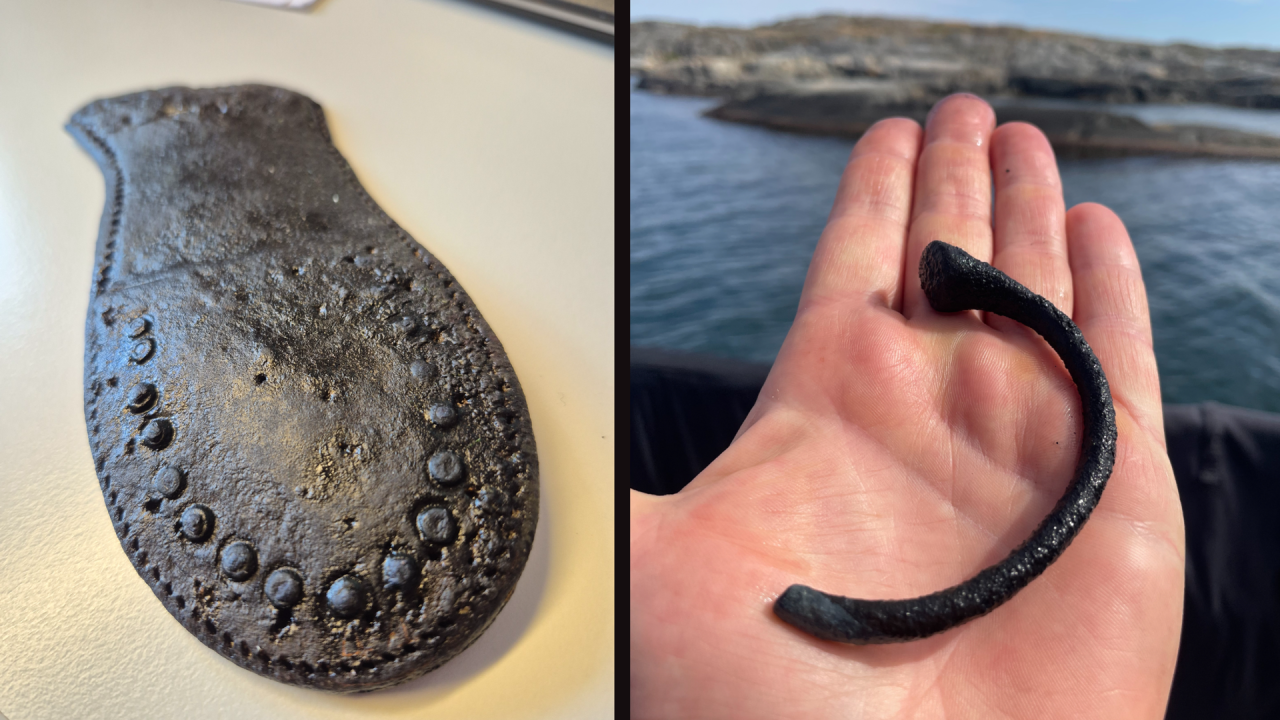
Maritime archaeologists investigating a 17th-century shipwreck off the coast of Sweden have uncovered a high-quality shoe and two metal rings used as currency in the transatlantic slave trade. The artifacts were recovered from the wreck of the Danish frigate Havmanden, also known as the “Merman,” which lies on the seabed just east of Gothenburg. The items were lost during a violent mutiny in 1683 that resulted in the death of Jørgen Iversen Dyppel, the first governor of the Danish West Indies.
The Havmanden was traveling to St. Thomas, a Caribbean island now part of the U.S. Virgin Islands, carrying convicts and indentured servants destined for the Danish West India Company. After dropping off the new colonists, the ship was planned to sail to West Africa to purchase enslaved people. However, due to a severe shortage of food and water, crew members and convicts seized control of the vessel near the Azores in the North Atlantic. The mutineers altered their course to return to Copenhagen, during which they shot the ship’s captain and threw other officers, including Dyppel, overboard in the English Channel. The mutineers were later tried in Copenhagen and sentenced to death for their crimes.
According to the National Museum of Denmark, the discovery provides new insight into one of the most violent mutinies in Danish history. Divers found the rear half of a men’s shoe, described as “unusually fine” in the archaeological record. Vivi Lena Andersen, director of the Rudersdal Museums in Denmark, noted that she had never seen a shipwreck shoe of such high craftsmanship. The precise perforations along the edge indicated that the shoe was made by highly skilled artisans and was an exclusive item affordable only by the elite.
Experts believe the shoe may have belonged to Dyppel himself, providing a personal connection to his dramatic death. Andreas Kallmeyer Bloch, a maritime archaeologist at the National Museum of Denmark’s Center for Maritime and Underwater Cultural Heritage, stated that the shoe offers a point of entry into the broader history of Danish colonial activities and the slave trade.
Additionally, researchers found two manillas, which are ring-shaped metal pieces cast from copper, brass, or iron. These were used by European merchants as currency to trade for enslaved people in West Africa, particularly along the coast of modern-day Nigeria. Such items are rarely found in Scandinavia, and their presence underscores the Havmanden’s direct connection to the slave trade, which was a central part of Denmark’s colonial endeavors. Although King Christian VII of Denmark-Norway banned the trade in 1792, slavery continued in the Danish West Indies until 1848, when hundreds of enslaved people revolted and were granted their freedom.


Leave a Reply