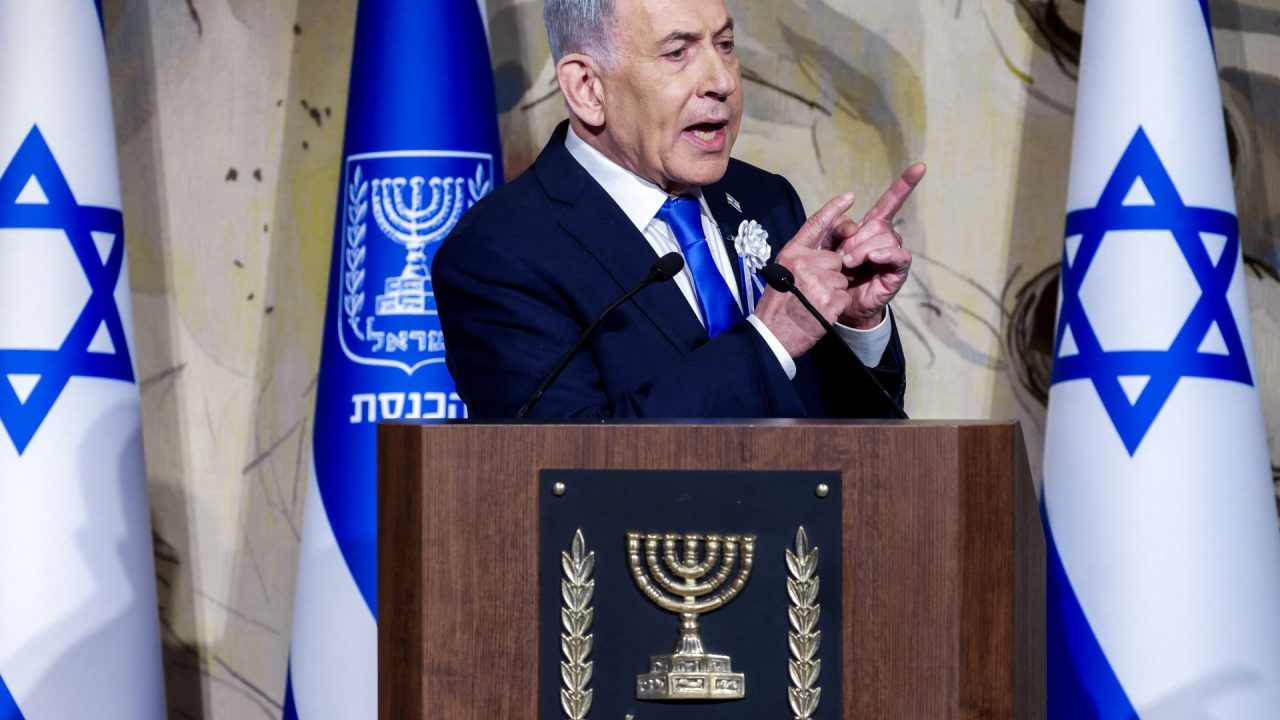
During the swearing-in of Israel’s new parliament, the Knesset, on Tuesday, Prime Minister Benjamin Netanyahu urged the formation of a national unity government. He called for Jewish Israelis to set aside ideological differences to address what he described as severe internal and external threats, specifically citing dangers from Iran and alleging, without evidence, that Palestinian citizens holding elected seats aim to destroy the state. The opposition bloc, which holds a majority of seats and is tasked with forming the next government, responded with heckles, catcalls, and walkouts, rejecting the proposal.
Netanyahu warned that a narrow government would be unable to manage the country’s challenges, suggesting that any coalition must not rely on parties representing Palestinian citizens, which he controversially labeled as supporting terrorism. The session marked an unusually contentious moment in Israeli politics, with former Prime Minister Naftali Bennett exchanging sharp remarks with Netanyahu’s allies, including his wife Sara and hard-right figure Itamar Ben-Gvir. In response, Gadi Eisenkot, who has been granted the first opportunity to form a new government, cancelled scheduled coalition talks with Netanyahu and declared him “unfit for office.”
Political experts indicate that Netanyahu has significantly transformed the Israeli political landscape by prioritizing personal branding over party platforms. Roi Zur, a voting behavior specialist at the University of Essex, described this shift as an “Americanization” of the party system, where leaders like Netanyahu turned Likud into a populist vehicle centered on individual charisma. This change has altered voter behavior, with citizens now identifying candidates by name rather than by traditional party labels such as Labor or Likud.
Dahlia Schneidlin, an American-Israeli pollster, noted that despite Israel’s electoral system requiring coalition-building, the campaign environment has become increasingly personalized. This focus on personality fosters a political culture where personal rivalries, such as the long-standing animosity between Netanyahu and opposition leader Avigdor Lieberman, often overshadow substantive policy differences. Yossi Mekelberg, a senior fellow at Chatham House, warned that this trend is toxic, enabling centralized, almost dictatorial leadership styles that allow politicians to make inflammatory accusations against elected officials without public censure.

Is the country actually unstable, or is this just performative theater? Hard to tell what is real policy and what is stagecraft.
I miss when Labor and Likud had clear platforms. Now it is just about who is the loudest voice in the room.
Personality-driven politics makes governance harder. Coalitions are messy enough without leaders acting like celebrity ego contests. Ugh.
Always suspicious when they single out Palestinian citizens. It is not new, but the new Knesset seems just as divided.
I actually agree with Eisenkot. If you poison the well, you cannot claim to want unity. He was right to cancel talks.
The walkouts at the swearing-in were shocking. Do we really have this much animosity in the Knesset? Unbelievable behavior.
Calling elected officials traitors without evidence is alarming. This erodes trust in our democratic institutions completely. Dangerous rhetoric.
The Americanization of politics is real. We pick leaders now, not policies. It feels weird but it is our reality.