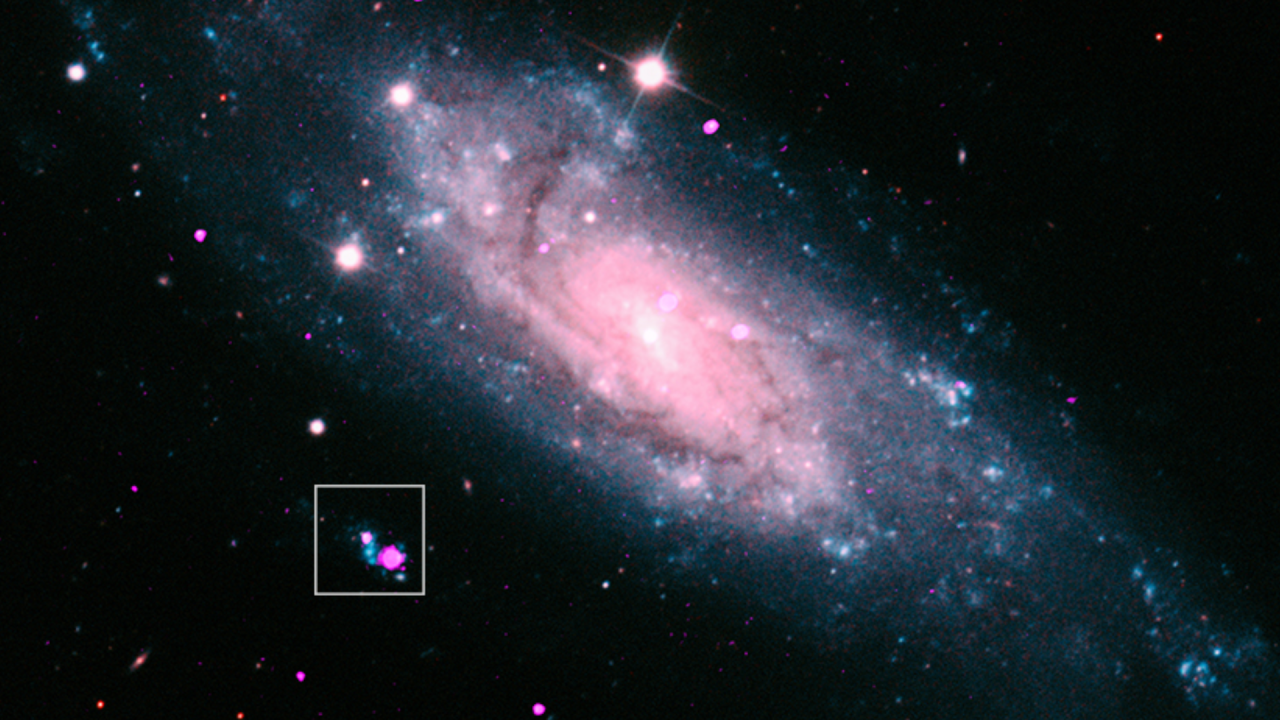
Astronomers have resolved a 15-year mystery regarding a stellar object that falsely mimicked a supernova explosion more than two dozen times. The culprit, identified by NASA’s Chandra X-ray Observatory, is not a single dying star but an unstable luminous blue variable (LBV) being drained of material by a hidden compact companion, likely a black hole or neutron star.
The object, designated AT 2016blu, is located in the spiral galaxy NGC 4559, approximately 25 million light-years from Earth in the constellation Coma Berenices. In January 2012, observers detected a brightening that appeared to be a standard supernova. However, instead of fading permanently, the star reappeared in brightness on a recurring 113-day cycle, leading researchers to classify it as a supernova imposter. For 15 years, the specific mechanism driving these periodic eruptions remained unknown.
Dr. Mojgan Aghakhanloo of the University of Virginia led the team that obtained the critical data. By commanding Chandra to observe the star during an active outburst in March 2026, the researchers captured a powerful burst of X-rays coinciding with the event. These observations revealed that AT 2016blu has an unseen companion in an elliptical orbit. As the compact object passes its closest point to the LBV, its intense gravity pulls material from the unstable star. This stolen matter forms a hot accretion disk around the companion, emitting high-energy X-rays that energize surrounding gas clouds, causing the visible light flashes initially mistaken for a supernova.
The study suggests that at least 440 billion trillion pounds of stellar material are stolen annually by the compact object, a rate that exceeds the Eddington limit for neutron stars. This discovery may help explain the nature of ultra-luminous X-ray (ULX) sources, a class of bright astrophysical objects whose power sources are poorly understood. While previous imposter cases involved massive stellar companions, AT 2016blu’s interaction with a compact remnant offers a new perspective on these phenomena. The findings were published in The Astrophysical Journal on November 9.


Wow, 440 billion trillion pounds stolen annually? I thought the Eddington limit was a hard stop for neutron stars.
So the star just keeps getting drained every 113 days? That periodic rhythm sounds almost like a cosmic metronome.