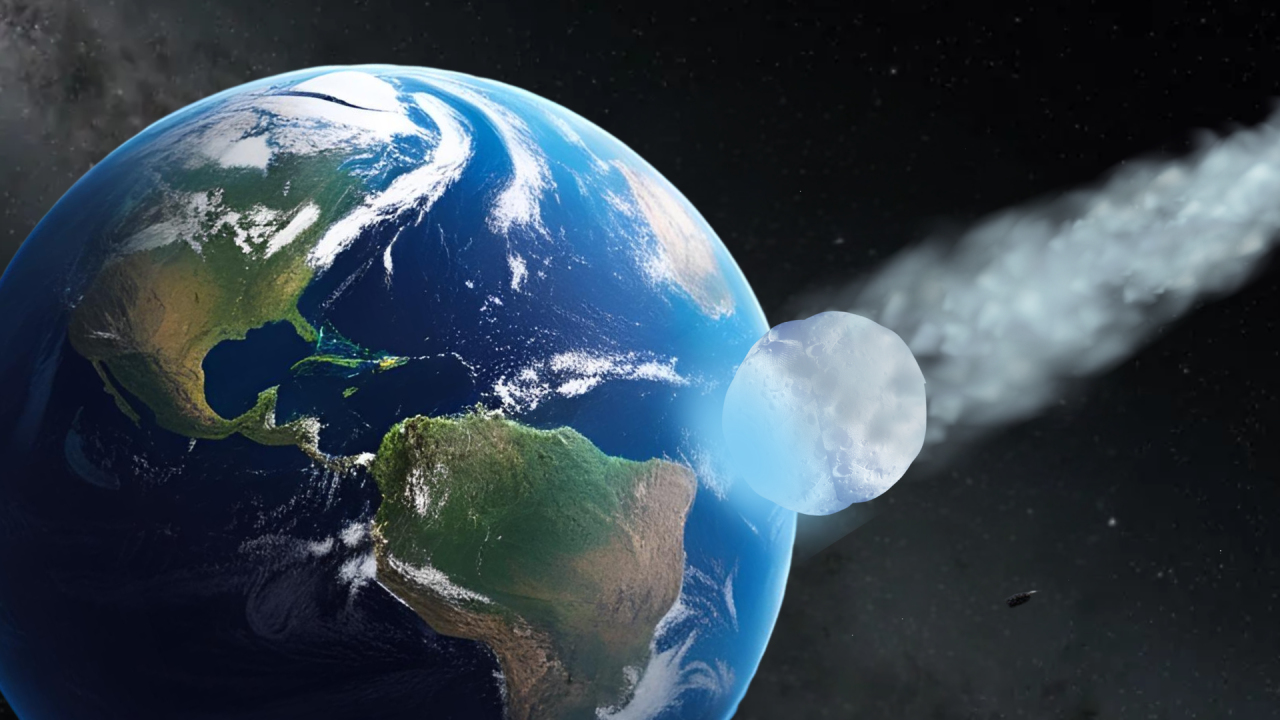
Researchers at the University of Cambridge have concluded that comets likely did not deliver the essential chemical building blocks of life to Earth. The study challenges the long-standing hypothesis that these icy bodies acted as carriers for complex organic molecules, suggesting instead that the impact forces were too severe for such materials to survive.
The research, led by planetary scientist Richard Anslow, utilized advanced computer modeling to simulate the origin, orbital evolution, and atmospheric entry of comets. By using hydrogen cyanide—a compound frequently found in comets and recently detected in interstellar comet 3I/ATLAS—as a proxy for complex organic molecules, the team assessed the likelihood of survival during hypervelocity impacts.
According to Anslow, for organic molecules to withstand an impact, the velocity would need to be below 15 kilometers per second, equivalent to 33,500 miles per hour. The simulations revealed that comets generally travel too fast and enter Earth’s atmosphere at too steep an angle. Consequently, the majority of these molecules are vaporized upon collision. Even in rare scenarios where some molecules survived, their abundance was insufficient to drive meaningful prebiotic chemistry.
“Historically, scientists thought that comets were important for the origin of life on Earth, because they carried carbon and nitrogen-bearing molecules, so these giant space snowballs were almost like a ‘get-out-of-jail-free card’ that brought all the molecules a planet would need to seed life,” said Anslow. However, the team’s findings suggest that this scenario is highly improbable for Earth.
While this casts doubt on comets as the primary source of life’s ingredients on Earth, the study notes that other planetary bodies may have benefited. The simulations indicate that comets might have a better chance of delivering organic material to Mars due to its thinner atmosphere and lower gravity. Additionally, exoplanet systems around red dwarf stars, such as TRAPPIST-1, could theoretically receive organic compounds via gravitational interactions with comets that lose velocity before impact.
As scientists consider these alternatives, the focus shifts to whether pre-biotic chemistry occurred entirely on Earth or was delivered by asteroids, which have been shown to be rich in essential molecules like those recovered from the OSIRIS-REx mission. The findings were published in Scientific Reports on October 28.



I always thought comets were essential. Are we now saying life started locally? That feels like a huge plot twist.
Wait, so comets were basically useless for Earth but might actually work for Mars? That is quite a twist.