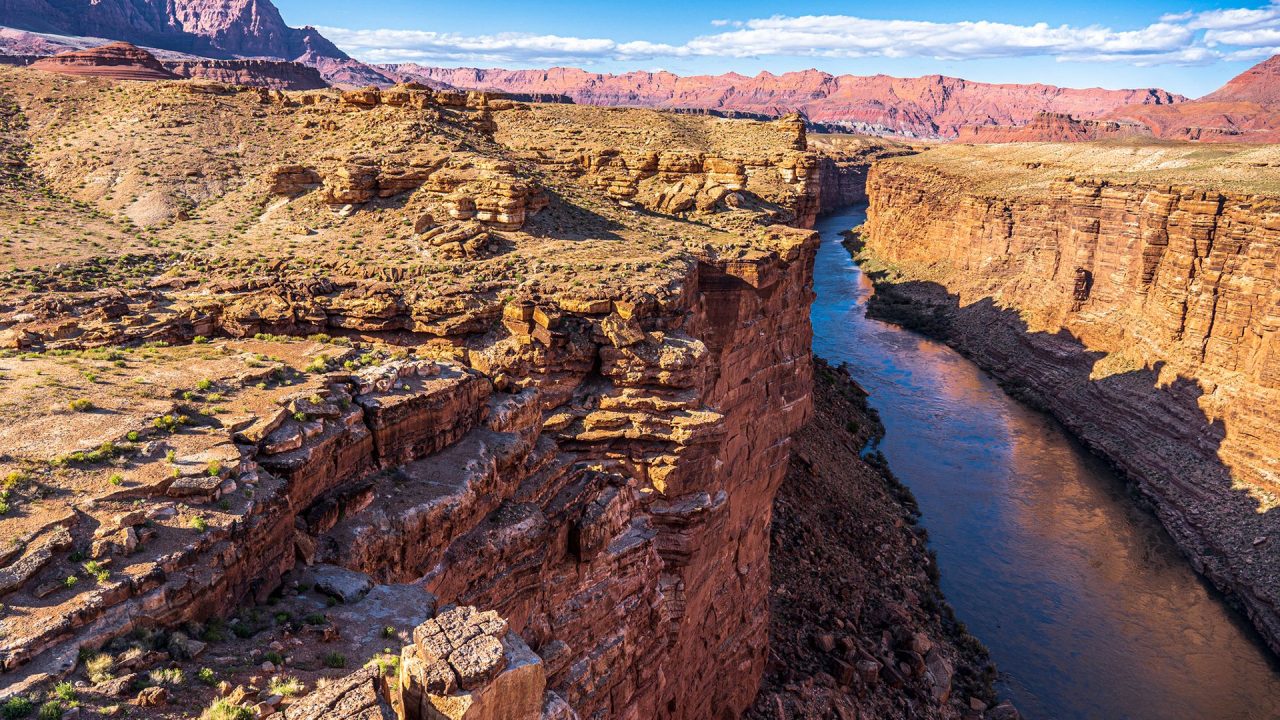
Scientists have identified a likely explanation for a massive gap in the geological record known as the Great Unconformity, which preserves missing time in rock formations at the Grand Canyon and across North America, the Baltic region of Europe, and northern China.
At the Grand Canyon, ancient igneous and metamorphic rocks dating to 1.7 billion years ago sit directly beneath sedimentary layers from 500 million years ago. The 1.2 billion-year interval in between was not preserved in these specific locations. This missing period is significant because it spans the time leading up to and during the Cambrian explosion, a key era of rapid biological diversification.
According to a study published on November 4 in the journal Nature, the slow, heat-driven circulation of Earth’s mantle pushed these three regions upward during that timeframe. This uplift facilitated erosion, causing sediments to wash off the continents and settle in the oceans. In contrast, during the following 540 million years, the same areas began to sink, allowing sediments to accumulate again in distinct layers, marking the end of the unconformity.
Nicolas Flament, a geoscientist at the University of Wollongong in Australia and co-author of the study, noted that while glaciation during the Snowball Earth era likely contributed to erosion, the primary driver was deep within the planet. Without the mantle pushing the continents upward, there would have been insufficient slope for glaciers and other forces to transport sediment away from the land.
Shanan Peters, a geologist at the University of Wisconsin-Madison not involved in the research, clarified that the term “missing information” is misleading. The absence of rock in these layers actually reveals details about the geological processes of that era, which may have influenced the evolution of complex life. Peters suggested that the exposure of crystalline rocks during this period could have released elements like potassium, iron, manganese, and carbon into the seas at increased rates, potentially prompting marine life to develop biomineralization, such as shells, and altering atmospheric oxygen levels.
Flament emphasized that the new model explains both the period of erosion and the subsequent return to sediment deposition. While more data is needed from regions like Africa and Russia to fully validate the models, the findings offer a planetary-scale explanation for one of Earth’s most significant geological gaps.


Great explanation. I never realized the Snowball Earth glaciation was just a helper, not the main driver.
Does this mean the Cambrian explosion happened because the sea chemistry changed? I am confused but intrigued.
Heat driven circulation is fascinating. Nature really likes to balance things out over geological time scales.
1.2 billion years gone in a blink. My family history has more preserved records than the Earth apparently.
The potassium release idea is wild. Could that actually trigger shell formation? That would change everything.
Models are always nice, but Africa and Russia data is still missing. How are we sure this is definitive?
I hiked the river mile a few years ago. Seeing that stark line between the layers finally makes sense.
Always thought it was just erosion. Sounds crazy that deep mantle convection dictates where we find fossils now.