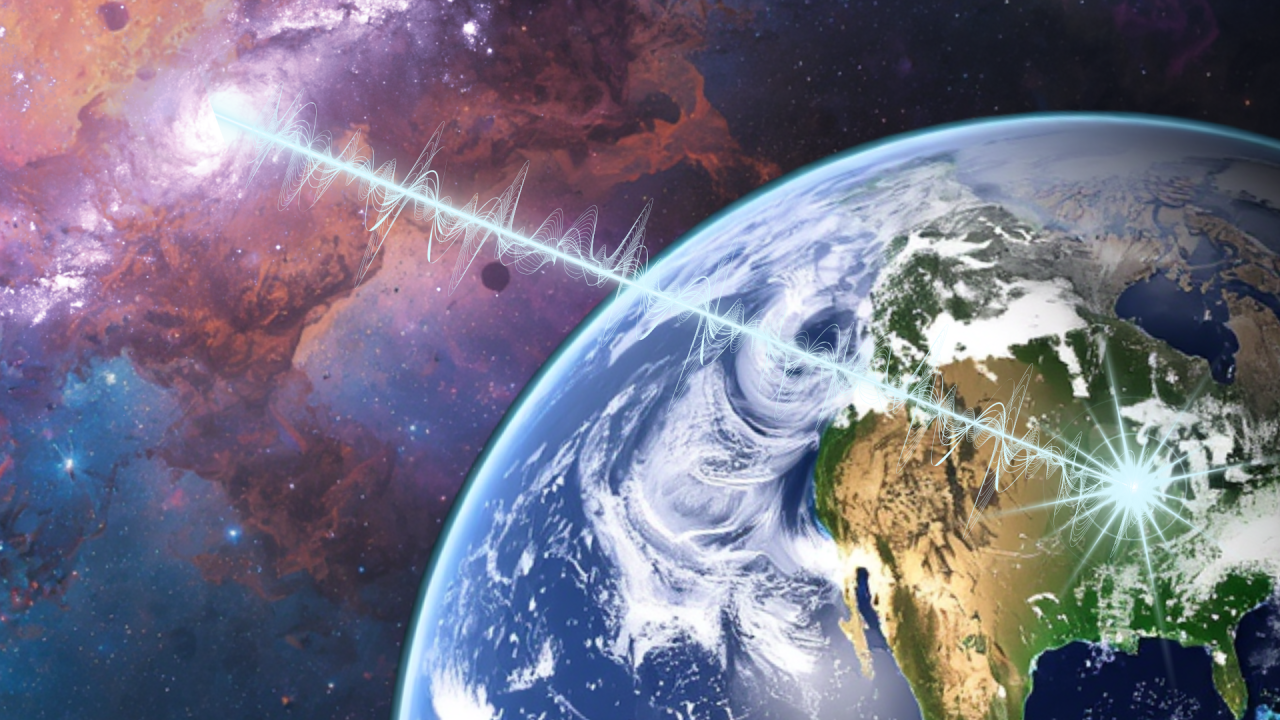
Fast radio bursts (FRBs), extreme cosmic flashes of energy that outshine entire galaxies, have been rendered audible to human ears through an artistic installation at Oulu Cathedral in Finland. Created by composer Andrew Melchior and MIT physics associate professor Kiyoshi Masui, the piece titled “The Logos” has played daily since early April and is scheduled to continue until the end of the year.
The installation sonifies data from 4,539 bursts recorded by the Canadian Hydrogen Intensity Mapping Experiment (CHIME) between 2018 and 2023. While FRBs are invisible radio pulses, Melchior and Masui translated their signals into acoustics, mapping the structure of each burst to varying musical pitches played through 12 loudspeakers inside the cathedral. The result produces a range of tones, with distant signals humming, rumbling, popping, and whistling.
Melchior noted that the physics of these signals is audible in the music. Each burst arrives with high frequencies that sweep downward due to dispersion through intergalactic gas, a phenomenon that can be heard as the sound falls from the cathedral’s dome. According to Melchior’s website, the youngest signals in the installation are approximately 50 million years old, while the oldest are about 8 to 9 billion years old.
The ongoing study of FRBs continues to yield new scientific insights. Recently, astronomers using the James Webb Space Telescope identified the host galaxy of the most distant FRB yet observed, which occurred when the universe was only 3 billion years old. This galaxy is a small, young, star-forming dwarf, a finding that challenges the theory that FRBs result from merging neutron stars and supports the hypothesis that they are produced by young magnetars, highly magnetic neutron stars that form after massive stellar explosions.
An upcoming event on November 21 will feature a live performance at Oulu Cathedral, where 30 singers will “sing back to the sky in Finnish” while Melchior performs the burst data on a keyboard. Masui described the expected effect as snare-like beats echoing through the space, creating a rich, layered experience that reflects the journey of these signals across billions of years of cosmic distance.

Wait, is that safe? Translating billions of years of energy into audio seems like it might give people a massive headache.
I never thought a cathedral would sound like the universe. The downward frequency sweep description makes me want to visit Oulu.
Singing back to the sky in Finnish sounds incredibly poetic. Curious if the choir harmonizes with the cosmic data or clashes.