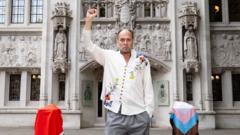
A UK appellate court has overturned laws criminalising same-sex intimacy in Trinidad and Tobago, ruling that the statutes violate the fundamental right to respect for private and family life.
The decision by London’s Judicial Committee of the Privy Council, which serves as the final court of appeal for the Caribbean island, concludes an 11-year legal campaign led by Jason Jones, a 62-year-old dual citizen. Jones had initially succeeded in challenging the laws in Trinidad’s High Court in 2018, but the ruling was later reversed on appeal by the local government.
Lord Sales, handing down the unanimous judgement, stated that the laws “cannot be regarded as reasonably justifiable in a society that has a proper respect for the rights and freedoms of an individual”. The court rejected arguments from the Trinidad and Tobago Attorney General, who had claimed the statutes were protected by “savings law clauses” that preserved existing British laws in newly independent states. Counsel for Jones argued that government amendments to the laws in 1988, which introduced stricter punishments, nullified those protections.
This marks the first time the Privy Council has ruled on a case to decriminalize same-sex intimacy. Prior to this verdict, Trinidad and Tobago was among approximately 34 Commonwealth nations where homosexuality remained criminalized under colonial-era legislation, with consensual acts punishable by imprisonment or, in some cases, the death penalty.
“These laws never reflected who we are as a people and a nation – diverse, multiracial, and secular. They told LGBTQ+ people that we were criminals in our own country. That message ends today,” Jones said. Campaigners hope the precedent will trigger similar successful legal challenges in other parts of the Commonwealth. Anand Ramlogan SC, Jones’s lawyer, described the outcome as a “landmark victory for gay rights, equal dignity and respect for private and family life in Trinidad and Tobago.”


Skeptical that political leaders will actually implement changes without further pushback from conservative groups locally.
Trinidad is such a vibrant, diverse culture. It is painful that it took this long to protect its LGBTQ+ citizens.
Funny how the same court that kept the laws alive for so long is the one finally striking them down.
I wonder if other Commonwealth countries are already drafting similar legal challenges based on this new precedent.
Jason Jones deserves massive credit. Standing alone against the state for over a decade takes serious courage.
The mention of death penalties in other nations still chills me. Legal progress is incredibly slow and uneven.
Do these specific rulings automatically erase the 1988 amendments, or does the local parliament still need to act on them?
Finally! It is refreshing to see the Privy Council use its final authority to correct these outdated colonial wrongs.
Eleven years is an awfully long time to wait for basic human rights to be recognized in court.