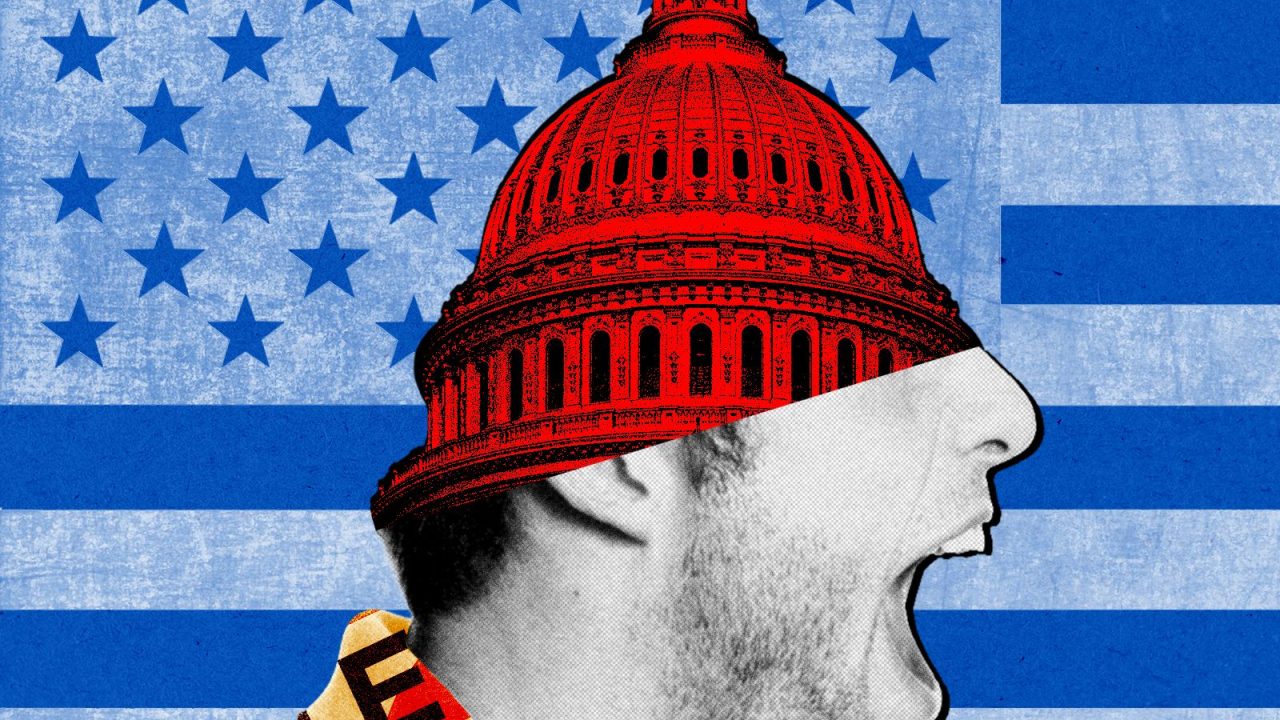
Following the Democratic victory in the 2026 midterm elections, prominent far-right figures are declaring that the outcome strengthens their position rather than weakening it. White nationalist Nick Fuentes, who urged his followers to vote for Democrats on Election Day, claimed responsibility for the result on Telegram, labeling it “the Groyper Effect.” In subsequent livestreams, Fuentes argued that the left’s dominance would eventually alienate the public, forcing them to turn to the far-right for leadership.
“There will come a time when the far left will terrorize people, and they’re going to push all of them into the arms of the right,” Fuentes stated, adding that extremist groups must now “take over the right wing.” He warned the Republican establishment that “It’s our party now,” insisting that the party must adopt an “America First” platform or face consequences from his supporters.
Analysis from Open Measures indicates that several extremist factions view the election results as validation for their long-standing critiques of the Trump administration. Jared Holt, a senior researcher at the firm, noted that these groups believe the political shift will create a backlash that drives disaffected voters toward their ideological camps. The Republican Party did not secure all extremist candidates, yet those who ran in statewide races achieved a high success rate.
The Institute for Research and Education on Human Rights tracked 535 candidates in statewide races who were members of far-right Facebook groups. Of the 476 races called by last Friday, 338 of these candidates won, a 71 percent victory rate that largely involved incumbent retention. In Florida, Marshall Rawson, a former Unite the Right rally attendee, defeated his Democratic opponent in the state’s 10th District. Additionally, voters in Arizona, Colorado, Nebraska, and Washington approved ballot measures restricting transgender participation in sports and enacting strict voter ID and anti-immigrant rules.
Groups such as the Proud Boys framed these ballot measure victories as a mandate for their movement. The Cape Fear Proud Boys wrote on Telegram that citizens were doing the job the Republican establishment failed to handle, implying a new dynamic of control. Chuck Tanner, research director at IREHR, noted that even in races where these candidates lost, they secured between 41 and 47 percent of the vote, providing a mobilizable base.
Warren Balogh, a white supremacist in Pittsburgh, urged his followers to begin organizing a “hostile takeover” of local Republican parties. While some leaders anticipate leveraging the current political moment, others like Christian nationalist pastor Joel Webbon prefer a direct path to power. Webbon, who plans to attend a conference in Texas with fellow pastors and conspiracy theorist Alex Jones, suggested that the goal is to “seize power.” The conference agenda includes discussions on “battle plans” for this objective.
Experts have not identified explicit calls for violence from the groups they monitor, but attention is turning to January 3, when Congress certifies the election results. Far-right activist and pardoned January 6 participant Jake Lang is planning an event in Washington, D.C., on that date. While it is unclear how many will attend, one of the listed speakers has indicated he will not be present. Lang, who recently disrupted a convention in New York, did not respond to requests for comment regarding his plans.
71 percent is a scary number. Are we just watching these extremist candidates get legitimized by holding office?
I can’t believe they think forcing a loss is a strategy. It proves our democracy is dangerously fragile right now.