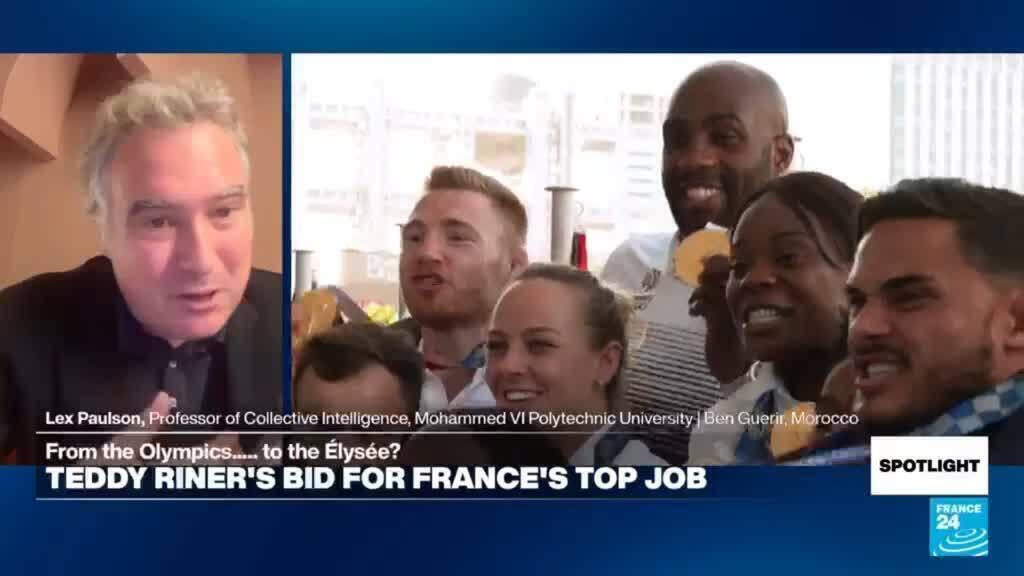
The potential entry of Olympic judo champion Teddy Riner into France’s presidential race has sparked a broader discussion regarding the state of French democracy. Lex Paulson, a Professor of Collective Intelligence at Mohammed VI Polytechnic University, suggests that Riner’s emergence signals a significant shift in political competition, driven by the fragmentation of traditional parties and a desire for new forms of representation.
Paulson noted in an interview with France 24 that the political landscape has evolved such that traditional resources are no longer sufficient. “The currency of politics now is no longer just money to buy television advertisements or open offices. It’s the ability to capture attention,” he explained. This shift highlights how personal credibility and public visibility have become critical assets for political candidates, particularly in a media environment where established elites struggle to maintain public trust.
While Riner’s celebrity status and public stance against racism provide him with a notable advantage, Paulson questioned whether the athlete has articulated a comprehensive political vision sufficient for a serious presidential candidacy. Visibility alone, the expert argued, does not automatically translate into the political credibility required to govern.
However, the core of Paulson’s analysis focuses on what Riner’s candidacy reveals about the weaknesses of France’s traditional political options. He emphasized that voters are increasingly drawn to leaders whose personal histories resonate with their own values rather than solely to policy platforms. “Voters don’t vote for policies. Voters vote for people they sense will stand up for them,” Paulson stated.
This dynamic reflects a wider crisis in democratic representation, where citizens perceive professional politicians as a distant governing class. “People don’t feel like they’re being listened to except for the few weeks before an election,” Paulson added. Consequently, Riner’s potential run is viewed not just as a celebrity phenomenon, but as a symptom of changing public trust and the need for more responsive institutions. The challenge for future leaders, Paulson concluded, is to reimagine governance by bringing decision-making closer to citizens and restoring a meaningful voice in the democratic process.

Funny how we need a sports star to make us feel heard again. Sigh.
Visibility is not policy. We need substance, not just a celebrity figure for the news.
It is actually refreshing to see someone who listens to people instead of just talking down.
Typical. The old guard is gone and now we expect a judoka to run the country.
I am surprised that an athlete is taking this seriously, but honestly I need some fresh air.
Riner is a hero, but does he really have a concrete policy plan or just good vibes?