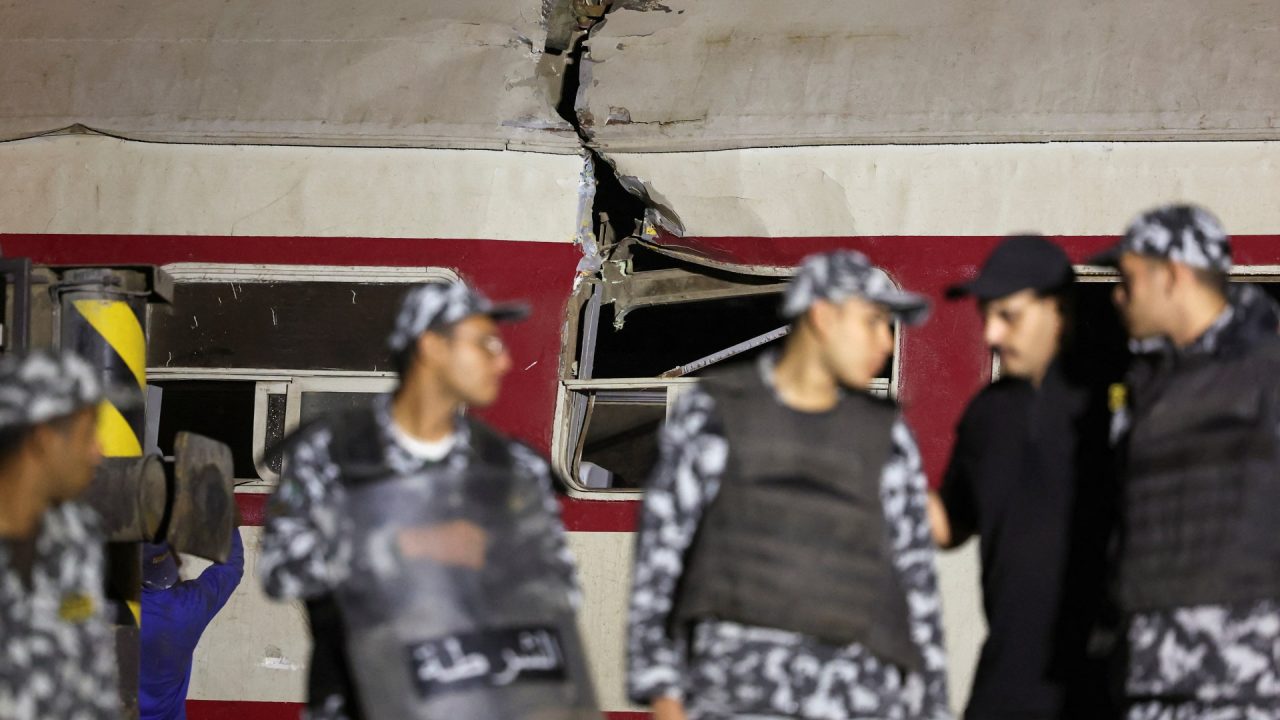
A catastrophic train collision in the outskirts of Cairo on Sunday resulted in at least seven fatalities and over 125 injuries, according to Egypt’s Ministry of Health and Population. The accident occurred when a passenger train traveling between Giza and Fayoum struck the rear of another train on the Cairo-to-Aswan route, causing the latter to derail onto a country road in the al-Ayyat district. Following the disaster, President Abdel Fattah el-Sisi ordered an urgent investigation to identify and hold accountable any individuals found to be negligent.
The incident has intensified political scrutiny regarding the safety of Egypt’s railway network, which has received significant state investment. Opposition figures are demanding broader political responsibility, with some calling for the dismissal of the entire cabinet. Abdel Moneim Imam, a member of Parliament and head of the Justice Party, cited the recurrence of accidents in al-Ayyat—including deadly incidents in 2002, 2009, and 2016—as evidence of a lack of genuine accountability among officials responsible for the sector.
“The recurrence of train accidents in the al-Ayyat area… reflects the absence of genuine accountability for the officials responsible for those accidents,” Imam stated, adding that holding officials accountable for past mistakes would have prevented the current crisis. Meanwhile, Atef el-Maghawry, head of the Tagammu Party’s parliamentary bloc, argued that the repeated failures point to wider government policy issues rather than those confined to the Transport Ministry. He emphasized that changing personnel without addressing underlying policies would not resolve the crisis.
In response to parliamentary inquiries, Ahmed el-Derby, secretary of the Transport and Communications Committee, clarified that the committee’s emergency session with Transport Minister Kamel el-Wazir was not intended to confront him with premeditated accusations. “We do not support the hasty demands to dismiss officials, and dismissals alone do not represent a solution to the crisis,” el-Derby said, noting that ultimate responsibility lies with the officials overseeing the railway system.
Parliamentarians are also demanding financial transparency, with Irene Saeed of the Reform and Development Party requesting a detailed breakdown of how loan funds obtained in 2026 were allocated. Saeed seeks to determine what proportion of these funds went toward safety, signalling, and maintenance. The Transport Ministry has stated that approximately $37 billion was allocated to transport investments between 2014 and 2024.
Experts warn against drawing immediate conclusions while the investigation is ongoing. Hassan Mahdy, a highway engineering professor at Ain Shams University, highlighted that investigators are examining why the first train stopped on the main track, potentially due to a technical failure or an emergency brake activation. Mahdy noted that previous upgrades, including the shift to electronic signalling systems, have reduced reliance on human intervention, but officials must verify whether warnings were effectively communicated to drivers before the collision.
Thirty-seven billion dollars invested and we still get deadly collisions. That is simply unacceptable for any modern government.
Did anyone check if the new electronic signaling systems were even working properly before this specific incident happened?
Blaming the whole cabinet feels like a political tactic. We need to fix the actual railway infrastructure, not just fire officials.
It is terrifying that al-Ayyat has seen multiple deadly crashes over the last two decades without proper safety fixes.