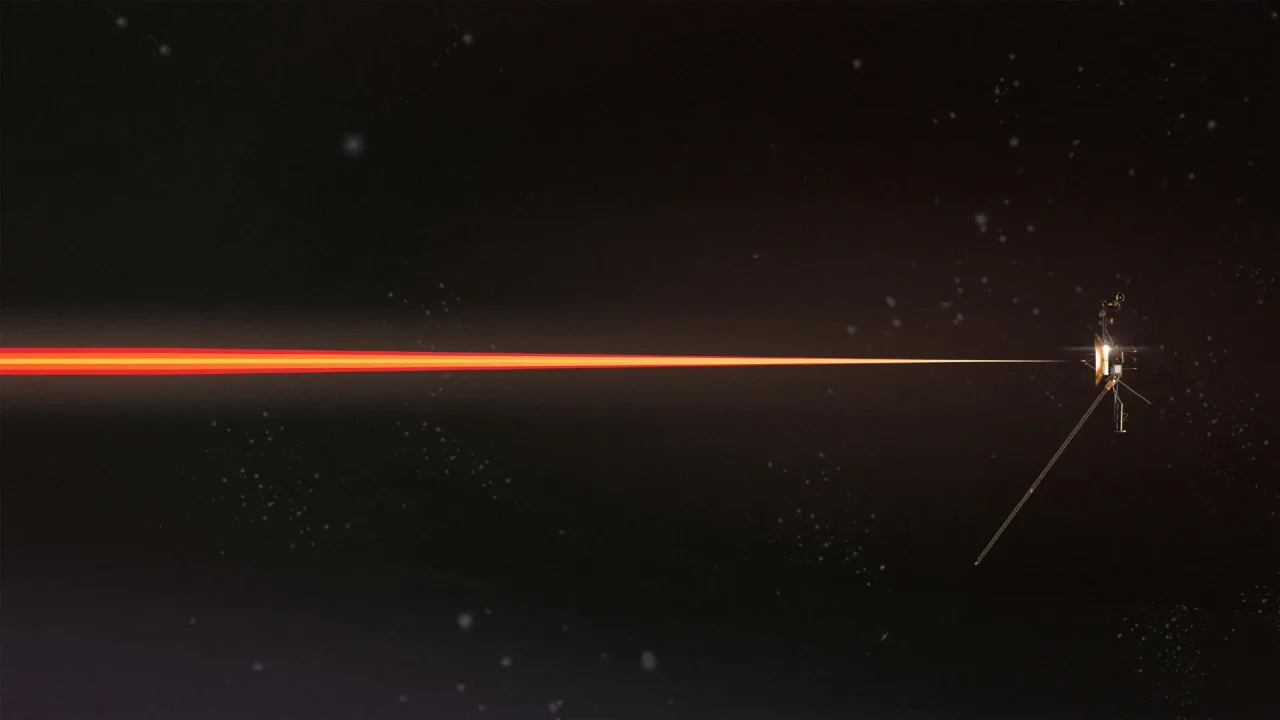
NASA’s Voyager 1 has reached a historic milestone, becoming the first human-made object to travel a distance of one light-day from Earth. As of November 18, the spacecraft is approximately 16.1 billion miles (25.9 billion kilometers) away. At this immense distance, a radio signal traveling at the speed of light requires a full 24 hours to journey from the spacecraft to Earth.
The milestone was confirmed by scientists at NASA’s Jet Propulsion Laboratory (JPL) on November 20, when they received a signal from Voyager 1 exactly 24 hours after the probe crossed the threshold. This achievement marks a significant chapter for a probe that has been traveling for over 49 years, surviving far beyond its original mission parameters to explore interstellar space.
The increasing distance presents substantial communication challenges for mission controllers. A command sent to Voyager 1 now takes 24 hours to arrive, and a response takes another 24 hours to return, meaning a complete data exchange spans two days. Currently, engineers are investigating a communication issue that began on November 14, when NASA stopped receiving scientific and engineering data from the probe. However, the spacecraft continues to transmit a carrier signal, which allowed specialists to track its trajectory and verify the light-day milestone.
Launched in 1977, Voyager 1 and its twin, Voyager 2, utilized planetary gravity to explore Jupiter and Saturn before venturing into interstellar space. Voyager 1 crossed the heliosphere’s boundary in 2012, followed by Voyager 2 in 2018. These probes are providing the first direct observations of conditions beyond the Sun’s magnetic bubble, revealing that the Sun’s influence extends much farther into interstellar space than previously understood.
Maintaining these nearly 50-year-old spacecraft requires innovative engineering. Both probes have faced issues such as clogged thrusters and computer malfunctions. In early 2026, engineers switched off three devices on Voyager 1 and replaced them with more power-efficient alternatives to stretch the remaining energy from its radioisotope thermal generators. These generators lose approximately four watts of power annually due to radioactive decay. Current conservation measures are expected to keep Voyager 1’s scientific instruments operational until at least the summer of 2027, coinciding with the 50th anniversary of the Voyager missions.
Despite the communication delays and aging systems, JPL continues to monitor Voyager 1 daily and transmit commands weekly using NASA’s Deep Space Network. The mission also carries the Golden Record, a gold-plated copper phonograph containing images and sounds from Earth, intended as a message for potential extraterrestrial civilizations. As Voyager 1 continues its journey, it remains a testament to human curiosity and engineering capability, serving as a silent ambassador to the stars when it eventually ceases communication with Earth.



Wait, two days for a single command exchange? That must make troubleshooting a total nightmare for the engineers.
Losing data after 49 years is honestly remarkable. Hope they can fix the communication issue before it fades completely.