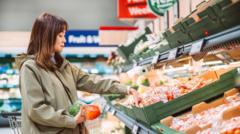
Following a new trade agreement between the United Kingdom and the European Union, the Prime Minister highlighted significant cost reductions for businesses and consumers. While the deal is designed to streamline post-Brexit trade by removing bureaucratic barriers, industry leaders have not committed to translating these savings into lower retail prices for shoppers.
Supermarket executives have welcomed the move as a major step toward eliminating unnecessary red tape. Alex Freudmann, Managing Director of Marks & Spencer, noted that the agreement will eliminate the extensive paperwork and vetinary checks previously required for shipping basic goods, such as spaghetti Bolognese, between UK and EU destinations. Similarly, Tesco chief executive Ken Murphy described the development as positive news for British agricultural sectors.
However, analysts suggest that a direct correlation between the deal and cheaper food bills at the checkout is unlikely. Industry insiders indicate that global economic volatility, particularly energy price shocks stemming from the Middle East conflict, makes it difficult to pass cost savings directly to consumers. The government and trade bodies are currently hoping that reduced operational costs for producers and sellers will eventually benefit customers, though this remains a hope rather than a guarantee.
The new framework replaces hundreds of pages of documentation with streamlined processes, allowing perishable goods to move through border checks without losing valuable time. This change is expected to aid smaller food exporters in re-entering the large EU market and potentially recover a portion of the 24% decline in the real value of agrifood exports observed since 2019.
Treasury assessments estimate the economy will gain £5 billion annually from this specific food agreement. When combined with other pacts on emissions and youth mobility, the overall economic boost is forecasted to reach 0.5%, or £17 billion per year. While the largest single economic driver will be the influx of young European workers, the government’s own analysis shows the per-capita economic benefit from this specific clause is negligible. The deal also involves aligning with EU regulations on issues such as pesticide use, a trade-off that was partially mitigated by an ‘exception period’ for UK-specific innovations like precision-bred foodstuffs. Critics argue that while the economic gains are modest by historical standards, this agreement represents a shift away from a piecemeal approach toward full alignment with the single market, a strategy the government aims to replicate in sectors like automotive and chemicals.
Streamlining veterinary checks is a lifesaver. Perishable goods spoil quickly. This saves actual money for producers.
It is better than nothing, but 0.5% growth? That sounds tiny. I expected more for such a huge deal.
Precision-bred foodstuffs getting an exception is good. We need to keep our agricultural innovation alive without total EU lockdown.
Wait, the biggest economic gain is just young workers moving around? The food deal seems like a footnote.
The 24% export decline was brutal. This streamlined process is the only way to recover that lost market share.
I appreciate the clarity. It is a win for trade, but do not expect supermarkets to lower prices overnight.
Energy prices are still chaotic. Saving on borders won’t help if gas costs keep spiking. The math doesn’t add up.
Does this actually mean my weekly grocery bill will drop? Or is it just another corporate profit boost? Skeptical.
Finally some sense! I was tired of reading about spaghetti paperwork. This will help small farmers get back into Europe.