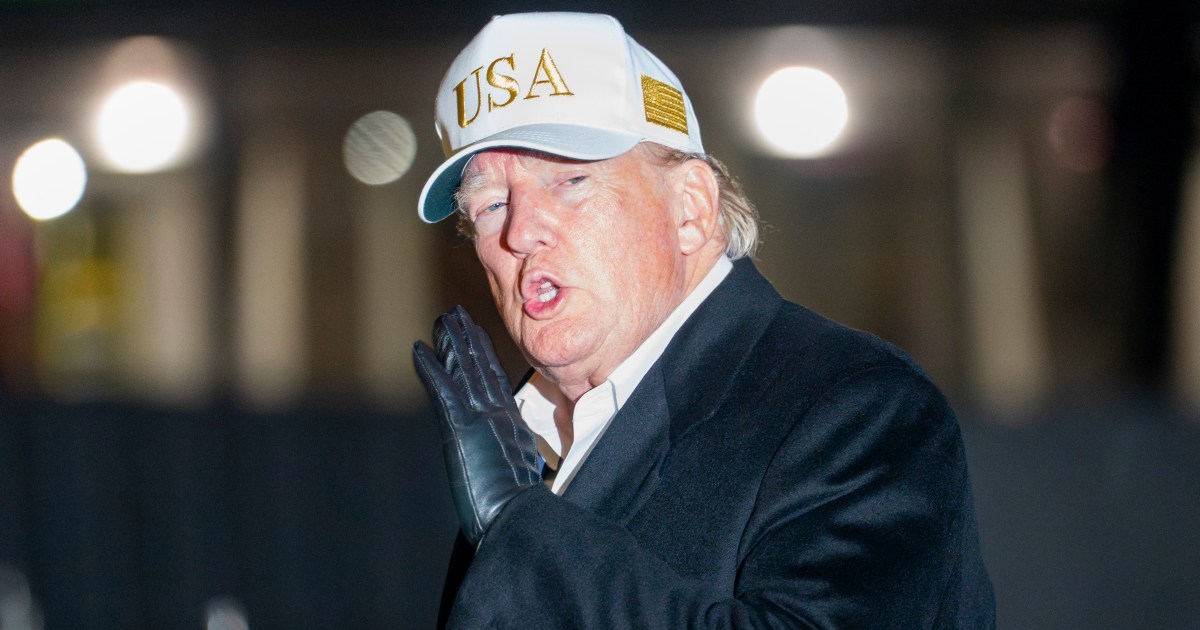
United States President Donald Trump accused Iran of developing chemical and biological weapons on Thursday, reviving concerns that Tehran might be preparing a ‘dirty bomb’ attack. Speaking on Fox News, the President stated that Iran was ‘looking at gases, looking at bio,’ though he did not present specific evidence to back up the assertion.
Trump suggested that Tehran had shifted focus away from nuclear ambitions because Washington had ‘shut them out,’ predicting, ‘We’ll see what happens after January 1.’ During the interview, he also referred to Iranians as ‘nasty people.’ These remarks followed a report by CNN on Tuesday, which cited US intelligence indicating that Iran might be planning to target senior US officials in Washington, DC, with chemical agents.
Despite the President’s claims, US Secretary of State Marco Rubio and Homeland Security Secretary Markwayne Mullin both dismissed the notion of an immediate threat. Rubio stated that the United States does not face an ‘imminent threat,’ while Mullin confirmed there was no indication of an upcoming attack. In response, Trump said he did not believe people in Washington needed to be concerned but issued a stark warning: ‘If it does happen, we wipe them out.’
Experts note that while Iran is a signatory to both the Biological Weapons Convention, ratified before the 1979 revolution, and the Chemical Weapons Convention, ratified in 1997, Western intelligence agencies have long suspected that the country is pursuing unconventional capabilities. A report by the Royal United Services Institute (RUSI) indicated that Iran’s biological weapons program may have accelerated after the Iran-Iraq War ended in 1988, during which Iraq used chemical weapons extensively. Analysts believe Tehran subsequently sought to prevent a similar asymmetry by developing biological agents under the cover of civilian research.
Hamish de Bretton-Gordon, a former British Army officer and analyst, stated it would not be surprising if Iran was turning to chemical weapons development following US strikes on its nuclear facilities. He added that with the rise of AI-enabled bio weapons, such tools could be as devastating as nuclear weapons at a fraction of the cost and time, while being much harder to detect.
Dan Kaszeta, an associate fellow at RUSI, described the current situation as ‘incredibly vague.’ He noted that while any country with Iran’s industrial and laboratory infrastructure could theoretically create chemical or biological hazards for a localized incident, whether Iran has an actual program has been debated for decades without a firm conclusion. Jacek Siewiera of the Atlantic Council’s Europe Center emphasized that scientific expertise alone does not prove operational capability or intent, advising caution against assigning probability to specific attack scenarios.
Critics of the US position have drawn parallels to previous accusations against Iraq. Glen Rangwala, a professor at the University of Cambridge, pointed out the history of successive US administrations making unfounded allegations about Middle Eastern countries possessing weapons of mass destruction. He referenced the 2003 invasion of Iraq, where a Senate committee later found that the CIA and other agencies manipulated evidence to justify the occupation, only for no banned weapons to be found. Rangwala argued that such tactics serve to raise international stakes and silence domestic critics, while often ignoring that some US allies in the region also host or possess such weapons.

Calling people ‘nasty’ on national television is not how you handle complex geopolitical security concerns. Disgraceful.
Rubio and Mullin saying there is no imminent threat is a huge relief. We need calm facts.
The AI bio-weapon point is genuinely terrifying. If true, the detection challenges are a nightmare for global security.
Remember Iraq? The evidence was never there. This feels like a dangerous political pretext for another conflict.