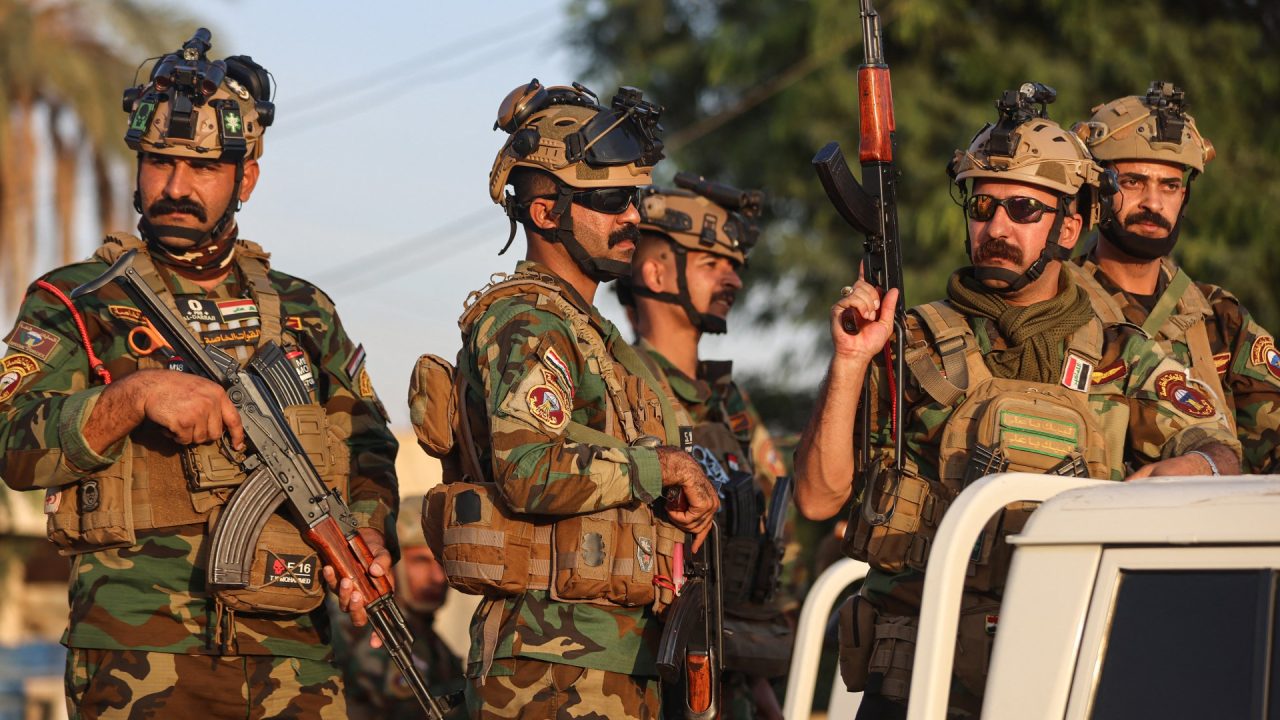
Jurf al-Sakhar, a territory controlled by Iran-linked militia Kataib Hezbollah in southwestern Iraq, has become the center of a major political and security crisis following allegations of widespread oil smuggling. Prime Minister Ali al-Zaidi launched an anticorruption campaign in response to a leaked intelligence report claiming that millions of dollars’ worth of crude oil had been siphoned from state pipelines since 2021.
The area, located roughly 60 kilometers southwest of Baghdad, holds significant strategic and economic value. Historically, it served as a site for Saddam Hussein’s military-industrial complexes. After the 2003 invasion and the rise of ISIL (ISIS), the territory was reclaimed in 2014 by the Iran-backed Popular Mobilisation Forces (PMF), with Kataib Hezbollah taking exclusive control and barring state institutions from entering. Approximately 140,000 displaced residents have been prevented from returning due to security restrictions.
Following a high-level investigative committee’s entry into the zone on November 13, the government announced that nine senior security and administrative officials in Babil province, including the police chief and the director of the Oil Pipelines Company, have been dismissed. The Iraqi government ordered armed forces to enter the area and set a Friday deadline for the militia to withdraw.
Kataib Hezbollah denied the smuggling allegations, accusing the prime minister of corruption and mobilizing approximately 8,000 fighters toward the area. Analysts suggest the militia’s resistance is driven more by economic interests than security, with the restricted zone also reportedly used for illegal fish farms. This move is viewed as part of Prime Minister al-Zaidi’s broader priority to disarm all armed factions under pressure from the United States, a deadline currently extended to June 2027.
The standoff has fractured Iraq’s ruling Coordination Framework, prompting behind-the-scenes mediation by leaders including Nouri al-Maliki and Hadi al-Amiri. In an effort to avert a direct military clash, Esmail Qaani, the commander of the Quds Force, traveled to Baghdad and held talks with al-Zaidi until dawn on Tuesday. While a tentative agreement was reached for Kataib Hezbollah to withdraw “soon,” observers warn that the crisis is not fully resolved and that the prime minister is determined to restore central state authority over all Iraqi territories.
It is impressive that Qaani actually traveled to Baghdad. The level of tension was probably high enough to require direct, high-stakes personal intervention.
The leaked intelligence report sounds convenient for the government. I remain skeptical that this is purely about anticorruption and not about power consolidation.
Prime Minister al-Zaidi is taking a massive risk here. If the US pressure deadline is 2027, why is he acting with such urgency right now?
Eight thousand fighters mobilized over some fish farms? I am confused. The economic incentives for keeping that zone restricted seem much larger than just smuggling.
Hope this doesn’t turn into another civil war. The Coordination Framework fracturing is terrifying for anyone actually living in Baghdad and fearing instability.
I find it ironic that they use the smuggling excuse to expand state control. The real issue is who controls the resources in that specific region.
Why is Iran involved in this mediation again? It feels like Iraq’s sovereignty is constantly at risk whenever external powers step in to solve internal issues.
It is shocking that a militia keeps 140,000 civilians trapped for years. This is not just politics, it is a humanitarian disaster waiting to happen.