NASA’s Voyager 1 spacecraft will mark a historic milestone on Wednesday (Nov. 18), reaching a distance of 16.09 billion miles (25.89 billion kilometers) from Earth. The probe, which has been traveling through the solar system since 1977, is now so far away that light takes 24 hours to travel between the spacecraft and our planet. While Earth celebrates this achievement, Voyager 1 continues its journey in darkness, as its camera was switched off in 1990 following the capture of the famous “Pale Blue Dot” and “Solar System Family Portrait” images.
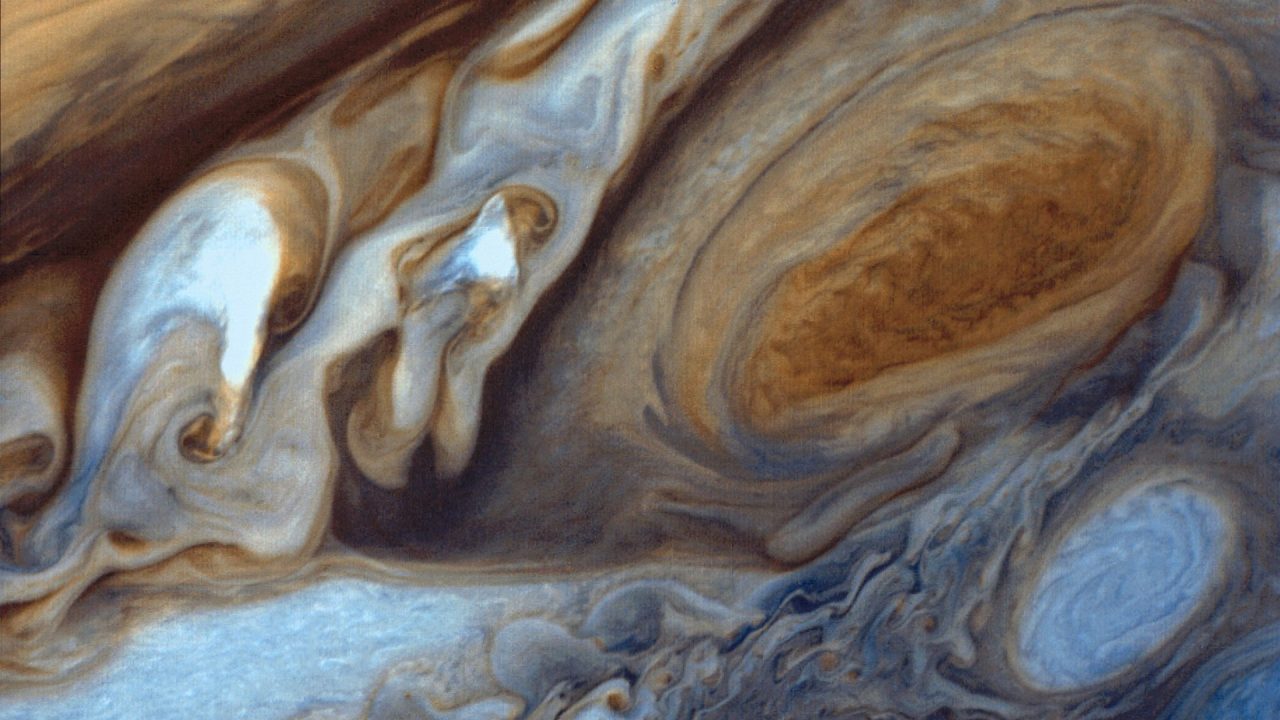
Before entering interstellar space, Voyager 1 captured tens of thousands of images that fundamentally altered our understanding of the outer planets. Its most significant contribution remains its 1979 flyby of Jupiter. Between January and April of that year, the probe observed the gas giant and its moons from a minimum distance of 174,000 miles (280,000 km) in March 1979. During its approach, the spacecraft photographed the planet every 96 seconds, creating a time-lapse animation that revealed Jupiter’s atmosphere as a highly dynamic system. The footage showed discrete cloud bands spinning in various directions and at different speeds, offering a far more comprehensive view than the data previously gathered by the Pioneer 10 and 11 probes.
One of the most remarkable findings during the mission was the discovery of Jupiter’s thin ring system. The rings, composed primarily of dust, were only visible when the planet was backlit by the sun, a feature no telescope had previously detected. Ground-based observatories soon confirmed the findings, and NASA’s Voyager 2 provided even clearer images of the rings during its subsequent flyby in July 1979. Scientists now understand that all four gas giants possess rings, with Jupiter’s dusty rings likely replenished by volcanic activity on its moon Io.
Voyager 1 also witnessed the first observed volcanic eruption on a world beyond Earth, capturing activity on Io, including the massive Loki Patera, which measures approximately 125 miles (200 km) wide. These observations demonstrated that moons, not just planets, can be geologically active. Collectively, these findings revealed the Jovian system as a chaotic and complex environment, transforming these distant worlds from mere points of light into tangible destinations for exploration. Recently, China’s space agency announced plans to send a lander to Jupiter’s moon Callisto, marking the first mission to land on a moon in the Jovian system.
Voyager 1 entered interstellar space in 2012 and continues to study the radiation environment using its remaining active instruments. With its camera disabled, the probe relies on magnetic field and plasma detectors, the last two of its ten science instruments still receiving power. Scientists estimate that the spacecraft will exhaust its power supply in the 2030s.

All four gas giants have rings? I had no idea. Earth is definitely the odd one out in this family of planets.
The power supply running out in the 2030s is sad. It feels like we are losing contact with a true member of our family.
Light travels 16 billion miles in a day? My Wi-Fi router takes longer than that just to load a webpage. Technology is weird.
Pioneer 10 and 11 paved the way, but Voyager really delivered the goods. These missions are the backbone of modern planetary science.
The time-lapse of Jupiter’s clouds was revolutionary. We finally stopped thinking of gas giants as static, boring balls of gas.
It is funny how the camera is off but the science instruments still work. The ship is basically just listening to the stars now.
Sending a lander to Callisto is ambitious. The radiation environment is brutal, so I am not sure that is the safest bet.
I remember being a kid when Io erupted on live feed. It was the first time I saw alien volcanoes. Unforgettable.
Does Voyager 2 have similar ring discoveries? I remember its images being sharper, so I am curious if the data matches up perfectly.
24 hours for light to travel is wild. The sheer scale of that distance makes my head spin every time I think about it.