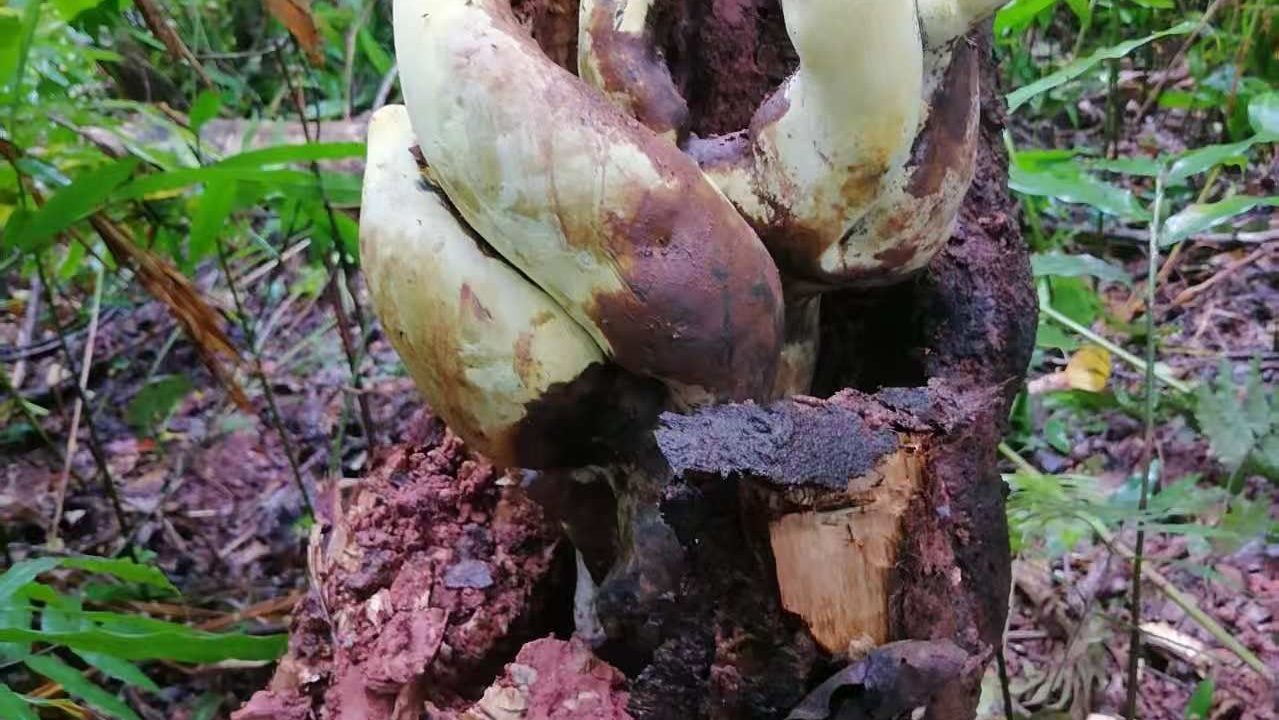
Scientists at the Kunming Institute of Botany, part of the Chinese Academy of Sciences, have identified a new species of giant fungus in Yunnan Province, China. Named Dianjunus rex, the organism is distinguished by its massive size, reaching heights of up to 20 inches and weighing nearly five pounds. The name combines a reference to the ancient Dian Kingdom and the Chinese pronunciation of the word for fungus.
The discovery, published in Frontiers in Fungal Biology, represents an entirely new biological family within the phylum Ascomycota. Unlike typical mushrooms, which feature caps and stems, D. rex produces large, whitish fruiting bodies that resemble reaching hands or cupped palms when they mature. These structures release spores for reproduction and were found growing in the soil near the roots of dying trees in the Nanban tropical rainforest.
Indunil C. Senanayake, an associate professor at the institute and the lead author of the study, noted that the finding highlights the significant biodiversity still undiscovered in East Asian forests. While approximately 6,000 fungal species have been documented in Yunnan, mycologists estimate the region could harbor up to 100,000 species. The fruiting bodies of D. rex exhibit specific physical characteristics, with above-ground parts covered in white, powdery fibers that turn dark yellow as they age, while the subterranean portions remain black and smooth.
DNA analysis using a molecular clock suggests that D. rex diverged from other species roughly 65 million years ago, immediately following the end of the Cretaceous period. This timing coincides with a mass extinction event that wiped out a significant portion of global flora and fauna, creating ecological opportunities for fungi to thrive on abundant dead plant material.
However, genomic sequencing revealed that D. rex possesses only about half the expected number of decomposition-related genes compared to its closest relatives. Researchers hypothesize that the fungus may lead a “double life,” living symbiotically inside healthy trees before feeding on the host once it dies. This strategy could allow the organism to accumulate sufficient energy to develop its unusually large fruiting bodies. Senanayake suggests that towering above the forest floor may provide a distinct advantage for wind-mediated spore dispersal, though this structural investment requires substantial energy reserves.


Two feet tall? My biggest mushroom found was barely an inch. Incredible size difference.
Wait, it eats healthy trees first? Sounds like a zombie fungus situation. Creepy!
Sixty-five million years ago? This thing has been hiding in plain sight the entire time.