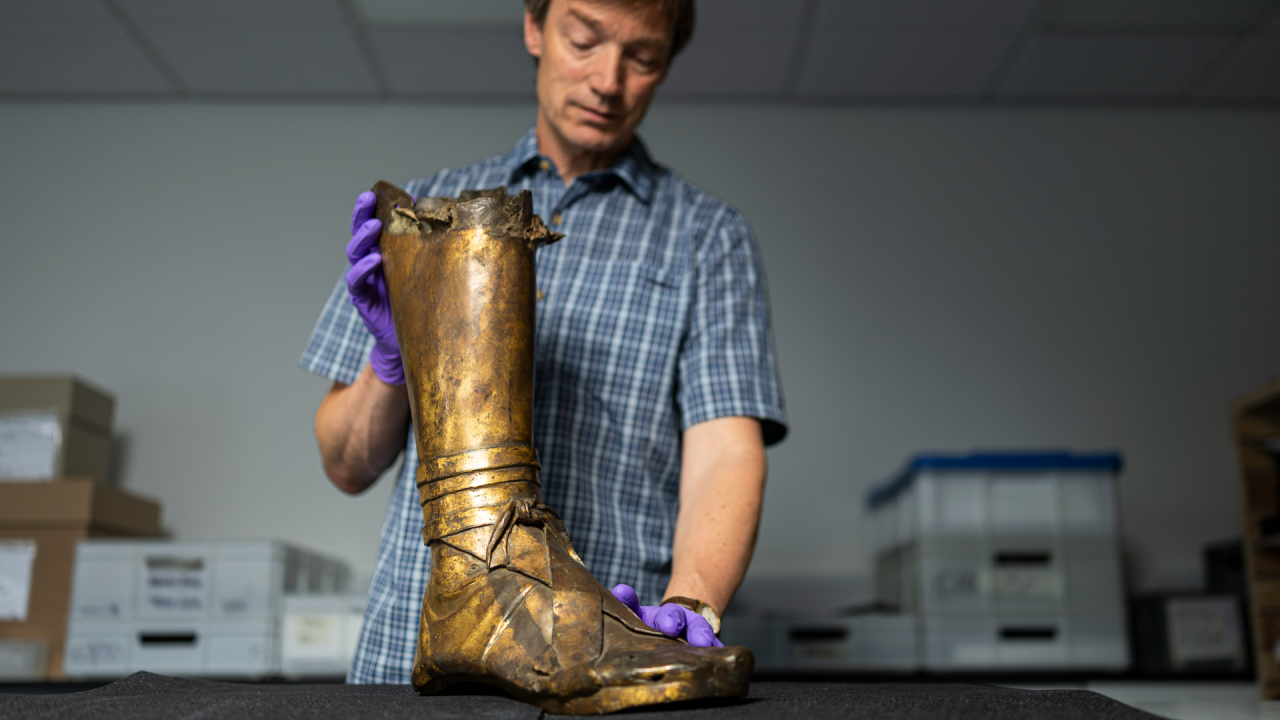
The gold-covered bronze foot and calf known as the Milsington leg, discovered in a Scottish bog in 1820, offer new insights into Roman history. National Museums Scotland revealed that the artifact likely belonged to a larger-than-life equestrian statue of Emperor Antoninus Pius. While researchers previously thought the sculpture was looted from York, evidence now points to its origin in southern Scotland, where it would have stood near the Antonine Wall.
Antoninus Pius, who ruled from A.D. 138 to 161, ordered the construction of the Antonine Wall to push the empire’s northern frontier further into Scotland. However, following his death, the Romans retreated, and the wall was abandoned. During this withdrawal, it appears the military carefully dismantled valuable statues rather than destroying them. An examination of the Milsington leg found no cut marks, suggesting the bronze was removed methodically instead of being hacked off for scrap or obliterated in a post-battle condemnation.
Fraser Hunter, principal curator of prehistoric art and Roman archaeology at National Museums Scotland, stated that this discovery reshapes the understanding of Rome’s second attempt to conquer Scotland. Hunter noted that the statue was likely a significant celebratory monument for the Emperor. Despite the new findings regarding the statue’s origin and removal, the whereabouts of the remaining pieces of the sculpture remain unknown. The Milsington leg is currently featured in the exhibition “Roman Scotland: Life on the Edge of Empire,” which opened on Nov. 14 at the National Museum of Scotland.



Cool story, but how can you be sure it was Antoninus Pius and not a later emperor?
This really changes the narrative about the Roman withdrawal from the north. It was much more orderly than I thought.
Gold-plated bronze is incredibly heavy. I do not know how they moved it without the right tools.
I wonder what the remaining parts are doing right now. Hopefully they are not sitting in some private collection.
Abandoning the wall makes total sense. Controlling that much wilderness must have been a logistical nightmare.
Romans in Scotland sounds impossible to me, but history keeps surprising me with these new archaeological finds.
Do we know if any other pieces of this specific statue have ever been found in Scotland?
I visited that exhibition last week. Seeing the actual leg is way more impressive than the photos online.
It is fascinating that they dismantled it so carefully instead of just smashing it up for scrap metal.