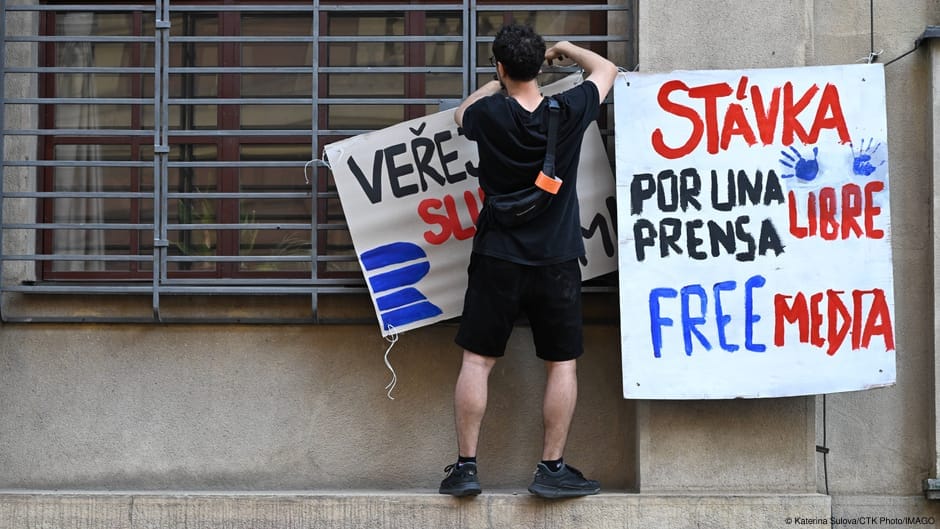
Prague is bracing for a significant public demonstration on Sunday, as hundreds of thousands of citizens are expected to gather in Letna Park to oppose the Czech government’s proposal to reform public media funding. The rally is organized by the civil society group Million Moments for Democracy and will take place two days before the anniversary of the Velvet Revolution, which ended communist rule in 1989.
The protest stems from the right-populist coalition government led by Prime Minister Andrej Babis, which recently fast-tracked a controversial bill through parliament. On the night of October 23 to October 24, the legislature approved the first reading of the legislation in a surprise session at 4:36 a.m., sparking immediate backlash and late-night pickets outside the parliament building. The bill, championed by Babis’s ANO party, the far-right SPD, and the radical conservative Motorists, aims to scrap the license fee model currently used to fund Czech Television (CT) and Czech Radio (CRo), replacing it with direct state budget allocations.
Government supporters argue that the current license fee is an unfair tax on citizens, particularly affecting less affluent voters, and that the new model would improve efficiency while aligning Czechia with similar changes in other European Union states. The proposal includes a 15% reduction in funding for public broadcasters in the first year. Critics, however, reject these justifications, accusing the administration of attempting to undermine editorial independence and subject critical reporting to political control. Analysts note that unlike other EU models, this bill lacks explicit guarantees for long-term financial stability and editorial autonomy.
The legislative push has triggered widespread civil unrest, including strikes by CT and CRo staff in early November, which have disrupted national broadcasting schedules. Demonstrations have also spread to other cities, led by students, trade unions, and cultural institutions. Political scientist Otto Eibl from Masaryk University noted that the government’s confrontational approach and its rhetoric toward journalists have fueled the public backlash. The upcoming rally is expected to be the largest of the series, following previous gatherings that drew over 200,000 participants earlier this year.


It’s wild how quickly this escalated from a parliamentary vote to nationwide protests. The government really underestimated the public.
15% cut in the first year sounds like a quiet way to starve the institution rather than genuinely reforming it.
My brother works at Czech Radio and he says the strikes are keeping everyone focused. Morale is surprisingly high despite the chaos.
The license fee used to seem reasonable until I saw my monthly bill. Now I see why people are angry.
Is it actually true that other EU countries did this successfully? I feel like I’m missing a lot of context.
If you just want state control of news, you should call it that instead of hiding behind ‘efficiency’ arguments.
I never realized how much the Velvet Revolution anniversary mattered here. It’s a powerful symbol to oppose this exact day.
Watching them pass this at 4 AM was shockingly undemocratic. Real politics usually involves actual debates, not midnight surprise votes.