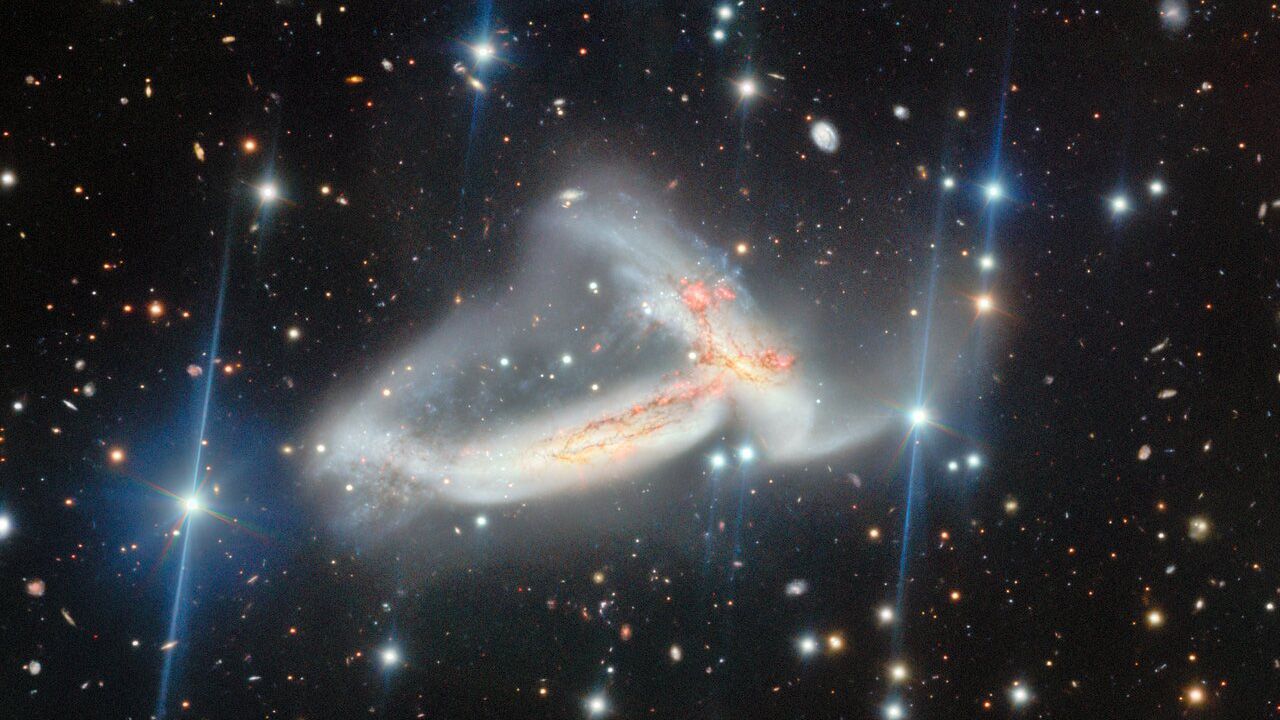
Astronomers using the Gemini North telescope on Mauna Kea in Hawaii have captured a striking image of NGC 7252, a pair of interacting spiral galaxies located 200 million light-years away in the constellation Pegasus. Also cataloged as Arp 278 in the Atlas of Peculiar Galaxies, this system defies the typical visual of a smooth cosmic coil, appearing instead like a twisted balloon animal formed by the mutual gravitational pull of the two galaxies.
The image, shared on September 1, 2026, reveals how the stars, gas, and dust of these ancient structures are being stretched and disrupted. While the encounter appears destructive, individual stars do not collide due to the vast distances between them. Instead, the gravitational forces compress the cold gas and dust clouds within the spiral arms, creating conditions favorable for the collapse of matter and the subsequent birth of new stars.
Visual evidence of this stellar nursery is visible in the image through scattered concentrations of bright pink light known as H II regions. These areas consist of hydrogen gas energized by the intense ultraviolet radiation emitted by hot, young stars. This gravitational interaction not only distorts the galaxies’ shapes but may eventually lead to their merger into a single entity.
The image has also received a culturally significant name from participants in the 2026 Project Hōkūlani internship program in Hawaii. The students named it Nā ‘Uhane Māhoe Huki Pū i ke Ola, which translates to “The Twin Spirits Pulling Together Creating Life.” The choice reflects the object’s position within the traditional Hawaiian constellation Ka Lupe o Kawelo, corresponding to Pegasus, as well as a symbolic connection to the twin telescopes of the Gemini Observatory located in Hawaii and Chile.


Wait, 200 million light-years away? How are we seeing this interaction in real-time?
I always forget stars don’t actually collide. The gas compression part is what really creates the new stars.
The Hawaiian name is beautifully poetic. It adds so much cultural depth to the scientific data.