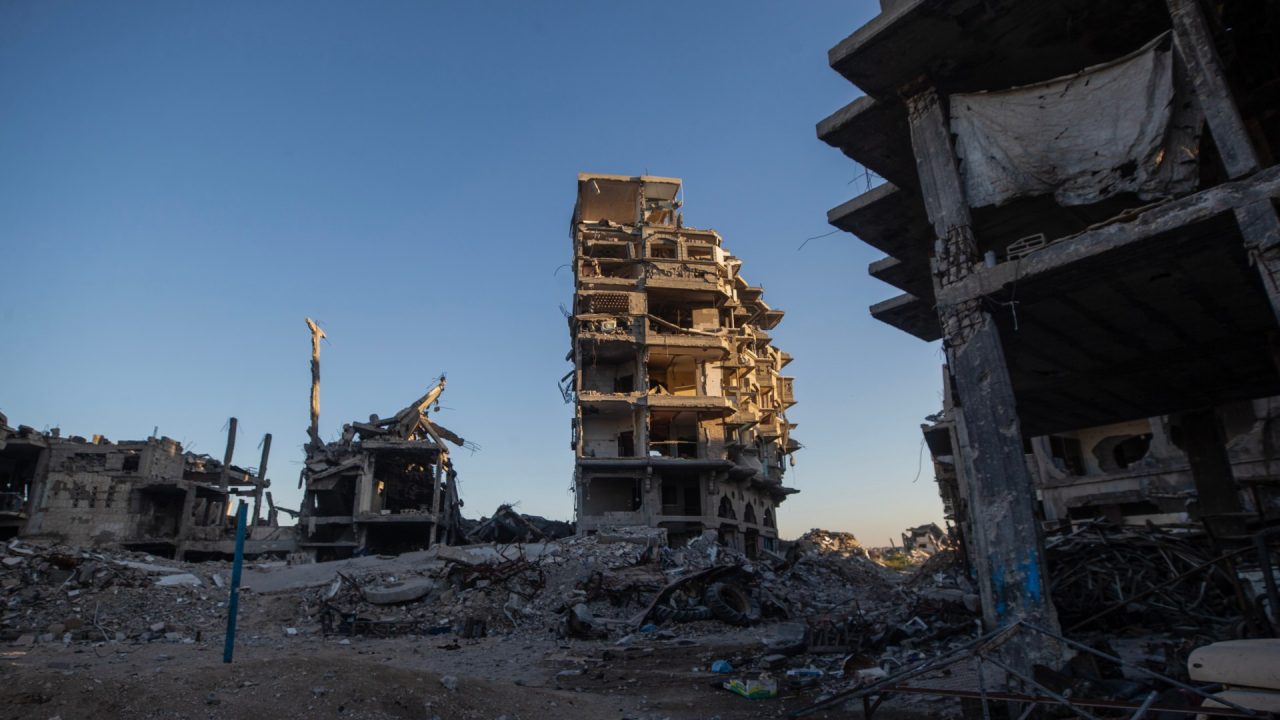
Hundreds of displaced Palestinians gathered on Saturday near the so-called “Yellow Line” in Deir el-Balah, Gaza, to protest against intensified Israeli air strikes that continue to target residential buildings beyond the areas designated for Israeli withdrawal under the October 2025 ceasefire agreement.
Al Jazeera correspondent Moath al-Kahlout reported from the scene that residents living in proximity to the demarcation line, which separates Israeli- and Hamas-controlled territories, took to the streets to demonstrate against the persistent violence. Mohammed Musleh, mayor of the Maghazi municipality, stated that more than 500 housing units had been destroyed in less than a month. He described the situation as part of a systematic policy of gradual creeping displacement, aimed at forcing residents out of their areas and destroying homes.
Gaza’s Ministry of Public Works and Housing reported that 350,000 families are currently homeless following attacks that have destroyed 80 percent of the enclave’s housing stock. The ministry also noted that recent flooding has further devastated temporary tent housing.
The original Yellow Line, established under US President Donald Trump’s 20-point plan to end the war, initially marked the territory to which Israeli forces withdrew. Although further gradual withdrawals were expected, Israeli forces instead seized additional territory. As of now, nearly two-thirds of Gaza is under Israeli army control or subject to access restrictions.
Israeli attacks on Saturday killed at least four Palestinians, including three individuals in Gaza City who died when an Israeli drone struck a van distributing food aid. Over the preceding 48 hours, strikes resulted in at least nine deaths and 55 injuries. These figures bring the total death toll since the October 2025 ceasefire to 1,661, with the total number of wounded standing at 6,062, according to Gaza’s Ministry of Health.
In a separate effort, Gaza’s Civil Defence announced the recovery of the bodies and remains of 129 people from 39 destroyed homes and other structures in the Nuseirat refugee camp, az-Zawayda, and Deir el-Balah. Rami al-Aidi, the Civil Defence director for central Gaza, said that 233 people are still missing beneath the rubble in these locations. This 53-day operation marked the end of the second phase of a recovery project in central Gaza funded by the International Committee of the Red Cross.
Civil Defence warned in October that approximately 8,000 bodies remain trapped under rubble across the enclave, with about 4,000 located in Israeli-controlled areas. The agency estimates that with current equipment, the recovery process could take between eight and ten years.


The Yellow Line becoming a blur is deeply concerning. How do you enforce a ceasefire with shifting boundaries?
Eight years to clear the rubble? That timeline is horrifying given the scale of destruction.