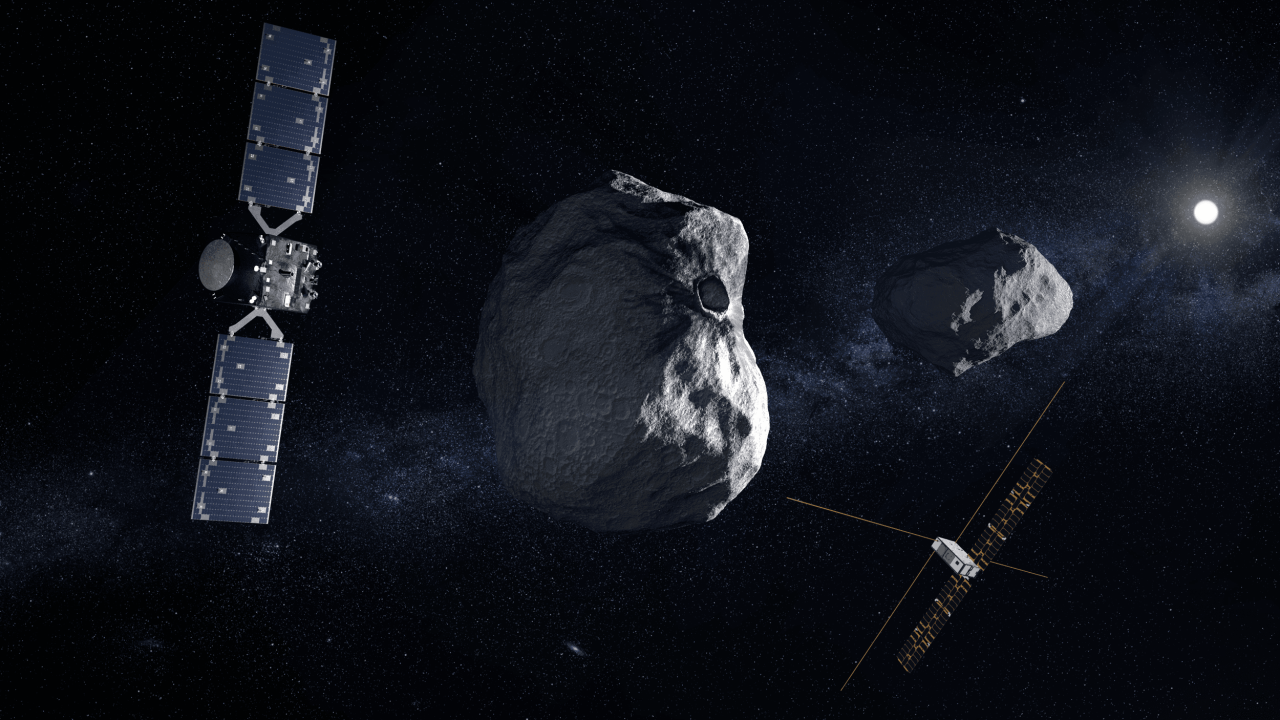
The European Space Agency’s Hera probe has entered the vicinity of the binary asteroid system Didymos and Dimorphos, where it will conduct a detailed investigation following NASA’s successful planetary defense test. The mission aims to assess the long-term effects of the Double Asteroid Redirection Test (DART), which deliberately crashed into the smaller body, Dimorphos, in 2022 to demonstrate kinetic impact deflection capabilities.
Before the arrival of Hera, the DART probe struck Dimorphos at a velocity exceeding 13,000 miles per hour. The impact altered the mini-moon’s orbital period by 33 minutes, a result significantly larger than predicted due to the recoil effect caused by ejected debris. This experiment highlighted the potential of kinetic deflection as a viable method for protecting Earth against hazardous near-Earth objects, such as the asteroid Apophis, which is predicted to pass closely by the planet in April 2029.
Hera began its arrival phase in October 2024 after a flyby of Mars and recently captured its first detailed images of the system from a distance of approximately 800 miles. The probe is now positioned to study the binary system in depth, marking the first time such a formation will be explored with this level of detail. Key objectives include understanding the formation mechanisms of binary asteroids and analyzing the specific impact site left by DART.
The spacecraft carries a suite of instruments, including lidar for topographic mapping and sensors for chemical analysis, capable of producing images with a resolution of one meter per pixel. Hera will also determine the precise mass of Dimorphos, a critical factor in evaluating the effectiveness of the DART mission. Additionally, the probe will deploy two CubeSats, named Juventas and Milani, in January 2027. Juventas will use radar to probe up to 100 meters beneath Dimorphos’s surface to study its geophysical properties, while Milani will search for volatile substances and dust on the asteroids’ surfaces.
As of 2026, scientific knowledge of near-Earth asteroids has expanded dramatically, with over 43,000 cataloged compared to just 300 in the year 2000. Data gathered by Hera is expected to remain relevant for decades, particularly as the approach of Apophis draws closer. The main phase of the Hera mission is scheduled to continue through the summer of 2027, providing essential insights for future planetary defense systems.



The radar data from Juventas sounds promising. Finally getting subsurface details of these binary systems.
Expensive probe for a minor asteroid. We should prioritize actual space exploration over hitting rocks.
Will Apophis be safe now? The article mentions it, but I am worried about the 2029 pass.
Crazy to think we actually changed an asteroid’s orbit. This is pure science fiction become reality.