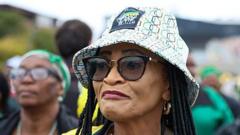
The African National Congress (ANC) is racing against time to secure power-sharing agreements with smaller political parties in South Africa’s major cities, aiming to maintain its urban influence after suffering its worst local election results since 1994. While the ANC remains the party with the highest overall vote share, its support has declined significantly, forcing the long-ruling party to reconsider its alliances in the face of a fragmented political landscape.
In this month’s local elections, the ANC secured a majority in only one of the country’s nine provinces, Limpopo, a sharp drop from the six provinces it held previously. Additionally, the party failed to win the most votes in six of the country’s eight major cities, compared to six victories in 2021. Although the ANC received 31% of the total votes, down from 46% five years ago, it remains the largest single party, followed by the Democratic Alliance (DA) which garnered 25% of the vote, up from 22%.
Despite its national decline, the ANC is actively avoiding a direct power-sharing deal with its long-time rival, the DA, at the municipal level. State broadcaster SABC reported that top ANC leaders view an alliance with the DA as a last resort. Instead, the party is courting smaller groups to form governing councils. In Gauteng, South Africa’s economic powerhouse, reports indicate a potential arrangement between the ANC and ActionSA, which emerged as the third-largest party in the province with 17% of the vote, making it a crucial kingmaker.
The DA has successfully consolidated its position in key urban centers. It won the most votes in Johannesburg, Pretoria, and the Ekurhuleni region, and it is the only party to secure an outright majority in a city, retaining control of Cape Town. The DA has also been engaging with smaller parties and the ANC to form local governments, though it appears likely to assume the opposition role in Gauteng if the ANC-ActionSA pact proceeds.
The left-leaning uMkhonto weSizwe (MK) Party, led by former President Jacob Zuma, finished third nationally with 10% of the vote, repeating its performance from the 2024 national election. MK emerged as the largest party in KwaZulu-Natal province, securing 34% of the vote, although it requires a coalition to govern.
Political analysts suggest that the ANC’s reluctance to partner with the DA locally mirrors the tensions within the national Government of National Unity (GNU), a coalition formed in 2024 after the ANC lost its parliamentary majority. While some insiders have called for the end of the national alliance, others warn that withdrawing from the GNU over local disputes would be counterproductive. Experts believe that a complex web of “asymmetrical coalitions” may emerge, with parties collaborating in some regions while opposing each other in others.
Voters have signaled a desire for improved basic services, citing corruption and service delivery failures as primary reasons for the ANC’s decline. However, the historical instability of coalition governments in South Africa raises concerns about the ability of these new arrangements to deliver on promises. Political experts estimate that it could take up to a decade to fully stabilize and restore functionality to South Africa’s municipalities, particularly in the country’s largest city, Johannesburg.
Zuma’s MK still strong in KwaZulu-Natal. Surprised more people did not switch to them.
Ten years to fix municipal services? That is a very long time to wait for basic water.
ActionSA is the kingmaker now. Wild how quickly the political landscape shifted in Gauteng.
Why avoid the DA? Feels like ego is preventing better services in Johannesburg. Frustrating honestly.
Finally! It is good to see the ANC admit they cannot rule alone anymore. Time to work together.