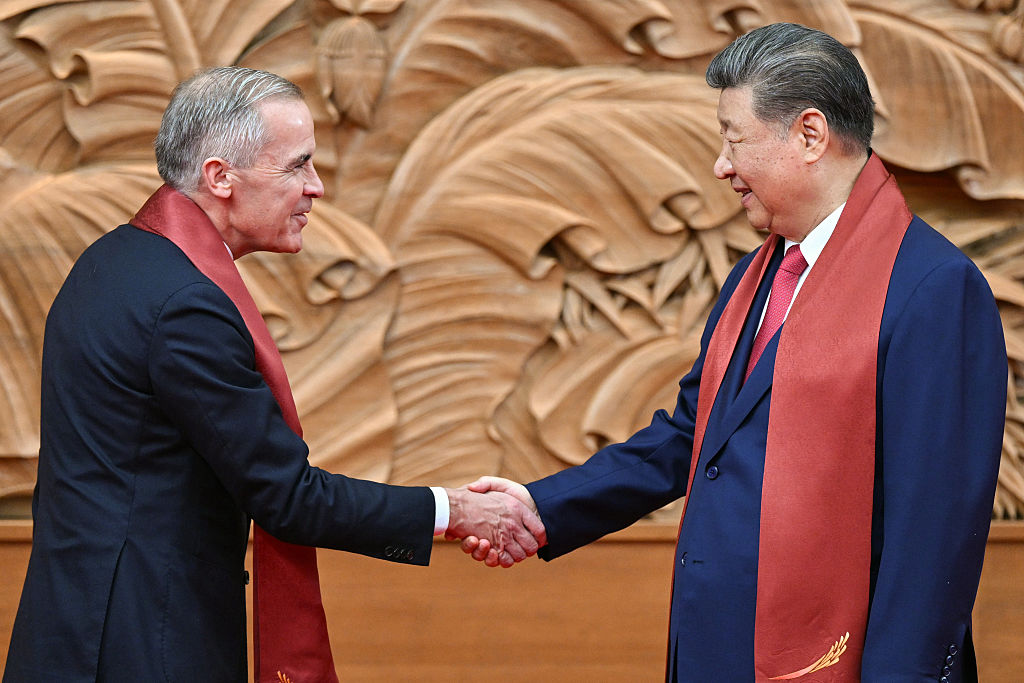
Canadian Prime Minister Mark Carney is actively seeking to deepen trade relationships with China and the European Union, a strategic shift intended to diversify Canada’s economy and limit its reliance on the United States. This move comes as Canada and the U.S. remain locked in a three-month trade war, with negotiations having broken down in August following mutual retaliatory tariffs.
Speaking from Shenzhen, China, where he attended the Asia-Pacific Economic Cooperation (APEC) summit, Carney addressed the stalled talks with Washington by highlighting Canada’s expanding global connections. “Our cards are that everyone else in the world wants to deal with us,” Carney stated in an interview with The New York Times. “If the U.S. doesn’t want to do the deal, we’re busy.”
The Canadian Prime Minister’s remarks followed President Donald Trump’s assertion that the U.S. holds “all the cards” in the dispute. Although Carney and Trump met on the sidelines of the APEC summit, the discussion resulted in no concrete progress, only a commitment to continue negotiations. In contrast, Carney described his interactions with Chinese President Xi Jinping more positively. The two leaders announced a trade pact that includes additional tariff relief for Canadian food and agricultural exports into China, while Canada agreed to extend tariff exemptions for certain Chinese steel and aluminum products by two years.
Experts note that this strategic pivot could challenge the Trump administration’s belief that Washington holds maximum leverage in trade discussions. Jennifer Hillman, co-director of the Institute of International Economic Law at Georgetown University, said, “Part of the Trump Administration’s [belief] is that everybody needs the U.S. more than anything else… What this is clearly saying is that Canada can afford to be less willing to give the U.S. whatever it asks for, because they have other options.”
China, possessing the world’s second-largest economy, represents a significant potential market for Canadian goods. Lori Turnbull, a professor at Dalhousie University, noted that a trade deal with China is a leverage point because of the economic scale and competitive relationship between Beijing and Washington. However, she warned that specific concessions, such as lowering tariffs on Chinese steel and aluminum, could provoke anger in Washington from both President Trump and U.S. Trade Representative Jamieson Greer.
Carney’s efforts to broaden Canada’s trading relationships were evident throughout his recent tour, which included stops in Ireland, the Philippines, and Cambodia. At the ASEAN summit in Manila, he announced the conclusion of negotiations on free trade agreements with the 11-country ASEAN bloc and the Philippines. The Prime Minister’s office stated that the deal with the Philippines could potentially triple exports by 2035. Additionally, in October, the European Union and Canada underscored a commitment to a plan for Canada to become an “associate member” of the bloc, facilitating deeper cooperation in areas such as artificial intelligence, energy, and critical minerals.
Despite the expansion of these ties, experts caution that the trade volume remains small compared to the U.S., which accounted for $683.3 billion Canadian dollars in total exports to Canada in 2025. Turnbull emphasized that diversification must include markets large enough to absorb a significant portion of Canadian supply.
The shift toward China has also drawn criticism from domestic figures. Ontario Premier Doug Ford warned Carney against importing more state-subsidized Chinese electric vehicles, arguing it would undermine Canadian auto workers. Michael Chong, a Conservative Party lawmaker, described the new strategic partnership with China as a “risky gambit” due to national security concerns. In 2025, the Canadian government identified China as a primary source of foreign interference and espionage, citing risks of intellectual property theft and the diversion of sensitive technologies for military use.
Carney has suggested that Canada may turn to Chinese or other Asian automakers if U.S. negotiations fail, noting that North America is behind China and Europe in the electric vehicle sector. He characterized this not as leverage, but as a natural “action, reaction” to protect Canadian assets. However, analysts point out significant geographical and logistical challenges, as the North American auto supply chain is highly integrated. White House trade adviser Peter Navarro criticized the move on social media, echoing Trump’s rhetoric that China would “eat Canada alive.”


Interesting move to pair with the EU while ignoring domestic critics. The APEC meeting was just another photo op, but the food deal is real.
Why are we extending tariff exemptions for Chinese steel now? This feels like a terrible trade-off just to appease Beijing. Disappointed in the leadership.
The U.S. market is still 60% larger than any other option. This pivot is symbolic but won’t replace American demand overnight. Keep perspective.
Great strategy for farmers, but what about the auto workers? Importing cheap Chinese vehicles sounds like a recipe for disaster for local jobs.
Carney is right. Relying entirely on Washington is dangerous. Diversifying into the EU and Asia makes total sense for long-term stability.