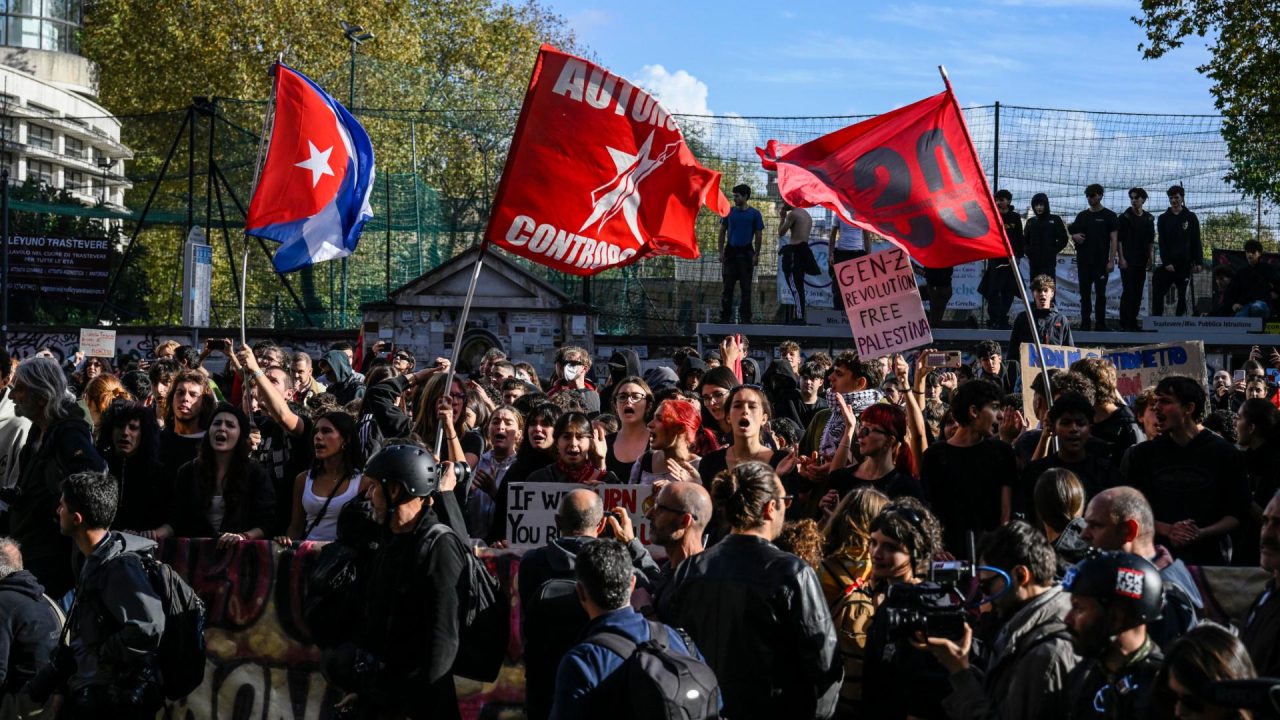
A wave of public discontent swept across Europe on Friday, with protests held in 25 nations concerning high living costs, military expenditure, and the climate crisis. The demonstrations, which ramped up pressure on political leaders accused of neglecting youth concerns, were inspired by the recent unrest in France. Thousands took to the streets in countries including the United Kingdom, Austria, Germany, Spain, Italy, Sweden, and Croatia.
In Italy, tens of thousands of workers and students rallied in more than 100 cities to demand higher wages and increased investment in public services. These rallies coincided with a general strike organized by the CGIL trade union, involving both private and public sector workers. CGIL leader Maurizio Landini stated at a rally in Rome that the demand for change among ordinary people across Europe is growing. The day was marked by several incidents, including demonstrators throwing objects at the Ministry of Education in Rome, clashes with police in Bologna, and the burning of cardboard figures depicting Israeli Prime Minister Benjamin Netanyahu and U.S. President Donald Trump in Milan.
These Italian protests follow a violent mobilisation on October 17, which led Prime Minister Giorgia Meloni’s government to approve sweeping security measures and deploy the army alongside police. Opposition figures joined the Friday demonstrations to criticize the government’s budget policies. Elly Schlein, leader of the centre-left Democratic Party, argued that the 2027 Budget Law lacks a vision for the country’s future, noting that it fails to support industries while cutting funding for healthcare and education.
In Germany, the campaign group “Gen Z regelt” organized protests in 73 cities and towns. Approximately 4,000 people gathered in Berlin’s Alexanderplatz, while thousands attended demonstrations in Cologne, where protesters called for better education funding and opposed the return of compulsory military service. In Austria, several hundred youth-led protesters gathered outside the University of Vienna to demand more education spending and less on weapons; police dispersed the event after reported disturbances and made several arrests using pepper spray. Meanwhile, in Croatia, students boycotted classes in about a dozen cities to advocate for investment in education, housing, and public services over military spending.
The European demonstrations mirror larger protests in France that began in September and evolved into violent confrontations and looting. France’s Interior Ministry reported that 146,000 people participated in nationwide protests last Tuesday, with the CGT trade union estimating the total at over 500,000. According to Eurostat, prices for everyday items such as food, energy, and transport have risen by 59 to 78 percent since 2000 in France, Italy, Spain, and Portugal. OECD data indicates that after adjusting for inflation, the average full-time wage in Italy fell by nearly 5 percent between 2000 and 2025, while real wages increased by 7 percent in Spain, 11 percent in France, and 20 percent in Portugal during the same period.

Cutting healthcare to buy weapons is just bad math. These crowds are right to question that specific budget choice.
Watching the French protests spiral into looting makes me nervous. Can Europe protest without turning into chaos every single time?
Meloni’s security crackdown seems counterproductive. You cannot arrest your way out of a genuine cost-of-living crisis.
My daughter joined the student boycott in Zagreb. It is rare to see such unified youth energy across so many borders.
Surprised to see Germany so active. Did everyone just decide to start compulsory military service again? That feels like a bad move.
I support the wage demands, but throwing things at government buildings undermines the legitimate points they are making.
The 59 percent price hike stat is terrifying. It explains why people are finally losing patience with politicians.