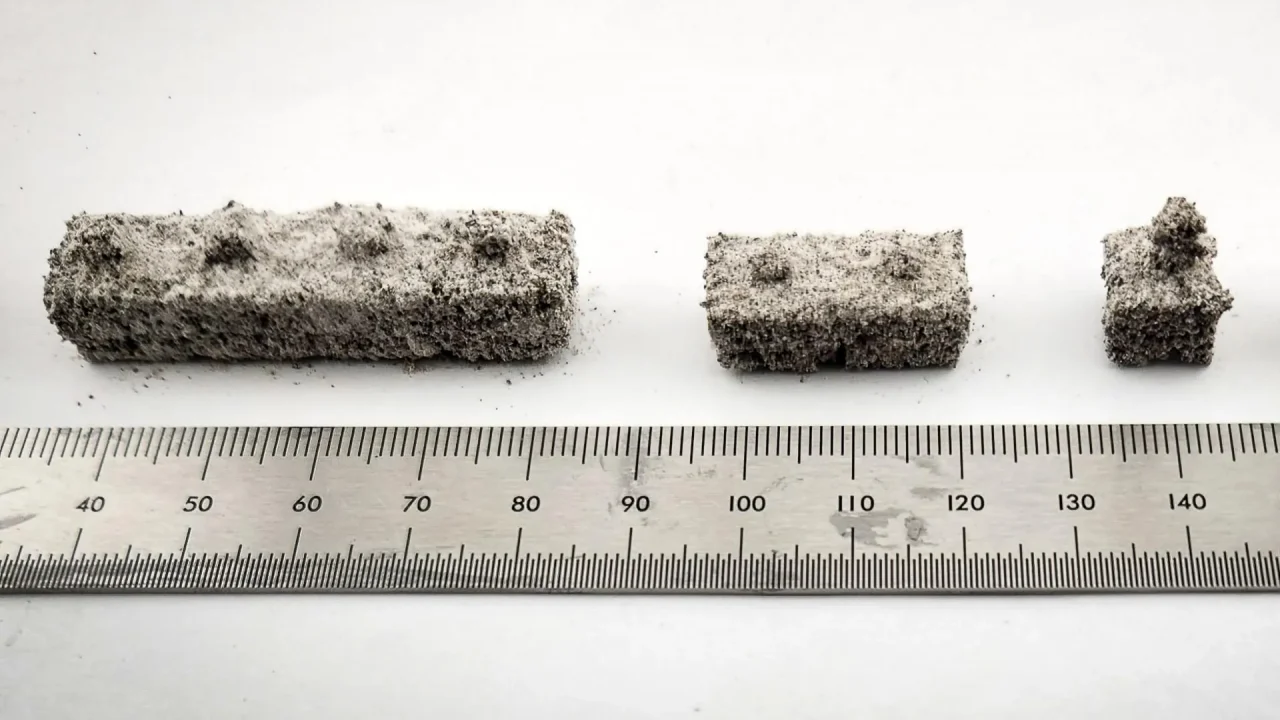
Researchers at the University of Arkansas have developed a method to 3D print simulated lunar dust into interlocking, LEGO-style construction bricks. The breakthrough, published in NPJ Advanced Manufacturing, suggests a viable pathway for producing building materials directly on the Moon, which could significantly reduce the logistics burden associated with transporting supplies from Earth for future permanent bases.
The study, led by undergraduate student Cole McCallum and senior author Wan Shou, an assistant professor of mechanical engineering, utilized a 3D printing technique known as laser powder bed fusion. This process involves spreading a thin layer of powder on a flat surface and using a concentrated light source to heat and fuse the particles together through sintering. By repeating this layering process, the team created solid three-dimensional objects from Lunar Highlands Regolith Simulant (LHS-1), a commercial substitute designed to mimic samples collected during NASA’s Apollo missions in the 1960s and early 1970s.
Unlike lunar regolith, which consists of sharp, irregular fragments with no organic material, previous attempts to print with lunar dust often required additional binders to hold the particles together. While these binders improved structural strength, they introduced significant logistical challenges, as they would need to be transported from Earth. The University of Arkansas team demonstrated that by using a relatively low-power light source, the lunar dust particles can fuse directly to one another without any added binding agent. McCallum noted, ‘There’s nothing else it’s binding to. The regolith powder is binding to itself.’
The team produced small bricks, several centimeters in size, including shapes like crosses and the letter H. These interlocking designs allow the blocks to fit together similarly to commercial plastic building toys, potentially enabling the assembly of larger structures. However, the researchers acknowledged that the experimental bricks currently contain more internal pores and have lower structural strength compared to binders-included models. McCallum stated that while the structures are self-supported, they are not yet suitable for bearing external loads.
Before this technology can be applied to actual lunar construction, scientists must determine how the printing process functions under the Moon’s low-gravity and vacuum conditions. The strength and durability of the finished bricks also require further improvement. Despite these hurdles, Shou believes the technique could provide an efficient method for manufacturing construction components for sustained human settlements on the Moon.
McCallum, who originated from Little Rock, Arkansas, joined Shou’s laboratory during his undergraduate studies. He recently graduated with dual degrees in mechanical engineering and physics and was selected for the inaugural class of Lafayette Fellows, a competitive program supporting students pursuing master’s degrees in France to commemorate the 250th anniversary of the United States. He is currently studying aerospace engineering at the Institut Supérieur de l’Aéronautique et de l’Espace in Toulouse, France. McCallum credited the research experience with helping him develop essential scientific skills and learn from early mistakes, providing a strong foundation for his future career.



Laser powder bed fusion is standard, but applying it to regolith without binder is a genuine material science breakthrough worth noting.
University of Arkansas did this? Glad to see them contributing to space tech. McCallum from Little Rock is a great example.
Binder-free is impressive, but the low power source seems risky. Can the heat really fuse those sharp irregular particles tightly enough?
Using simulant from Apollo era rocks is a nice touch. It connects our current efforts to that historic exploration era perfectly.
What happens if we accidentally crush the bricks? The article says they are porous, so structural strength remains a huge issue.
Sounds great until you realize vacuum and low gravity change everything. Testing on Earth is just the very first step.
LEGO bricks for the Moon? That is absolutely hilarious and genius. Finally, construction that makes sense for low gravity.