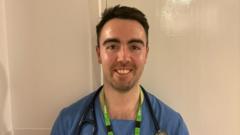
Resident doctors in Northern Ireland have warned that medical staff are increasingly leaving the region for higher wages and better working conditions in other jurisdictions, following the rejection of a proposed 3.5% pay rise.
Dr Oisín Fearon, a Belfast-based resident doctor supporting a 24-hour strike, stated that colleagues have emigrated to Australia, the United States, and New Zealand. He noted that while family ties currently keep him in the UK, he has begun the registration process for training in the Republic of Ireland as a contingency.
The strike, organised by the British Medical Association (BMA) Northern Ireland, began at 07:00 GMT on Friday. It targets the rejection of the pay offer, with the BMA arguing that doctors’ salaries have fallen significantly in real terms due to years of pay rises that lagged behind inflation since 2008. Dr Steven Montgomery, chair of the BMA’s Northern Ireland Resident Doctors Committee, cited burnout, emotional distress, and 500,000 people on waiting lists as key drivers for the industrial action.
Health Minister Robbie Butler acknowledged the financial constraints facing the department, citing the absence of a Stormont budget. While stating he would implement the recommended 3.5% award to the best of his ability, Butler argued that offering more would have severe repercussions for other public sector workers, including nurses and teachers, who have received cumulative pay uplifts of 24% to 30% over the last three years.
Dr Alan Stout, chair of the BMA’s Northern Ireland Council, dismissed the minister’s position as a “pass the parcel of blame.” He calculated that while inflation since 2008 has risen by 65% to 73%, real-term doctor pay has only increased by 40% to 45%, leaving the profession “miles behind.” Stout emphasised that the BMA is seeking a long-term plan for pay restoration rather than a single lump sum.
The current strike has resulted in the cancellation of non-emergency appointments and elective surgeries, though emergency services remain fully operational. Further industrial action is scheduled for Monday, when consultants, specialist, and speciality grade doctors will also strike, effectively providing Christmas Day cover. This follows earlier strikes in June 2026 that cancelled over 2,200 appointments.

Remember the NHS waiting lists from the nineties? This is a repeat of that crisis, just with fewer doctors.
Passing the blame is easy. Real solutions require actual funding. We are all suffering from this standoff.
My cousin moved to Australia last year. The pay difference here is honestly embarrassing for our health service.
They strike just before Christmas? Feels a bit cynical, but the government really has no budget to offer.
As a nurse, I see their frustration daily. We all need a proper budget to keep working sustainably.
I don’t think 3.5 percent is the real issue. It feels more like a political statement than a wage dispute.
Every year the numbers leaving for the Republic increase. It’s a talent drain we cannot afford to ignore.
The waiting list situation is genuinely scary. You can’t blame doctors for wanting fair pay in this economy.