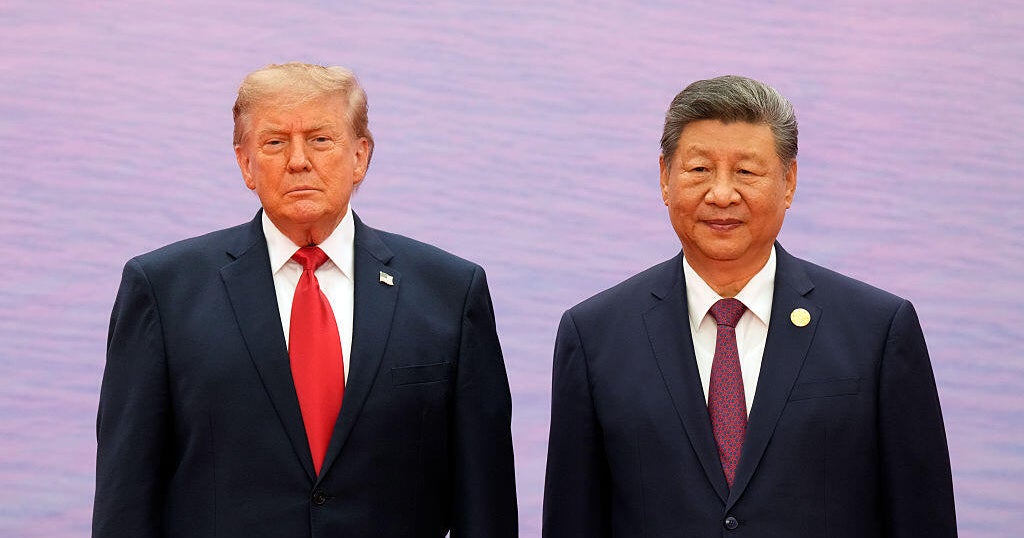
President Donald Trump is holding a high-level bilateral meeting with Chinese President Xi Jinping in Shenzhen, China, on Thursday. The talks are taking place on the sidelines of the Asia-Pacific Economic Cooperation (APEC) summit and occur against the backdrop of growing tensions over advanced artificial intelligence (AI) chips and export controls.
This is the third face-to-face encounter between the two leaders this year, following a September summit at the White House. The Trump-Xi meeting will be immediately followed by a trilateral session with Russian President Vladimir Putin, marking the first time these three leaders have convened in such a format.
Key discussions are expected to center on a widening scandal involving the diversion of U.S. semiconductor chips to China. The Justice Department is investigating Singapore-based Megaspeed for allegedly routing chips to China. The probe involves former Megaspeed executive Alice Huang and her alleged relationship with former Nvidia CEO Jensen Huang. President Trump questioned the assessment that Huang is a Chinese spy, stating, “I don’t know that she is a spy… I really don’t.”
Experts note that the issue extends beyond individual allegations to a broader strategic concern about the effectiveness of U.S. export controls. Chris McGuire of the Council on Foreign Relations described the situation as a long-term scandal regarding how porous export controls have been. To address this, the administration recently issued interim trade rules restricting Chinese AI companies from remotely accessing advanced U.S. chips in data centers abroad. This move followed internal disagreements within the Cabinet, with Treasury Secretary Scott Bessent accusing Commerce Secretary Howard Lutnick of slowing down restrictions on Megaspeed.
“One view is you don’t want to insult China… and the other view is just go, you know, down and dirty and do what you have to do,” Trump said, acknowledging the differing approaches within his team regarding engagement with Beijing. Analysts suggest the new digital access restrictions could significantly impact China’s ability to train advanced AI models, which are largely dependent on U.S. hardware.
Taiwan security is also expected to be on the agenda. A $14 billion arms package for Taiwan remains pending, a move that was previously paused due to concerns over munitions supply for the conflict in Iran. David Sacks of the Council on Foreign Relations expects Xi to raise concerns about cross-strait dynamics and pressure the U.S. on the arms sale.
Looking ahead to the trilateral meeting with Putin, President Trump indicated that topics will include denuclearization, Iran, and Ukraine. Trump referenced recent U.S. intelligence reports suggesting Iran may be planning a so-called dirty bomb attack on its capital, warning that Tehran would face severe consequences. While the White House initially said Ukraine would not be discussed due to the absence of Ukrainian representatives, the President confirmed on Monday that it will be part of the conversation with his counterparts.



Dirty bomb threats are scary. Hopefully the consequences Trump mentioned are actually enforceable.
First trilateral meeting with Putin, Xi, and Trump. History books are going to get very busy.
Taiwan arms package paused for Iran? That logic makes zero sense to me. Why are we linking those issues?
The internal fight between Bessent and Lutnick sounds chaotic. Can the administration even agree on a strategy?
Blocking remote access to chips abroad is a smart move. They can’t just buy the hardware anymore.
Interesting that Ukraine is back on the agenda despite no Ukrainian representatives present. A bit odd but expected.
Trump’s comments about the spy situation feel incredibly reckless. Do we actually trust him to handle this delicate intelligence issue?
The Megaspeed scandal is a nightmare. How on earth did we let chips slip through the cracks so easily?
Wait, three leaders in Shenzhen? The geopolitical chessboard just got infinitely more complicated and unpredictable.