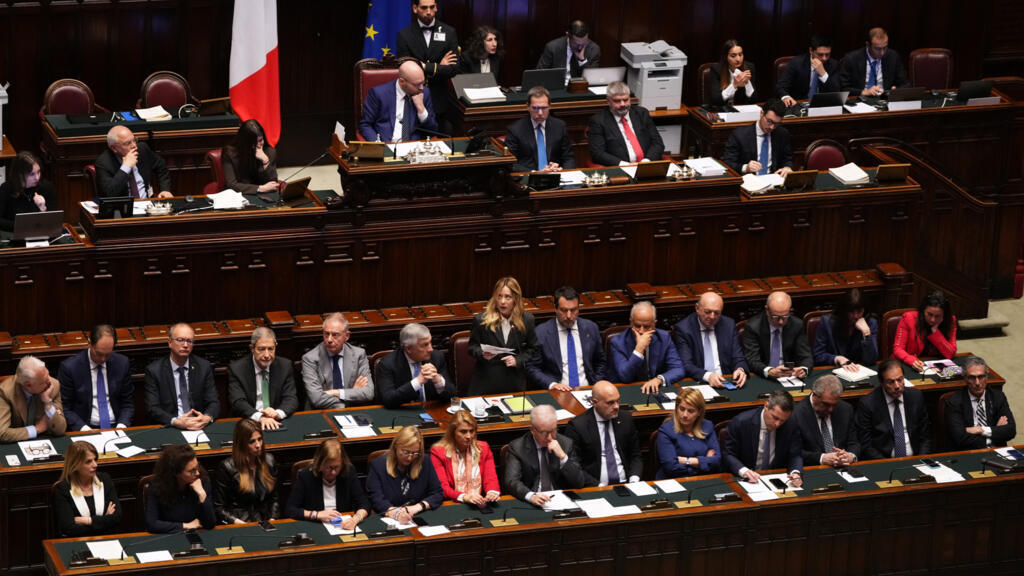
The Italian parliament has finalized a legislative package designed to combat anti-Semitism, a move that has drawn sharp criticism from opponents who argue the new legal framework could impinge upon freedom of speech and rights-based advocacy. The legislation, which the lower chamber passed with 147 votes in favor and 93 against, formally adopts the definition of anti-Semitism established by the International Holocaust Remembrance Alliance (IHRA). This definition includes certain instances of criticism directed at Israel as examples of anti-Semitic behavior.
While the center-right coalition led by Prime Minister Giorgia Meloni maintains that the law is a necessary tool to address rising discrimination and violence, detractors within the political landscape view it as an attempt to silence dissent. Angelo Bonelli, co-leader of the Green-Left Alliance, characterized the measure as an effort by the ruling majority to suppress legitimate criticism of the government’s policies.
The debate is unfolding against the backdrop of intensified pro-Palestinian activism in Italy since the Gaza conflict escalated following the attacks on October 7, 2023. Data from the Antisemitism Observatory, a research arm of Milan’s Jewish Contemporary Documentation Centre (CDEC), highlights the urgency cited by the government, recording 963 incidents in 2025—a figure nearly four times higher than the annual total from 2022. Gadi Luzzatto Voghera, the CDEC director, noted that the year included 18 physical attacks, such as individuals being shoved or slapped.
Livia Ottolenghi, president of the Union of Italian Jewish Communities (UCEI), praised the bill, describing it as a means to fortify the “democratic antibodies” of Italian society. She emphasized that the struggle against anti-Semitism is a collective societal responsibility rather than a partisan one. Although the bill lacks provisions for financial penalties or criminal sanctions, opposition parties had unsuccessfully urged amendments to the definitions. The ruling coalition insists that political discourse and criticism of state policies remain fully protected, dismissing concerns that the law would chill open debate.

Do the new rules actually apply to regular political commentary, or just extreme hate speech? I need clarity.
Defining criticism of Israel as hate speech is a worrying precedent for democratic debate in modern Europe.
That 963 percent increase is terrifying. We need stronger protections for our Jewish communities and civil society.