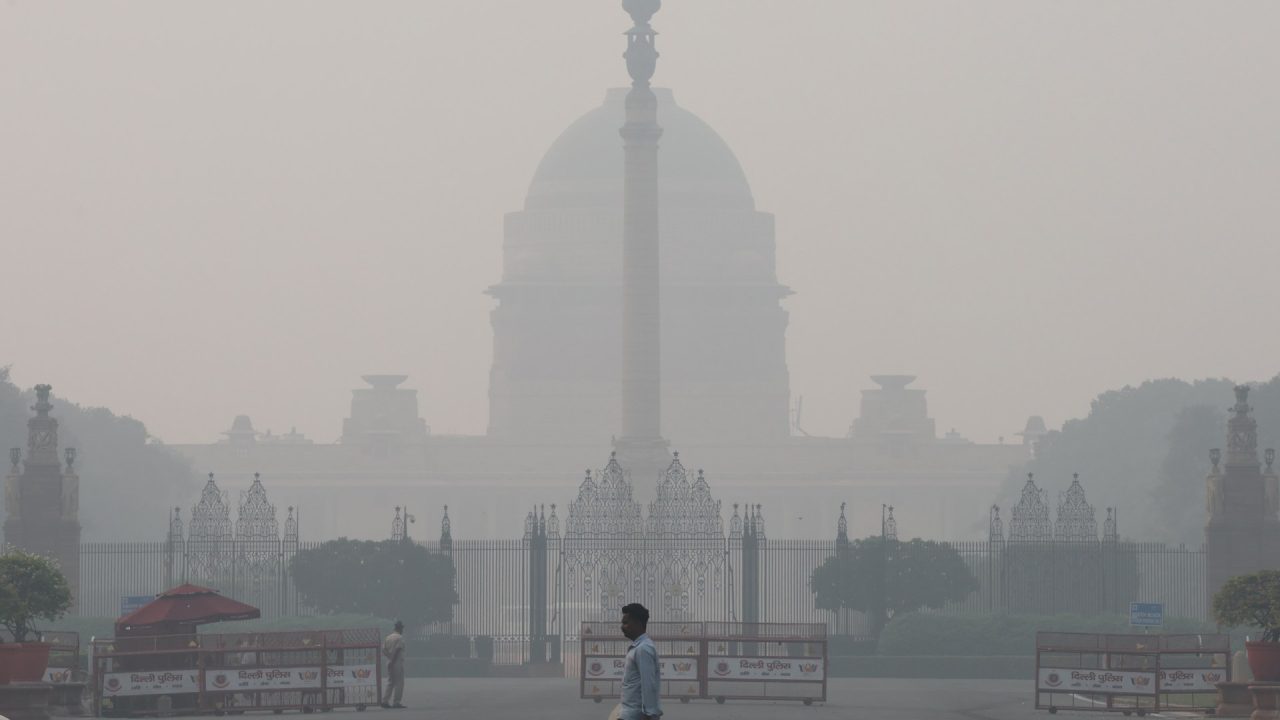
As winter sets in across the Northern Hemisphere, South Asia is once again grappling with severe smog, a phenomenon particularly devastating for cities like New Delhi and Dhaka. According to the air quality monitoring platform IQAir, the Air Quality Index (AQI) in parts of India’s capital recently exceeded 350, a level classified as “hazardous.” This sharp increase is driven by a combination of meteorological conditions and geographic factors that prevent the dispersion of pollutants.
During the winter months, a layer of warm air often forms over cooler ground-level air, creating an inversion layer. When combined with low wind speeds, this traps emissions from vehicles, industrial activities, and crop burning close to the surface. The situation is exacerbated by the geography of the Indo-Gangetic Plain, which spans parts of Pakistan, northern India, Nepal, and Bangladesh. Hemmed in by the Himalayas to the north and characterized by weak winter winds, the region’s pollution has few pathways for escape.
IQAir reported that all 50 of the world’s most polluted cities in 2025 were located in Asia, with 42 found in India and Pakistan. Loni, situated on the outskirts of Delhi in Uttar Pradesh state, recorded the highest average PM2.5 levels at 112.5 micrograms per cubic metre, more than 22 times the World Health Organization’s recommended limit. In Delhi, vehicles contribute approximately 23 percent of winter pollution, while biomass burning, including agricultural residue fires, accounts for another 20 percent.
The health implications of such air quality are significant. The World Health Organization links air pollution to roughly seven million premature deaths globally each year. Fine particulate matter (PM2.5), which can penetrate deep into the lungs and enter the bloodstream, is strongly associated with stroke, heart disease, chronic obstructive pulmonary disease (COPD), and lung cancer. Vulnerable groups, including children, the elderly, and pregnant women, face heightened risks, with exposure during pregnancy linked to adverse outcomes such as low birth weight.
To mitigate these effects, health experts recommend wearing well-fitting N95 masks outdoors, as standard cloth masks offer limited protection against fine particles. Keeping windows closed on high-pollution days and using air purifiers with HEPA filters are also advised. Additionally, limiting strenuous outdoor activity and checking local AQI reports via weather applications can help individuals make informed decisions about their daily routines.
Governments worldwide are implementing various strategies to reduce pollution levels. Paris introduced car-free days in 2015, which led to a 40 percent drop in nitrogen dioxide levels in some areas, and London’s Ultra Low Emission Zone saw a nearly 20 percent reduction in nitrogen dioxide concentrations within three months of its 2019 launch. In Krakow, Poland, the replacement of over 25,000 coal and wood-burning heating devices contributed to a 40 percent decrease in annual PM2.5 levels between 2010 and 2021.



Interesting comparison to Paris. I wonder if car-free days would even work with our current road infrastructure and population density.
Staying inside all winter is not sustainable. My mental health is taking a real hit from the isolation and grey skies.
Did anyone read about Krakow? Replacing coal heaters made a huge difference. We need similar concrete policy changes here.
It is heartbreaking to see children struggle to breathe. This is a public health emergency that we keep ignoring.
Skeptical about the N95 advice. They are expensive and uncomfortable. We need serious government intervention instead of just masks.
Is it just the city? My rural village outside Delhi has seen the same terrible smoke levels recently.
The inversion layer is the real villain here. Even if we ban vehicles, the trapped air makes it hopeless.
I bought my third air purifier this week. It feels like I am living in a giant dust cloud every morning.