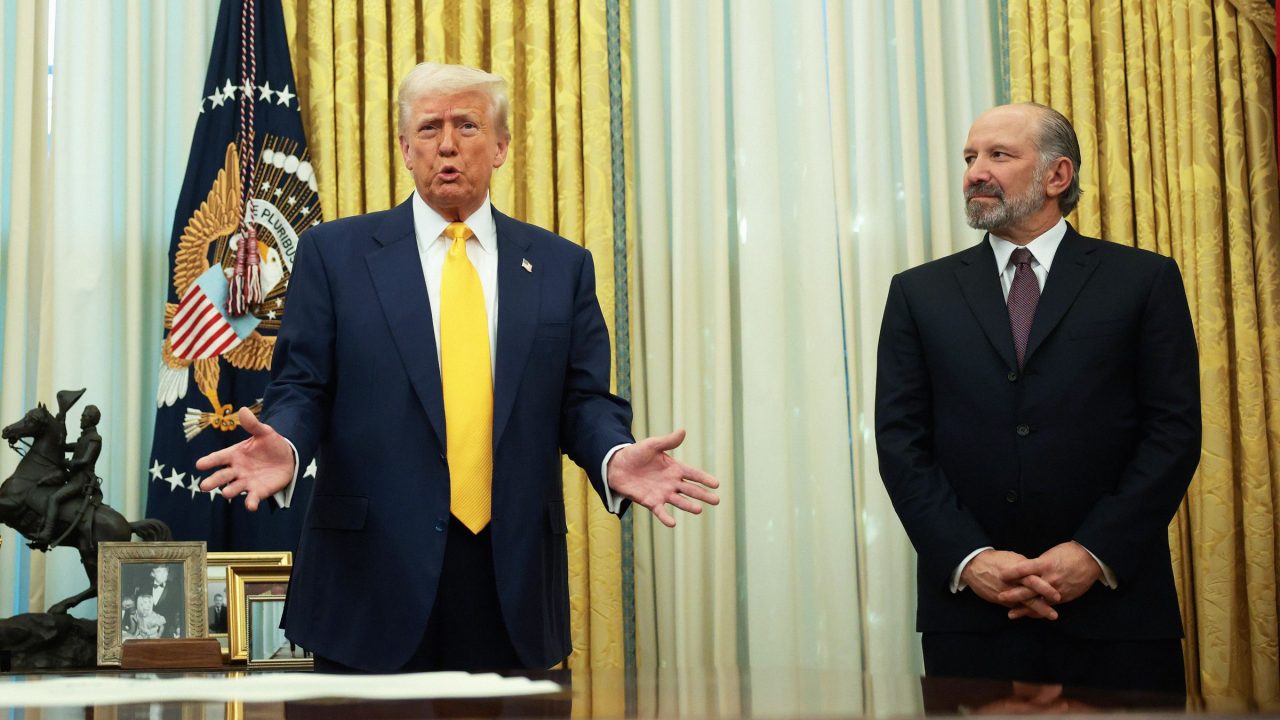
President Donald Trump is publicly defending Commerce Secretary Howard Lutnick following intense internal criticism regarding the handling of advanced AI chip sales to China. The political dispute stems from the controversy surrounding former Nvidia CEO Jensen Huang, who was involved in a personal relationship with a suspected Chinese intelligence asset. While Treasury Secretary Scott Bessent has urged Lutnick to impose stricter export restrictions, the White House is taking a more measured approach to avoid disrupting the current diplomatic climate.
During a closed-door Oval Office meeting on November 5, President Trump and senior officials discussed the fallout from Huang’s situation. Alice Huang, the individual at the center of the scandal, was formerly an executive at Megaspeed, a company that acquired Nvidia-manufactured advanced AI chips through complex corporate layers. Reports indicate these supply chains originated from Inspur, a Chinese server manufacturer that is on the blacklisted entity list.
In the meeting, Secretary Bessent questioned why Megaspeed had not been added to the US entity list sooner, a move already supported by Secretary of State Marco Rubio and Trade Representative Jamieson Greer. Lutnick responded that he was awaiting the President’s specific instructions. Trump ultimately chose a third path, directing Lutnick to develop an interim trade rule targeting the remote leasing of compute power. This measure aims to prevent Chinese AI labs from accessing advanced chips by renting server capacity from data centers located in Southeast Asia.
A White House spokesperson stated that the new regulation is designed to “crack down on the smuggling of advanced US SI chips” and ensure that top-tier technology remains with American innovators. A senior official clarified that while China is barred from acquiring the most advanced Blackwell and Rubin chips, the H200 chips purchased by Megaspeed are based on the older Hopper architecture and fall under different regulatory considerations.
Lutnick’s cautious stance is attributed to the risk of triggering a broader trade conflict. After the administration began using the “affiliates rule” in September 2025 to automatically extend bans to subsidiaries of listed companies, China retaliated by suspending exports of critical rare earth metals. Following a trade truce agreed upon at the Busan summit in late October 2025, the White House halted the use of the affiliates rule, requiring that new export controls be cleared in advance.
Despite the regulatory shift, Aivres, a California-based subsidiary of Inspur, had already transferred billions of dollars’ worth of restricted H200 chips to Megaspeed’s subsidiaries. Rather than shipping the hardware into China, Megaspeed installed these servers in data centers in Malaysia and Indonesia, where they are used to provide remote computing power to major Chinese firms. Aivres maintains that it is in full compliance with US export controls.
Who is Alice Huang? The personal angle makes this scandal sound like a bad corporate espionage movie plot.
H200 chips are older architecture, so the panic is overblown. The administration is just trying to save face.
The rare earth retaliation was smart by China. We need a measured response to keep the trade truce alive.
It is amusing how they blame one CEO for a complex corporate supply chain issue. Too easy a target.
Did anyone verify if the Malaysian data centers actually restrict access? Southeast Asian compliance is notoriously difficult to enforce.
Lutnick looks weak here. Awaiting specific instructions while billions in chips vanish is unacceptable for a Commerce Secretary.
I am surprised they are not just banning it outright. The diplomatic truce seems fragile and easily broken.
The remote leasing loophole is a huge security risk. You cannot secure AI dominance by ignoring cloud infrastructure.