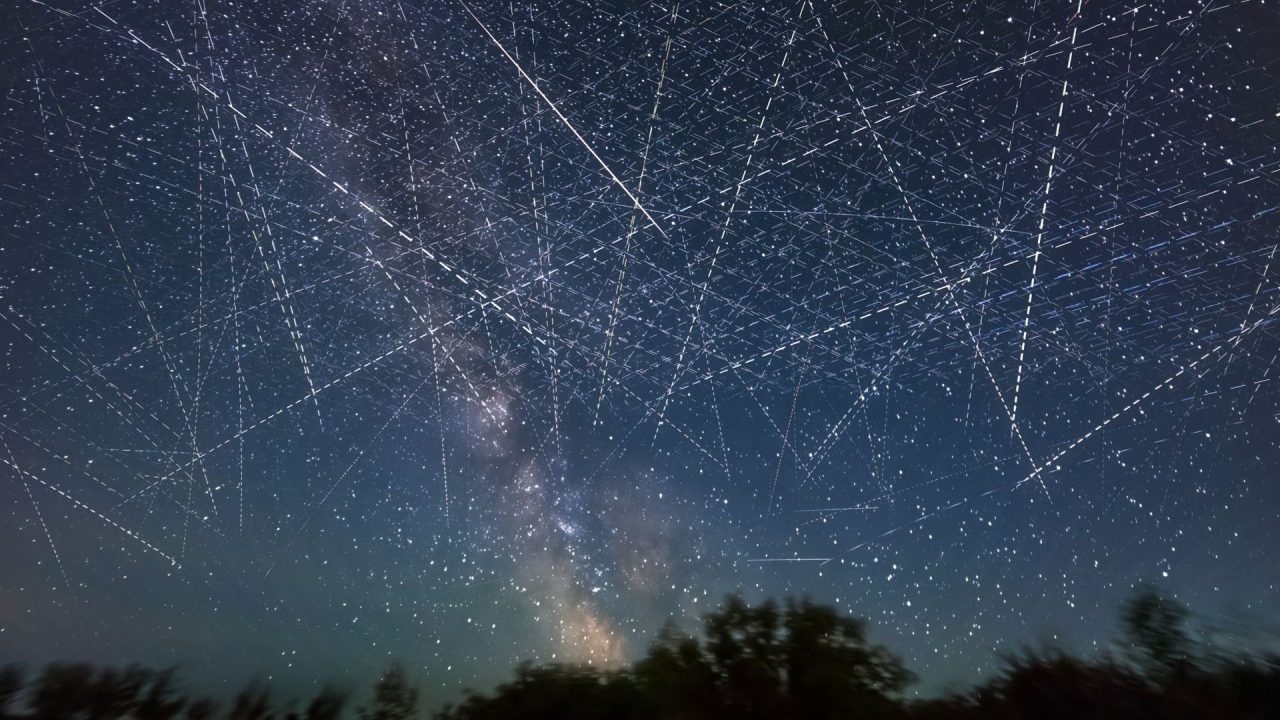
More than 700 satellites are currently crossing the sky above an average mid-latitude town at any given moment during the night, a figure that often surpasses the number of stars visible to the naked eye. This finding stems from an analysis of the trajectories of 15,833 active satellites orbiting Earth at altitudes below 1,200 miles (2,000 kilometers) in low Earth orbit.
Researchers examined data from October 12 and 18 of this year and determined that 710 satellites were passing over an average town in the United Kingdom at every single moment of the night, assuming an unobstructed horizon. The study, conducted by engineering firm Accu Components and published as a non-peer-reviewed paper, utilized satellite monitoring data from the U.S. Space Force via the CelesTrak website. While the analysis focused on the U.K., officials noted that similar heavy satellite traffic affects most of Europe, the U.S., and other mid-latitude regions, particularly between 40 and 50 degrees north or south latitude.
“Most Starlink satellites orbit at around 53 degrees to the equator, so the satellites bunch up over the mid-latitudes,” an Accu Components spokesperson explained. “These worldwide figures are approximate, based on a global grid over a single day. Skies near the equator are the quietest, with around 490 satellites.”
Not all of these satellites are visible to the unaided eye. Unlike stars, satellites do not generate their own light; they must be illuminated by the sun while the ground below is in darkness to be seen. The study indicates that on average, 105 of the 710 satellites were catching sunlight as they passed overhead, appearing as bright as stars. However, visibility varies significantly throughout the night. Approximately 300 satellites are illuminated in the hour after dark, dropping to fewer than 20 around midnight before rising again before dawn.
In comparison, only a few dozen stars are visible to the naked eye in the dead of night above large, light-polluted megacities such as London or New York, according to OwnStarMap. In suburban areas and smaller towns, the count increases to a few hundred, while thousands of stars are only visible in remote countryside or isolated mountain ranges.
The number of satellites orbiting Earth has increased sharply over the past decade, driven largely by Elon Musk’s SpaceX and its Starlink internet constellation. Satellite companies plan to launch hundreds of thousands, potentially millions, of satellites in the coming decades. If these plans are realized, the density of passing satellites will vastly outnumber stars globally. This trend raises concerns among astronomers, who fear that satellite trails will degrade the ability of ground-based telescopes to study the universe by leaving streaks in images and increasing overall sky brightness.
The study further found that throughout a single night, an average U.K. town sees 12,891 different satellites passing overhead.



SpaceX needs to start thinking about light pollution. We are losing our connection to the cosmos.
Is this really true? I live in a dark area but never see that many lights moving.
I noticed these streaks more often now. It feels like the universe is becoming very cluttered.
Wild to think moving objects outnumber static stars. Makes you wonder what the night sky actually looks like tonight.