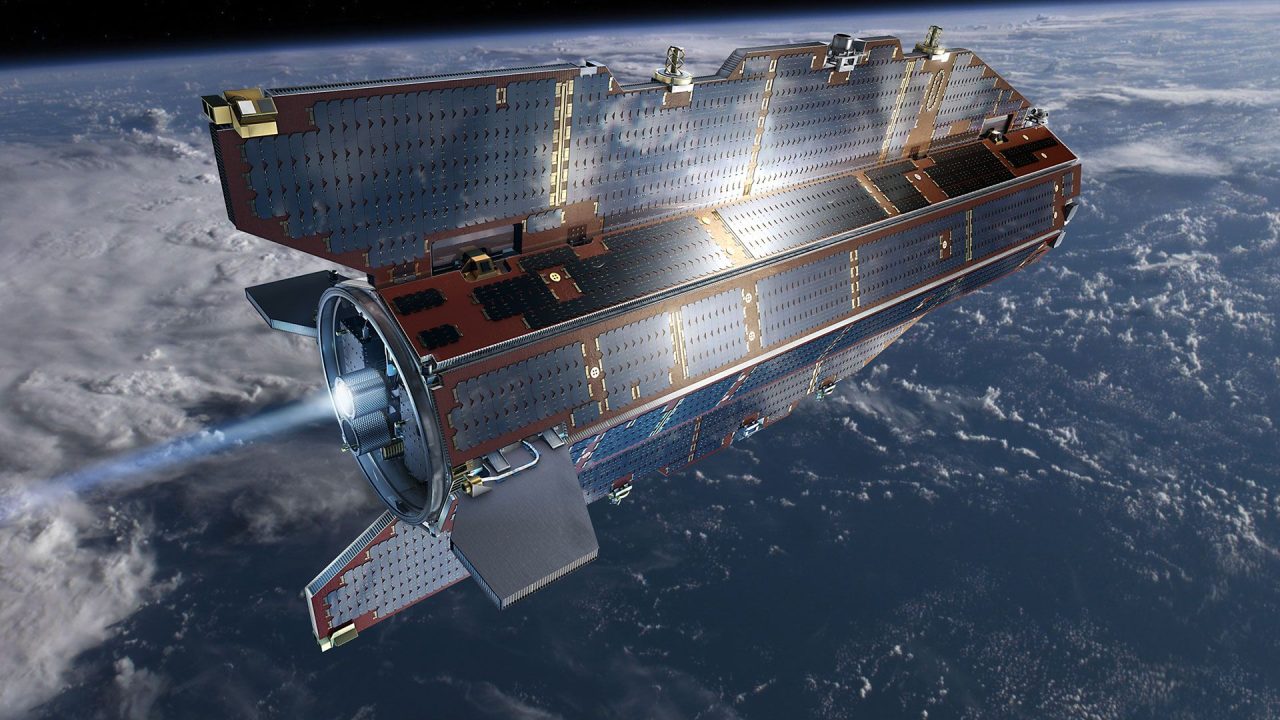
On November 10, 2013, the European Space Agency’s Gravity field and steady-state Ocean Circulation Explorer (GOCE) concluded its orbital tenure by re-entering Earth’s atmosphere. Launched in 2009, the satellite had spent four years meticulously mapping the planet’s gravitational field, a mission that ended when its xenon ion engine depleted its fuel supply.
Despite the loss of fuel, the spacecraft’s deorbit was managed with precision. While initial concerns existed that the 1-ton satellite might crash into a populated region, it disintegrated approximately 50 miles above the Falkland Islands in the South Atlantic Ocean. No property damage was reported, and the ESA officially declared the mission a success due to its longevity and scientific yield.
GOCE was renowned for its aerodynamic profile, which earned it the nickname “Ferrari of space.” This sleek design was not merely aesthetic; it was functional. To generate the most accurate map of Earth’s gravity to date, the satellite had to orbit at a remarkably low altitude of 139 miles (224 kilometers)—roughly half the altitude of the International Space Station. At this height, the satellite had to actively counteract atmospheric drag using its ion engine.
During its operational life, GOCE provided critical data on minor variations in Earth’s gravity, mapped the structure of the planet’s crust and mantle, and tracked ocean currents. The spacecraft was 17 feet (5.3 meters) long and 3.2 feet (1 meter) wide. Although a significant portion of the satellite was expected to survive reentry, it ultimately broke up in the atmosphere without causing harm on the ground.


Ferrari of space. I wish they had named satellites like that more often.
The ocean circulation data was a game changer for understanding global currents.
Half the ISS altitude makes me wonder how they managed to keep it stable.
Sad to lose it, but the data it collected is incredibly valuable for geology.
Ions for four years? The efficiency of those engines must have been incredible.
Did anyone actually see the disintegration from down there? That must have looked spectacular.
Still surprised they did not just leave it in orbit forever instead of deorbiting.
Low orbit is brutal for maintenance, but absolutely essential for high-resolution gravity mapping.
Glad it broke up over the Falklands. Scary to think it might have hit a city.
The Ferrari nickname is perfect for how it had to constantly fight atmospheric drag.