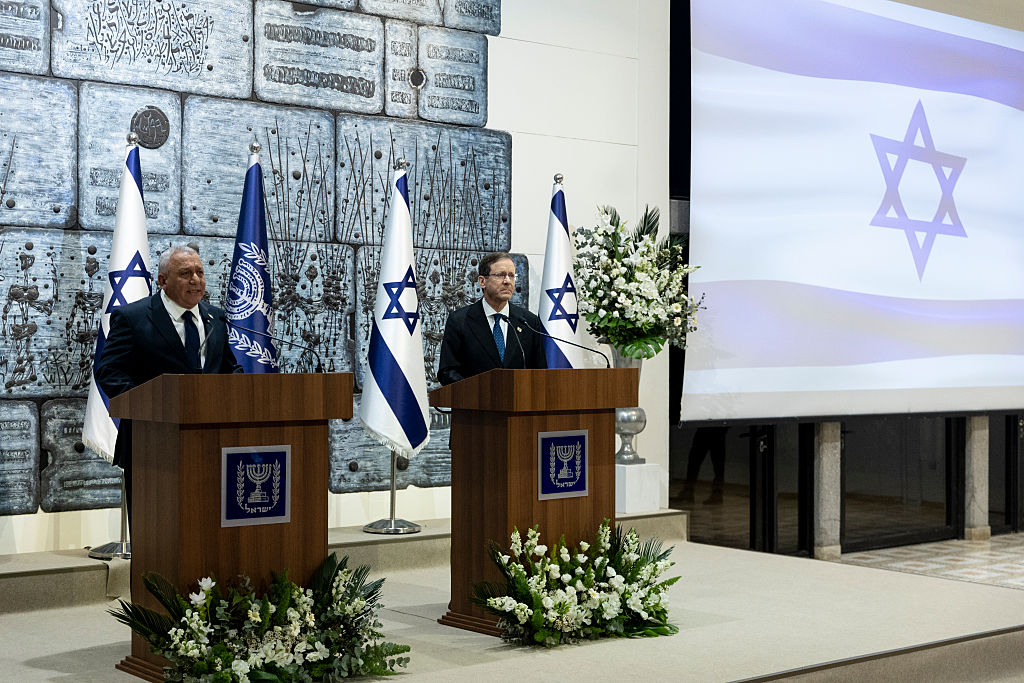
Israeli President Isaac Herzog has formally tasked Gadi Eisenkot, the leader of the center-right Yashar party and a former military chief, with the mission of forming Israel’s next government. This decision follows last month’s Knesset election, in which no single political bloc secured the 61 seats required for a majority in the 120-seat parliament. Eisenkot now has a 28-day deadline, extending through December 6, to assemble a coalition that can win a confidence vote in parliament, with the possibility of a 14-day extension.
Benjamin Netanyahu, whose Likud party emerged as the largest bloc with 53 seats, remains the caretaker prime minister during this process. Although Netanyahu’s camp secured the most votes, Eisenkot’s coalition of four Jewish-led parties, comprising Yashar, B’Yachad, the Democrats, and Yisrael Beytenu, won 48 seats. The remaining 19 seats are held by two Arab-led parties, a record high that adds complexity to coalition-building.
Herzog’s selection of Eisenkot was based on consultations with Knesset members, of which 67 endorsed Eisenkot compared to 46 who supported Netanyahu. The president determined that Eisenkot had a greater likelihood of successfully bridging the divides between disparate political factions. The two primary rival blocs could theoretically reach a majority by aligning with the Arab-led parties, but negotiations are hindered by opposition from nationalist figures within Eisenkot’s camp who resist formal alliances with Arab leaders.
If Eisenkot fails to form a government within the allotted time, the Knesset may dissolve, triggering new elections within 90 days. However, the president also retains the option to appoint another Knesset member, potentially Netanyahu, for a final 14-day attempt to build a coalition. In that scenario, Netanyahu would likely court right-leaning members of Eisenkot’s bloc, such as Naftali Bennett and Avigdor Lieberman, to secure the necessary majority. A prolonged deadlock risks repeating the unstable political cycles seen between 2019 and 2022, where five elections were held in three years.



I just want a stable government so we can stop worrying about yet another election cycle coming up.
If this fails, we might see Bennett and Lieberman defecting to Netanyahu in a final push.
Did anyone else notice the 28-day deadline? That seems incredibly short given the complex political situation right now.
It is strange that nationalist figures reject Arab parties even when it is necessary to form a majority.
Eisenkot’s experience as a military chief really seems like the right choice here. Fingers crossed.
Hope this works out better than the last time. Another election would be devastating for the country.