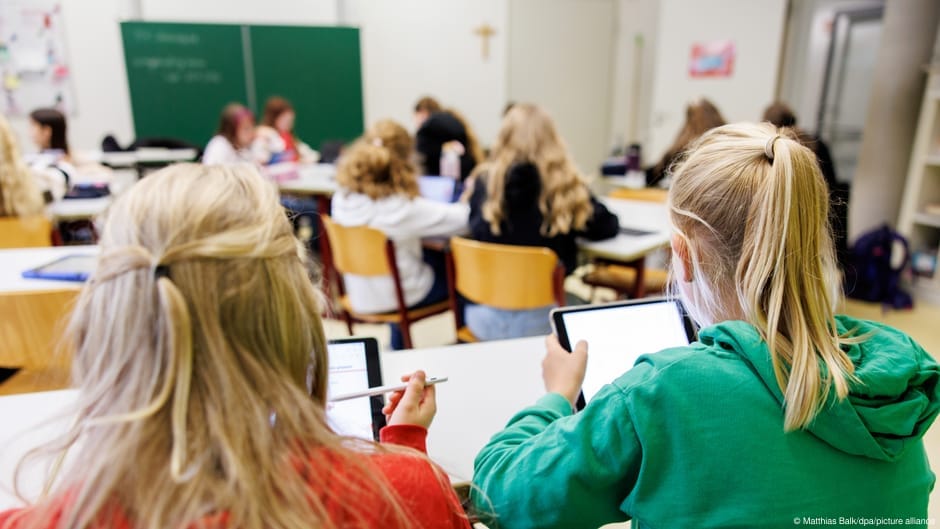
A growing concern among German educators is that the widespread use of artificial intelligence tools in schools is leading to a phenomenon termed ‘cognitive outsourcing,’ where students offload mental tasks to machines, potentially harming their academic development. In recent findings, the Program for International Student Assessment (PISA) revealed that 15-year-olds in Germany posted their lowest scores in the 25-year history of the study, marking a significant decline in performance.
Andreas Schleicher, the OECD director for education and skills, noted that students who reported using AI chatbots achieved lower average scores in science compared to those who did not. This trend persists despite the tool’s ability to assist with summarizing texts and conducting research, suggesting that passive consumption of AI-generated content does not replace the active cognitive engagement required for learning.
Classroom anecdotes reflect these statistical trends. A German secondary school teacher identified only by the name Franziska Müller reported that some students can no longer think independently, relying on tablets to read out AI-generated answers during lessons. Müller observed that students are developing a diminished ability to comprehend text because they increasingly rely on AI for summaries rather than reading materials directly.
Student Jakob, a 15-year-old at a Gymnasium, admitted to using ChatGPT to review topics for a French test, noting that it is often used only when students are stuck. He suggested that high-performing students avoid such dependence, but the ease of access to AI for subjects like math, chemistry, and physics creates a challenge for maintaining academic rigor.
German media research conducted by the JIM study indicates that 91% of young people aged 12 to 19 use at least one AI application, with 74% utilizing these tools for homework and learning. In response to the potential cognitive downsides, the US think tank Brookings Institution argued that the risks of AI in education currently outweigh the benefits, citing declines in critical thinking, memory, and independent judgment.
Responses to the issue vary globally. New York Mayor Zohran Mamdani has banned the use of AI in public schools up to the eighth grade for the 2026 and 2027 school years. In contrast, German teacher Julian Hinn, who instructs students aged 15 to 18, advocates for a more pragmatic approach, stating that banning AI is unrealistic given its presence in students’ homes. Hinn works to integrate the technology strategically in the classroom, focusing on how to manage its use rather than eliminating it entirely.

Banning it is useless. We need to teach students how to use it properly instead.
It is scary how many kids just let AI do the thinking for them now.