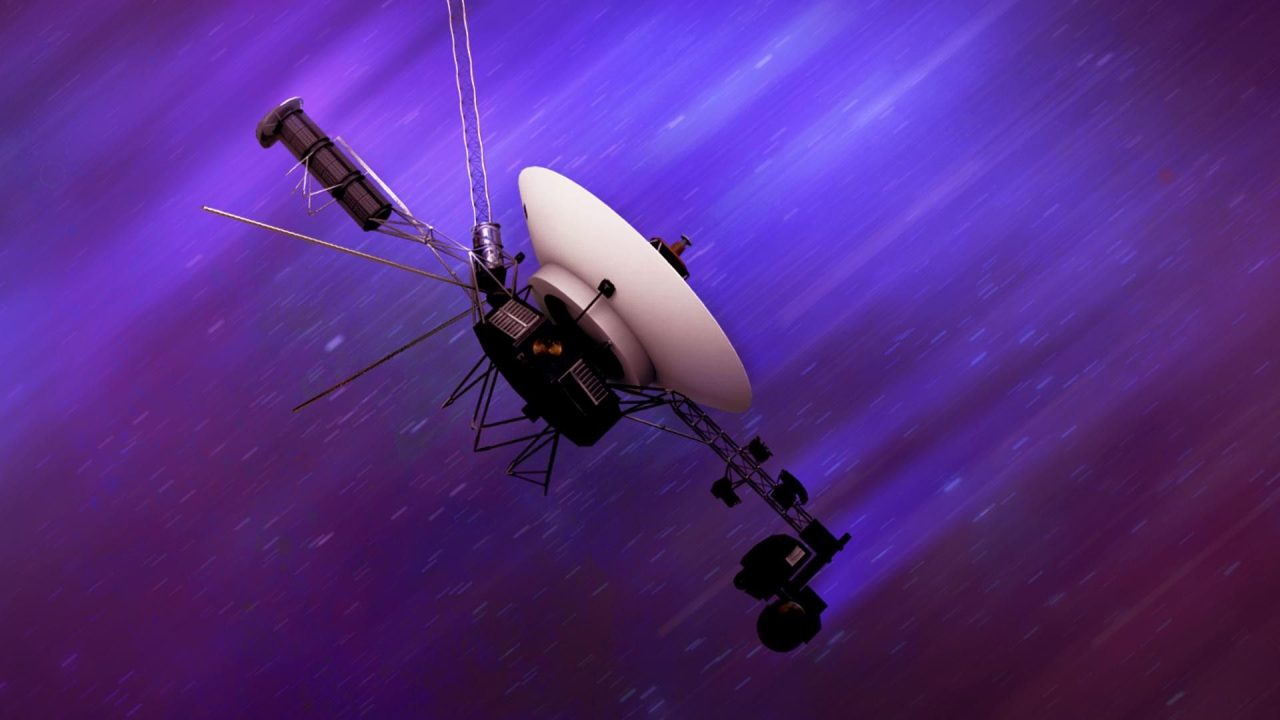
NASA’s Voyager 1 probe, currently the most distant human-made object in space, is set to achieve a significant symbolic milestone on November 18. On that day, the spacecraft will be located approximately 16 billion miles (26 billion kilometers) from Earth, a distance equivalent to one light-day, meaning it takes light a full 24 hours to travel between the two points. This achievement marks nearly five decades since the twin Voyager probes launched in September 1977, outlasting many of the engineers who originally built them.
Pascal Lee, a planetary scientist at the SETI Institute who served on the Voyager 2 team during its 1989 Neptune flyby, noted that the missions are transcending generations. “Not only is their data relevant, but they themselves are still out there, moving into the unknown,” Lee told Live Science. Despite the vast distance, Lee emphasized that in the context of the galaxy, the spacecraft is moving relatively slowly, serving as a reminder of the immense scale of space and time.
While Voyager 1 crossed the heliosphere—the bubble of plasma protecting the solar system from cosmic radiation—in 2012, it remains within the sun’s gravitational influence. NASA estimates that the probe will need roughly 300 years to reach the inner edge of the Oort Cloud and potentially 30,000 years to pass completely beyond it. In the far future, Voyager 1 is projected to pass within 1.7 light-years of the star Gliese 445 in approximately 40,000 years, at which point it will be closer to that star than to the sun.
The increasing distance has implications for communication. Suzanne Dodd, the Voyager project manager at NASA’s Jet Propulsion Laboratory, explained that a radio signal sent from Earth takes 24 hours to reach the probe, and another 24 hours for a response to return. “If you want to say ‘hello’ to Voyager, you send your message and then you go home and you wait two days before you finally get a response,” Dodd said.
Power is currently the primary limiting factor for the mission. Voyager 1 relies on radioisotope thermoelectric generators (nuclear batteries) that convert heat from plutonium decay into electricity. As this power source gradually depletes, NASA has systematically shut down nonessential instruments to conserve energy. Kelly Perry, a data systems engineer at JPL, stated that the team’s priority is to keep the spacecraft operational as long as possible. Recent engineering efforts, including a reconfiguration nicknamed the “Big Bang” that switched to lower-power subsystems, have extended the mission’s operational life by nearly two years.
Since their launch, the Voyagers utilized a rare planetary alignment occurring every 176 years to slingshot through the solar system. Together, the twins discovered 23 moons, revealed faint rings around Jupiter, and provided the first detailed atmospheric data for Saturn, Uranus, and Neptune. Voyager 1 also captured the first evidence of active volcanoes on Jupiter’s moon Io in 1979, fundamentally changing scientific understanding of the outer solar system. These findings laid the groundwork for subsequent missions, including Galileo and Cassini.
As the only spacecraft to provide in-situ data from interstellar space, the Voyagers have demonstrated that the region beyond the heliosphere is a dynamic frontier rather than an empty void. Although both probes carry Golden Records containing sounds, images, and greetings intended for extraterrestrial listeners, experts agree that the likelihood of an alien civilization intercepting them is vanishingly small. “The chances of us going after Voyager 1 and bringing it back for the Smithsonian… are more believable than any chance of an alien civilization finding it, and then playing the record,” Lee said.
Even after the science instruments power down, which is expected to happen when no operational science tools remain, the probes will continue to transmit basic engineering data until approximately 2036. Thereafter, they will coast silently through interstellar space, remaining intact but out of reach. Deana Weibel, an anthropologist at Grand Valley State University, noted that while humans will lose contact, the probes will endure as a symbolic representation of human presence. “Knowing that Voyager will continue its mission long past my lifetime actually gives me comfort,” Perry said. “I love knowing that I’ll always be able to look to the stars and know they’re still on their way.”



Watching these missions transcend generations is inspiring. Even with power fading, they keep pushing the frontier.
Is it really true that it’s still under the sun’s gravity? Felt like it escaped a while ago.
I’d like to see a return trip, but realistically, the Smithsonian comment is the most logical outcome.
The discovery of rings around Jupiter and volcanoes on Io changed everything. Great legacy for such old tech.
It’s wild that it’s still moving slowly in a galactic context. We are tiny in so many ways.
We outlived the engineers who built it? That really gets me. These probes are outliving their creators.
I keep thinking about the Golden Record. The chance of aliens finding it is basically zero, but it’s poetic.
The ‘Big Bang’ reconfiguration extending life by two years is clever. Engineering under constraints is incredible.
30,000 years to leave the Oort Cloud puts the scale of space into perspective. Truly humbling.
Fascinating that a 24-hour delay makes saying hello feel like a letter. Engineering triumphs are amazing.