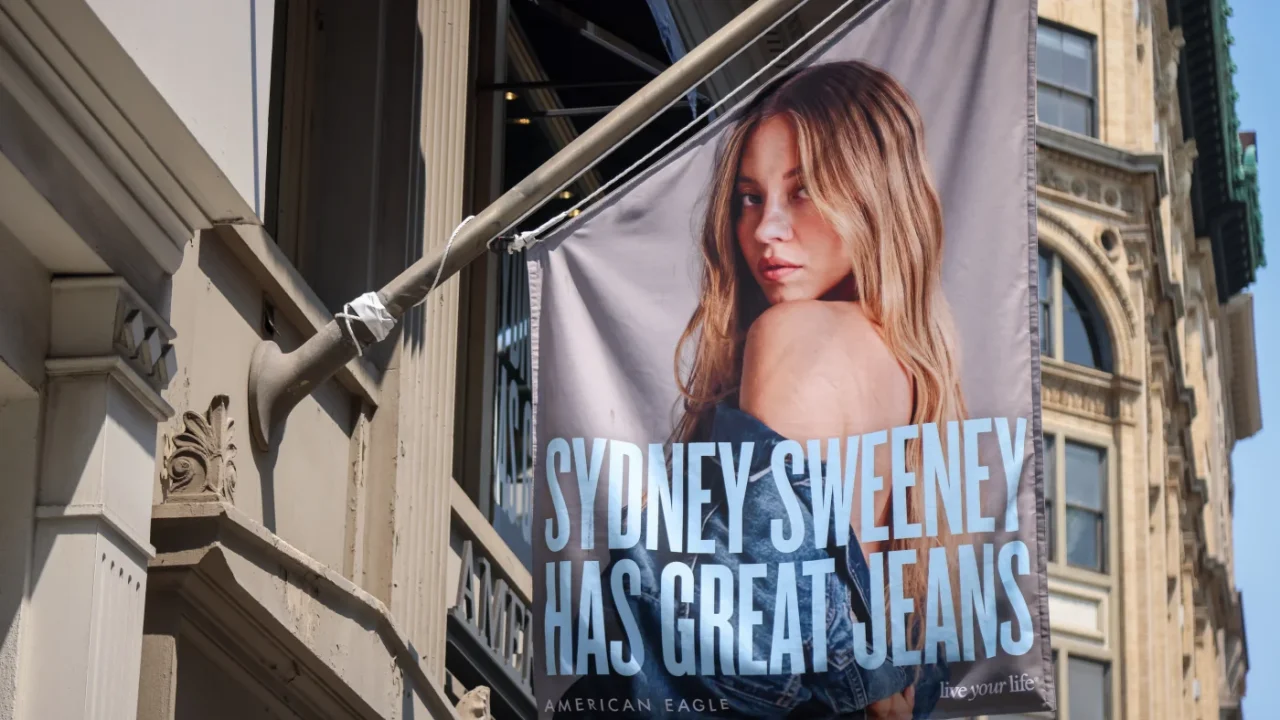
A recent controversy surrounding an American Eagle Outfitters advertisement featuring actress Sydney Sweeney has shifted focus from cultural debates to the precarious working conditions of garment workers in South Asia. While the campaign’s tagline, ‘Sydney Sweeney has great jeans,’ sparked online discussion about its implications, NPR’s reporting highlights that the broader issue lies with the laborers who produce the denim in factories located primarily in Pakistan and Bangladesh.
In Karachi, Pakistan, a garment worker identified only as S. recounted working at Artistic Garment Industries, a supplier for American Eagle. S., a single mother earning approximately $144 a month, described the factory environment as ‘oppressively hot,’ with indoor temperatures often exceeding outdoor levels. She reported fainting three times in a year due to the combination of intense heat and rigid production quotas, noting that workers are rarely permitted to sit down or take adequate breaks for hydration. S. stated that voicing complaints often results in termination, leaving workers feeling ‘helpless.’
Artistic Garment Industries confirmed it manufactures for American Eagle but asserted that it does not retaliate against employees who report issues, citing a robust complaint system. American Eagle responded to NPR’s inquiries by stating it is committed to protecting worker rights and takes the concerns raised seriously.
NPR interviewed approximately 20 workers across factories in Bangladesh and Pakistan, two of the world’s largest garment production hubs outside of China. These workers, who produced items for major brands including Levi’s, H&M, The Gap, and Massimo Dutti, consistently reported low wages paired with unreasonably high output targets. One worker, R., based in Dhaka, Bangladesh, earns roughly $140 a month working six 12-hour days at a factory run by MBM. R. admitted to limiting water intake to avoid bathroom breaks, as managers can terminate employment if workers are absent for health reasons too frequently.
Experts warn that climate change is exacerbating these hazards. Jason Judd, executive director of the Global Labor Institute at Cornell University, noted that factory interiors are often four to six degrees hotter than the outdoors due to machinery and poor ventilation. Cara Schulte, a researcher at Climate Rights International, emphasized that workers are forced to risk their health due to poverty and the pressure of tight deadlines demanded by global brands. ‘Workers are not choosing to take these risks,’ Schulte said. ‘They’re being forced into them by poverty.’


I used to buy fast fashion without thinking. Now I realize the human cost behind every cheap pair of jeans.
It is sad that poverty traps people into risking their health for a paycheck. There is no real choice involved.
American Eagle says they have a complaint system. I hope it works, but these women say they are fired for speaking.
Climate change makes indoor heat much worse. Factories need better ventilation, not just higher wages to offset the suffering.
It is not just Sweeney. Levi’s, H&M, and Gap are all using these supply chains, so the problem is systemic.
$144 a month is insulting. How can anyone claim these workers are treated well when they are literally fainting?
The connection between the celebrity ad and these grim factory conditions is jarring. We need to look past the stars.