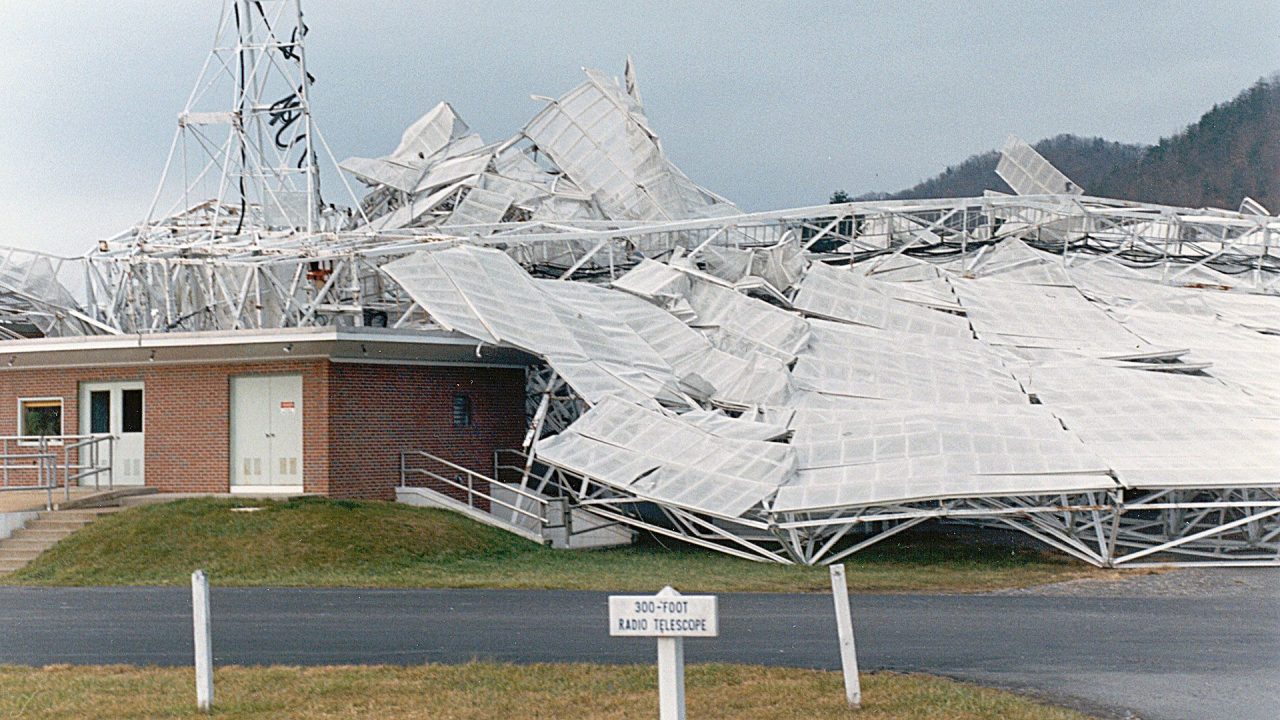
On the clear night of November 15, 1988, a major radio observatory in Green Bank, West Virginia, suffered a sudden and catastrophic structural failure. At 9:46 p.m., with no strong winds present, the 300-foot telescope collapsed under its own weight, leaving a significant pile of twisted wreckage that observatory staff discovered the following morning.
Investigations revealed that the collapse was caused by the failure of a gusset plate, a critical component among four connecting plates that held the instrument’s large metal beams together. Researchers determined that these structural elements were not designed to withstand the stresses of the telescope’s 26 years of continuous operation. Although the failure was described as unforeseeable, the incident highlighted issues stemming from the instrument’s initial rapid construction.
At the time of its launch, the 300-foot telescope was the largest radio facility in the world. However, it required significant upgrades over the decades; by 1970, for instance, the original surface had warped due to maintenance activities, snow, and gravity, necessitating the installation of a finer-meshed aluminum surface and a larger traveling feed at the prime focus.
Despite its structural end, the telescope made substantial scientific contributions before its collapse. It played a key role in the discovery of dark matter and helped confirm that pulsars originate from supernova explosions. Additionally, it produced the Green Bank 6cm Survey, a catalog of radio objects that remains a foundational resource for northern hemisphere radio astronomy.
Following the 1988 incident, construction began on a new instrument three years later. The resulting Green Bank Telescope, which commenced scientific operations in 2001, is larger and more sensitive than its predecessor, continuing the legacy of radio astronomy research in the region.



The dark matter discovery alone justified the whole thing. Sad it fell apart, but the data was priceless.
Still can’t believe a single gusset plate took down such a giant. Engineering from the 60s was definitely rushed.