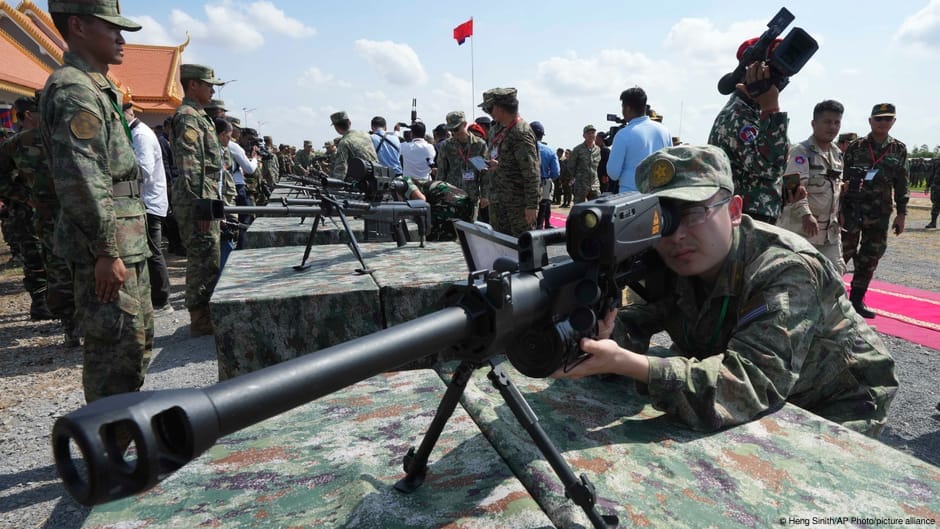
China’s expanding influence in Southeast Asia has recently taken a military dimension, with the opening of new facilities in Laos and the deepening of its presence in Cambodia. These developments have raised concerns among smaller regional nations about Beijing’s strategic ambitions in the area.
In early November, Chinese Foreign Minister Wang Yi invited counterparts from Laos, Cambodia, Vietnam, Thailand, and Myanmar to Beijing, where the six nations agreed to strengthen economic and security ties. While China has long cultivated economic relationships in the region through infrastructure projects such as the China-Laos railway, the recent focus on military cooperation marks a significant shift.
At the end of September, China and Laos inaugurated a joint military support and training center near the Ban Keun airfield, north of Vientiane. According to Beijing, the site will primarily be used to train Laotian air force pilots. Marco Bünte, a professor of Asian politics at the University Erlangen Nuremberg, noted that this move could grant China greater strategic depth in mainland Southeast Asia and improved access to the South China Sea, although he cautioned against labeling it as outright military hegemony.
The concern is compounded by earlier expansions at Cambodia’s Ream naval base on the Gulf of Thailand, which China now uses for logistics and training. While other nations’ ships can visit the port, they are restricted to a different quay, leading to questions about whether Chinese vessels enjoy superior access rights. Johann Fuhrmann, head of the Konrad Adenauer Foundation’s Beijing office, emphasized the need to distinguish between training local pilots and the potential future deployment of Chinese forces.
Analysts point out that the Ban Keun runway is only 2,000 meters long, insufficient for large Chinese bombers, suggesting that any significant Chinese air corridor would remain a future scenario rather than a current reality. Nevertheless, the crucial question remains whether China will require government approval for each new use of the facilities or if longer-term commitments allow for broader operational freedom in times of crisis.
Surrounding countries are reacting with varying degrees of caution. Vietnam and the Philippines are monitoring the situation closely, given their territorial disputes with China in the South China Sea. Other Southeast Asian nations are adopting a hedging strategy, seeking to leverage China’s economic offerings while maintaining diplomatic and economic ties with the United States and other Western partners.

I bet the local populations care more about jobs than military bases. Realpolitik in action.
The US should watch this closely. These moves create strategic depth in the mainland.
Laos and Cambodia are playing a dangerous game. Economic aid does not equal sovereignty.
Is this just training or the start of actual deployment? The distinction matters for regional security.
Surprised by the formal agreement with all those neighboring nations. Seems like a major diplomatic win for Beijing.
The runway length point is key. It really limits immediate heavy bomber access for them.