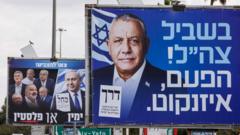
Israel’s new parliament is set to be sworn in on Tuesday amid intense competition between political factions to form a stable government. Following last month’s election, former army chief and opposition leader Gadi Eisenkot was tasked by President Isaac Herzog with assembling a coalition, having secured backing from 67 of the 120 Knesset members compared to 46 for caretaker Prime Minister Benjamin Netanyahu.
Eisenkot faces a significant challenge, as his bloc of four parties won 48 seats while Netanyahu’s camp secured 53, leaving both short of a majority. Eisenkot has 28 days to complete the process, with the possibility of a two-week extension. The new legislature includes nearly half of members who did not serve in the previous term, alongside a record number of seats won by Arab-led parties.
The election results have given the two major Arab alliances, the United Arab List and the Joint List, an unprecedented 19 combined seats following a surge in voter turnout. Consequently, these parties now hold the balance of power. Netanyahu has ruled out governing with them, while three parties in Eisenkot’s bloc oppose including them in a coalition. Nevertheless, the United Arab List has indicated willingness to join an Eisenkot-led government, and the Joint List has offered external parliamentary support.
During his appointment on Sunday, Eisenkot called for a “national emergency government,” urging parties to set aside ideological differences to remove Netanyahu from office. He outlined four principles for prospective partners: recognizing Israel as a Jewish and democratic state, accepting the values of the Declaration of Independence, backing mandatory national service for all, and acknowledging Hamas as a terrorist organization.
These conditions have sparked debate, particularly regarding the conscription of ultra-Orthodox Jews, a major election issue. The ultra-Orthodox United Torah Judaism and Shas parties, which won 13 seats in total, have fiercely opposed changes to their current exemption from military service. Additionally, Eisenkot’s demand for all citizens to recognize Hamas as a terrorist group conflicts with the stances of the Arab parties, which prioritize equal civic rights and have not publicly endorsed that designation.
Avigdor Lieberman’s Yisrael Beiteinu party, which won seven seats, has so far refused to support a minority government dependent on Arab MKs. In response, Netanyahu reiterated his call for a government of national unity that he would lead. He warned against a coalition relying on what he termed “Islamists,” stating, “You cannot form a government with Hamas supporters.”


Twenty-eight days is not enough time for such complex negotiations. We might see another extension or election.
Why is everyone focused so much on Netanyahu? The actual policy issues like conscription matter way more.
Seems unlikely that Eisenkot will get everyone to agree on mandatory service without causing a major political crisis.
The inclusion of Arab parties holding the balance of power feels like a historic turning point for Israeli politics.