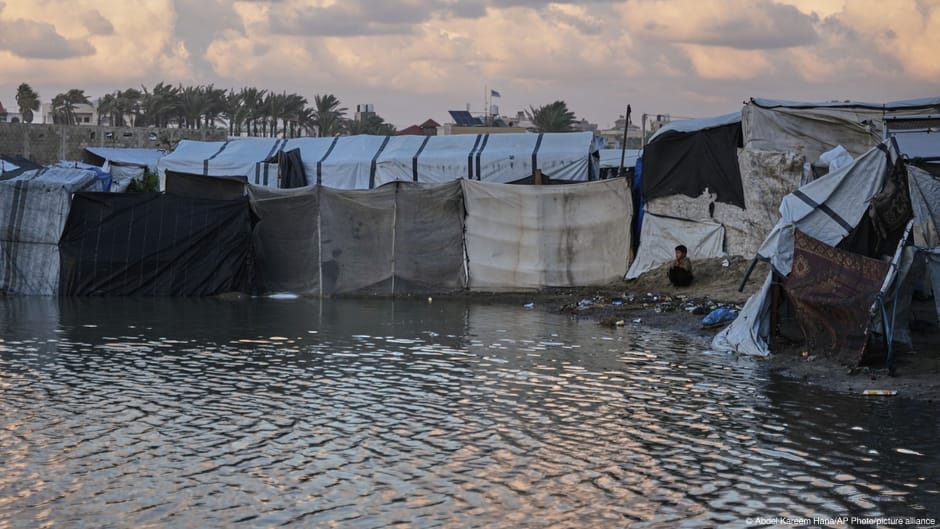
The humanitarian situation in the Gaza Strip has deteriorated significantly as severe autumn weather exposes the vulnerabilities of a population already devastated by conflict. According to UNICEF, torrential rainfall over the weekend resulted in at least six deaths, including children. Local authorities reported that approximately 70,000 tents were flooded, affecting more than 200,000 people.
Residents describe the living conditions as increasingly unmanageable. Rawan Al-Omari, a mother of two living west of Jabalia, said she and her family have had to use sand and rubble to prevent water from seeping into their tent, noting that the surrounding mud makes movement difficult. Similarly, Radi Amin, 45, stated that it took three consecutive days to dry his and his children’s clothes, describing the rain as a stark reminder of their dire circumstances.
While the UN Office for the Coordination of Humanitarian Affairs (OCHA) reported that aid teams began clearing blocked sewer lines and stormwater basins at 60 locations to assist an estimated 30,000 families, the agency warned that there is insufficient space to relocate those in flooded areas or damaged buildings. OCHA further noted that Israeli authorities are restricting Palestinian access to areas behind the military demarcation line, known as the ‘Yellow Line,’ leaving most of Gaza’s land off-limits for aid or shelter.
The ongoing humanitarian challenges are compounded by a political stalemate following the US-brokered ceasefire established in October 2025. Although a ‘Board of Peace’ committee was created to oversee the truce and postwar governance, negotiations have stalled on the terms of Hamas’s disarmament and the withdrawal of Israeli troops. As a result, Israel continues to conduct airstrikes, including a recent strike on Nasser Hospital in Khan Younis targeted at alleged Hamas members.
A joint assessment by the World Bank, the United Nations, and the European Union published in April 2026 estimates that Gaza’s reconstruction will require $71.4 billion over the next decade. However, experts say this progress is hampered by disagreements between the parties. Nathan Brown, a professor at George Washington University, attributed the lack of advancement to Israel’s insistence that Hamas must fully disarm first. In response, the Board of Peace issued a statement on Monday, stating that Israel’s current efforts to improve the humanitarian situation ahead of winter are insufficient and urging the Israeli government to immediately facilitate the entry of necessary winterization aid.

I doubt any amount of money will fix this without genuine political will. Sounds like everyone is just waiting.
Seventy thousand tents flooded is a disaster waiting to happen. How are they supposed to stay warm tonight?
You can’t blame the weather for the political deadlock. Leaders need to stop stalling and let aid through now.
The rain is just another cruel layer on top of all this suffering. Children dying from water is heartbreaking.