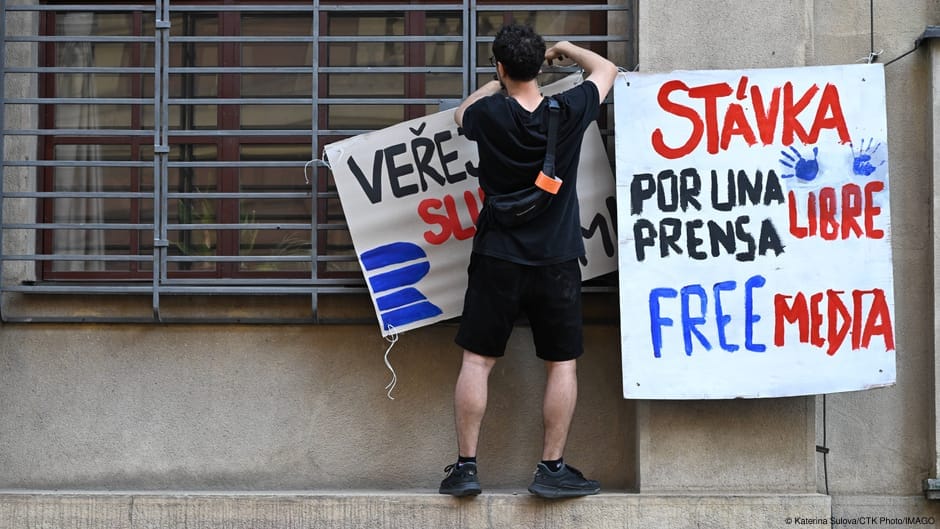
Czechia is bracing for a significant public demonstration in Prague as citizens mobilize against the government’s plan to overhaul public media funding. The initiative has sparked widespread anger, leading to strikes within broadcast sectors and a series of rallies across the country. A major protest is scheduled for November 15 at Letna Park in the capital, with estimates suggesting hundreds of thousands of participants may attend. This gathering is expected to be the largest manifestation to date in the ongoing dispute over the legislative changes.
The controversy centers on a fast-tracked bill that was pushed through its first reading by the coalition government led by Prime Minister Andrej Babis. The legislation, which was approved in a surprise overnight session at 04:36 a.m. on October 24, proposes eliminating the license fee model that currently supports Czech Television (CT) and Czech Radio (CRo). Instead, the broadcasters would receive funding directly from the state budget. The coalition, which includes Babis’s centrist ANO party, the far-right SPD, and the Motorists party, argues that the current license fee constitutes an unfair tax. They assert that the new arrangement, which includes an approximately 15% budget cut for the first year, will improve operational efficiency.
Critics, however, contend that the reform threatens the independence of public broadcasters. Opposition parties, civil society groups, and international watchdog organizations accuse the government of attempting to undermine editorial freedom. Analysts point out that similar funding models in other European Union countries typically include guarantees for long-term financial stability and editorial independence, provisions absent from the Czech proposal. The proposed budget reductions have already prompted warnings from CT and CRo staff regarding potential cuts to programming and personnel.
The legislative process itself has drawn scrutiny. The government’s use of fast-tracking to limit parliamentary debate was met with immediate backlash, with crowds picketing parliament as the first reading was passed. Otto Eibl, a political scientist at Masaryk University in Brno, noted that the government’s confrontational approach and rhetoric toward journalists have fueled the public outrage. In response to the legislative move, staff at the public broadcasters went on strike in early November, disrupting television and radio schedules.
The upcoming rally takes on added symbolic weight as it occurs just two days before the anniversary of the Velvet Revolution, the event that ended communist rule in the region in 1989. Organized by the civil society group Million Moments for Democracy, the protest follows previous large-scale demonstrations held in 2019 and earlier this year. Babis’s push for the reform is viewed as an effort to fulfill a campaign pledge from the October 2025 election, following previous attempts during his first term in office to influence the governance of Czech Television.
I pay my license fee to keep them independent. I will stop paying once this is done.
Why did they pass this at 4:36 in the morning? That is how you avoid public scrutiny.
A 15% cut in year one? That will devastate the newsrooms and reduce their editorial capacity.
Honestly, I don’t care much. If the state funds them, maybe they will stop being so boring.
The timing with the Velvet Revolution anniversary is not a coincidence. It is deeply symbolic and worrying.