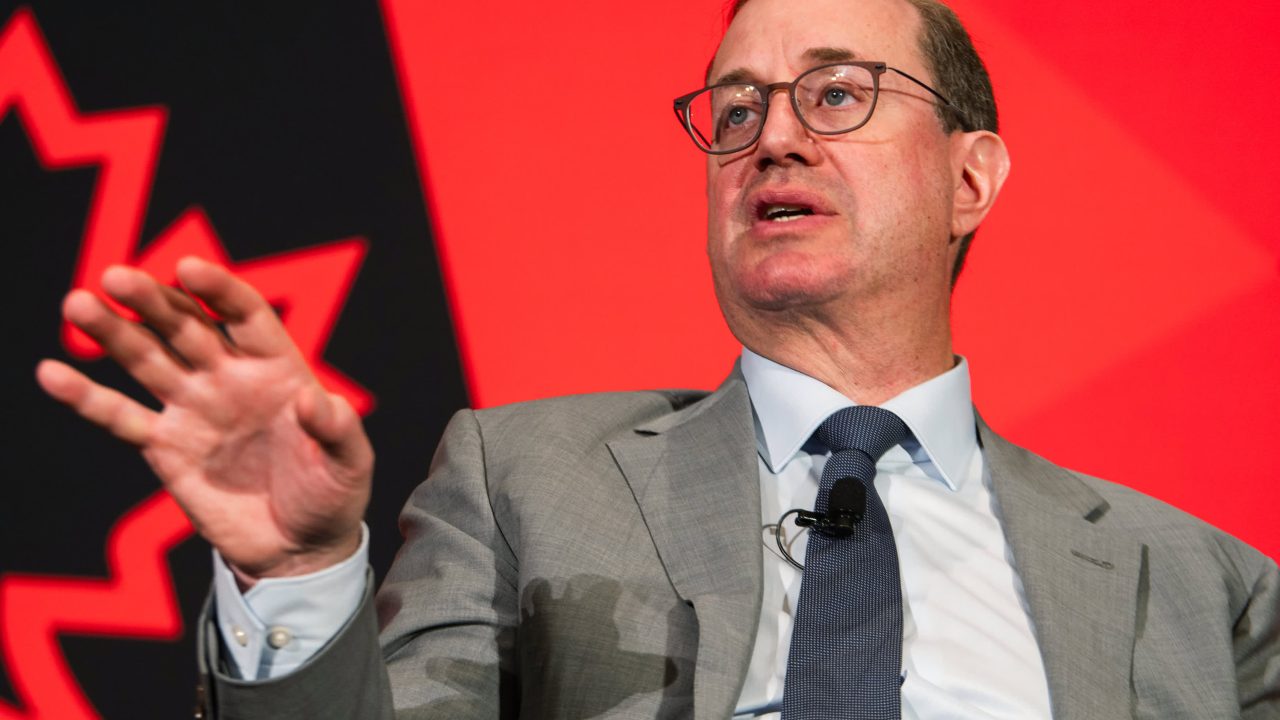
Mark Wiseman, Canada’s ambassador to the United States, warned on Wednesday that the uncertainty surrounding President Donald Trump’s tariff policies is increasing the cost of capital and discouraging businesses from undertaking new expansions.
Speaking at the B20 summit in Washington, D.C., a gathering of global business leaders hosted by the U.S. Chamber of Commerce, Wiseman noted that economic predictability is a key driver for corporate decision-making. “If you’re going to build a new plant, add a new ship, spend money on R&D, the more certainty you have, the more likely you’re going to do that,” the former BlackRock executive said. He emphasized that ambiguity in trade policy directly impacts investment confidence.
The diplomatic warning comes amid ongoing tensions between Washington and Ottawa over trade. U.S. Census Bureau data indicates that the two countries exchanged approximately $570 billion in goods during the first nine months of 2026. While this figure represents an increase from the same period in 2025, it remains lower than the totals recorded in the comparable nine-month periods of the previous three years under the Biden administration.
The financial impact of the trade dispute is evident in customs data, which shows that U.S. duties on Canadian imports reached $10 billion in 2025, a sharp rise from $400 million in 2024, according to the Congressional Research Service. Despite the tensions, the two governments have resumed negotiations after talks collapsed in August, with current discussions focused on reducing tariffs on Canadian steel and other goods.
New research from the Federal Reserve Bank of New York highlights the domestic economic consequences of these policies. An October study found that nearly 90% of tariff costs were passed on to U.S. importers, with approximately a quarter of those increases eventually reflected in consumer prices. Researchers expect additional price pressures to materialize in 2027.
These findings align with recent Labor Department data showing that consumer prices rose by 0.4% in October, a higher-than-expected increase that has intensified inflation concerns following the Republican midterm election losses. President Trump has continued to defend the tariffs, arguing they are essential for protecting U.S. manufacturers and workers, and has accused Canada of employing discriminatory trade practices that disadvantage American exporters.
As part of its strategy to attract investment amidst persistent trade friction, Canada is also leveraging a lower effective business tax rate to appeal to companies considering long-term capital expenditures.


Wiseman has a point. R&D is long-term, and nobody wants to invest when policy changes weekly.
Funny how inflation keeps rising just when they are focused on something else. The Fed data tells the truth.
Resuming negotiations is a good sign, but can steel tariffs really be resolved without hurting both sides?
I’m skeptical that a lower tax rate will actually fix the deep structural issues in our cross-border trade.
Did anyone else notice the trade volume is actually lower than under Biden? The numbers don’t support the hype.
Uncertainty is the real enemy here. No business will build a factory if they don’t know next year’s rules.
The 90% stat is wild. We thought Canada paid the tariffs, but it looks like American consumers are footing the bill.