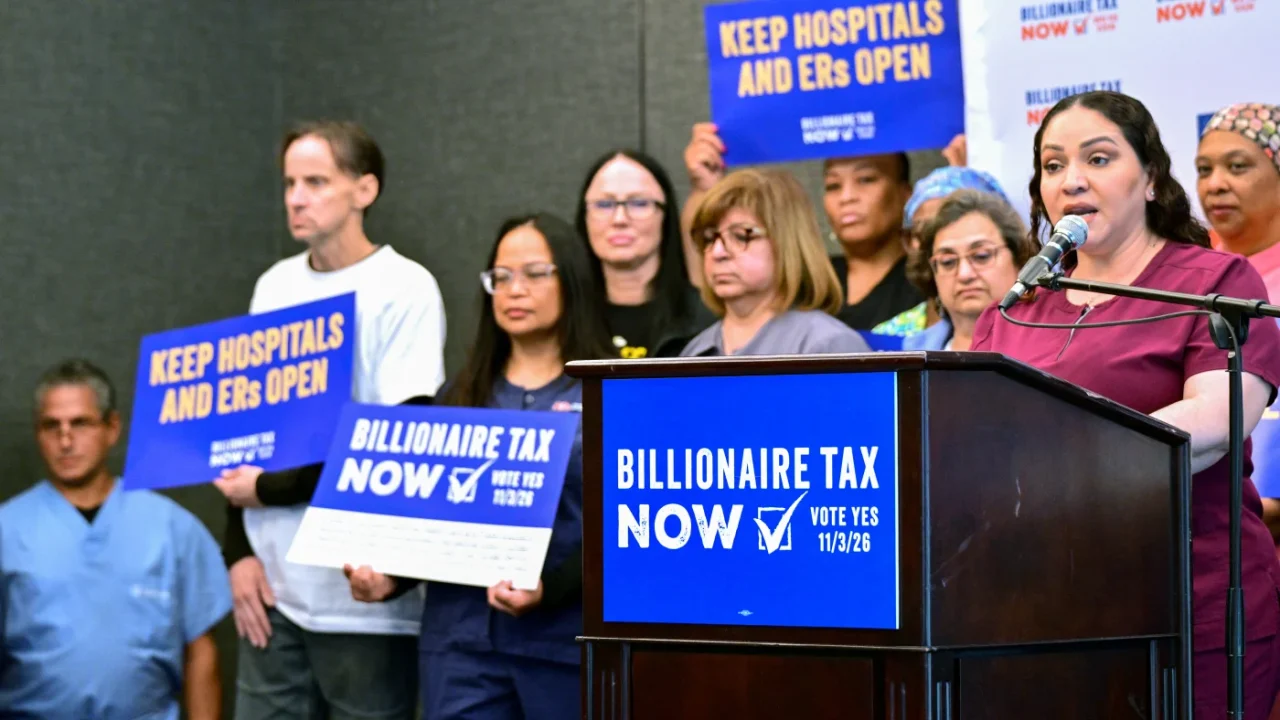
On late Monday, The Associated Press determined that California voters had rejected Proposition 40, an initiative that proposed a one-time 5% wealth tax on the state’s billionaires. The failure of the measure stands out against the broader political backdrop of the 2026 midterms, where a significant Democratic “blue wave” swept many other races nationwide. As NPR’s Planet Money reported, analysts are now examining why this specific policy lost support in a state with strong progressive leanings.
To analyze the outcome, experts consulted two prominent economists: Gabriel Zucman from UC Berkeley, a major advocate for wealth taxes, and Joshua Rauh from Stanford University, a critic of such measures. Their previous discussions had focused on economic impacts, but their recent dialogue shifted to the political factors behind the ballot failure.
Zucman attributed the defeat to the massive financial advantage held by opponents. He noted that those against Prop 40 spent nearly $400 million, including funds directed at competing ballot measures, making it one of the most expensive fights in history. “The money spent by the billionaires was critical,” Zucman said, describing a “deluge of ads” that saturated California media. He contrasted this with races like the Texas Senate contest, where large expenditures were more evenly distributed between parties, arguing that the one-sided spending on Prop 40 was decisive in a closely contested ballot initiative where voters lack the party-label shortcuts available in candidate races.
Conversely, Rauh argued that the rejection reflects a broader public skepticism toward wealth taxation itself rather than just the influence of money. He pointed to data showing that support for Prop 40 was significantly lower in progressive Bay Area counties compared to support for former Vice President Kamala Harris in 2024. Rauh suggested that voters in these affluent areas, who have greater proximity to the wealthy and businesses being taxed, were more skeptical. “The electorate even in progressive California has shown that it isn’t ready for a wealth tax,” Rauh stated.
Additional factors in the loss included the specific design of the proposal. As a one-time tax, it drew criticism from traditional Democratic allies, such as the California Teachers Association, who argued that the initiative allocated 90% of the revenue to healthcare and only 10% to food assistance and education, failing to provide sustainable funding for schools. Furthermore, Governor Gavin Newsom opposed the measure, arguing that wealth is mobile and that the fight belongs at the federal level rather than the state.
Despite the defeat, Zucman believes the momentum for wealth taxes will continue in the new Congress, expecting proposals to be prominent in the coming two years. Rauh, however, noted that with President Trump in office, passing such legislation is unlikely in the short term, and highlighted potential constitutional hurdles regarding whether federal wealth taxes constitute restricted “direct taxes.” Both economists agree that the 2028 election will serve as the next major test for public support of wealth taxation.

Let us focus on federal solutions. Fighting this state-by-state creates legal chaos and confusion for everyone.
Surprised it failed despite the blue wave. Maybe voters just did not trust the spending breakdown.
One-time taxes are always bad. They do not create sustainable revenue for our schools or healthcare programs.
Do people actually trust that billionaires would stay in California? I worry the tax just makes them leave.
Newsom opposing it was a huge mistake. He alienated his own base and handed the argument to opponents.
It is shocking how much money was spent to stop this single measure compared to actual candidates.